Decentralized prediction market platform Polymarket has clarified that its upcoming Protocol V2 rollout will not automatically migrate existing user bets held under its older Conditional Tokens Framework (CTF) onto the new smart contracts. According to official migration guidance issued by the platform, trading integrations and developers must retain active support for legacy holdings while concurrently adopting a separate system designed specifically to handle V2 positions and new trading permissions.
The transition marks a substantial architectural update for the leading prediction market. In an announcement on Oct. 5, Rajath Alex outlined the rollout schedule, noting that Polymarket would operate a series of live test markets—commonly referred to as canary markets—running from Oct. 5 through Oct. 30. Alex pointed to Nov. 2 as a tentative target switch date for newly created markets rather than a hard deadline requiring the immediate conversion or forced liquidation of every legacy bet currently active on the platform.
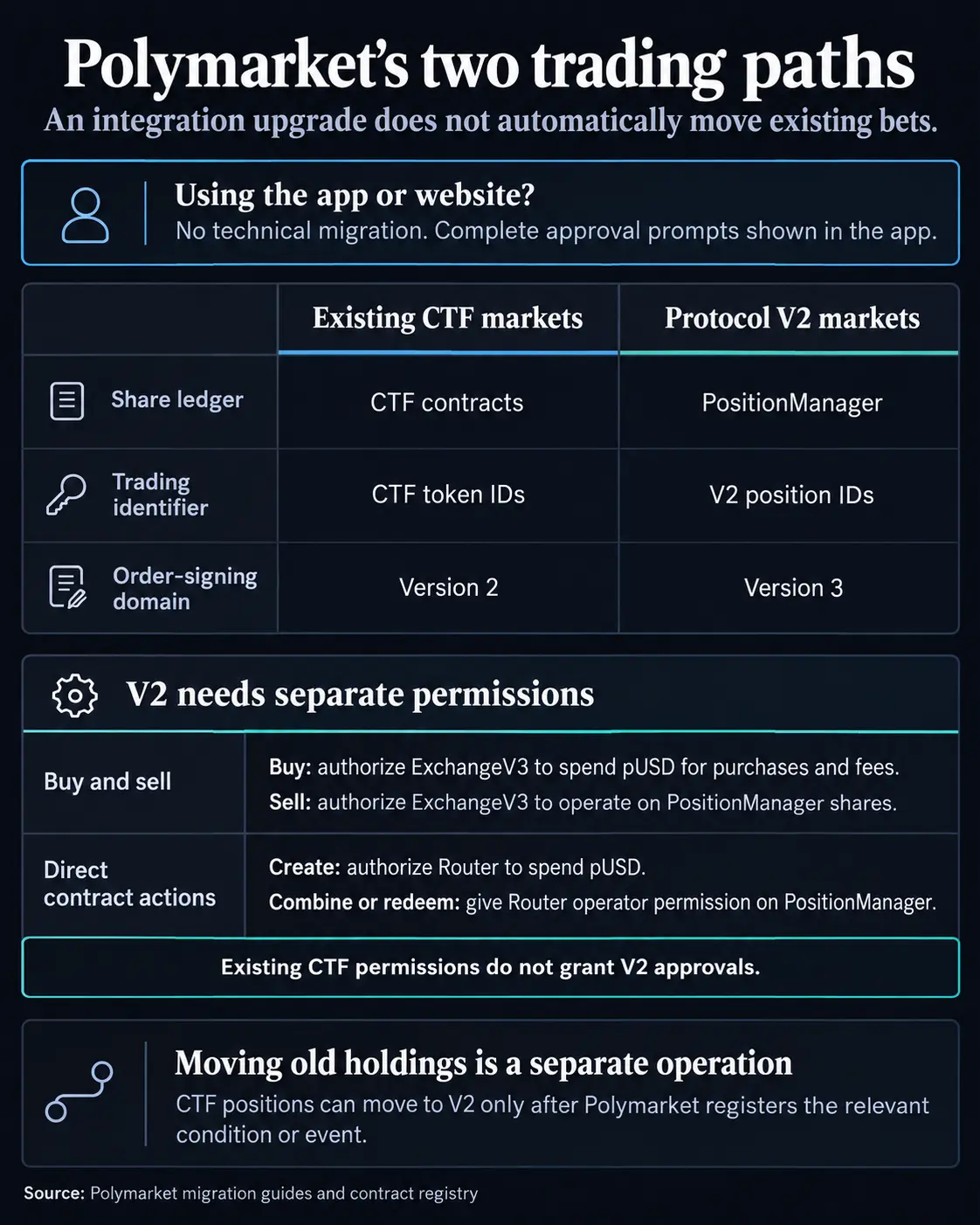
For everyday retail participants engaging with Polymarket through its official web application or mobile interface, the upgrade requires minimal technical interaction. Users are not expected to perform manual contract migrations or complex ledger transfers. Instead, platform participants simply need to follow standard approval prompts that appear directly within the application as the system updates. This aspect of the deployment is focused on Polygon-based onchain trading activity, while users of Polymarket US must refer to separate documentation tailored to that specific regional infrastructure.
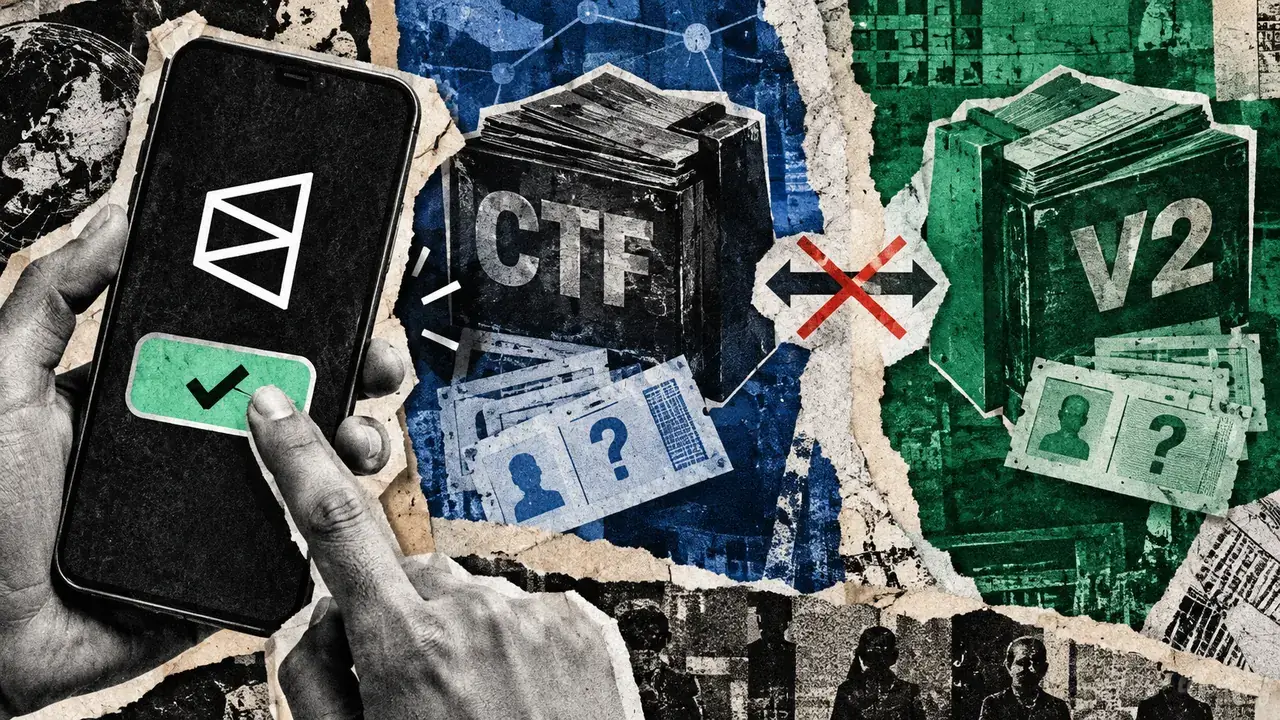
Despite the lack of automatic migration for existing positions, a distinct mechanism has been provided to allow holders to move their legacy CTF positions into the new V2 architecture if they choose to do so. According to Polymarket’s contract registry, the relevant market condition or event must first be officially registered by the platform. The platform’s indexing reference details the specific events required to connect an old CTF balance to the new PositionManager balance. Developers and advanced users should note that performing this manual asset transition is entirely separate from the routine process of updating underlying trading software or API integrations.
Integrations Must Support Both Systems
For developers, market makers, and institutional partners, adapting to the Protocol V2 upgrade begins with understanding how and where asset shares are recorded. Legacy CTF positions continue to reside on the older ledger infrastructure, whereas new V2 balances are accounted for within a separate contract known as PositionManager. Under the official contract migration guidelines, external integrations are strictly required to handle both sets of balances accurately and must retain legacy CTF identifiers to properly service older markets that have not yet concluded.
Account permissions have similarly been decoupled between the two systems. According to the API migration guide, any account holding V2 shares must explicitly authorize ExchangeV3—Polymarket’s newly deployed trading contract—to spend a sufficient amount of pUSD, the platform’s designated trading collateral, to adequately cover upcoming purchases and associated fees. Similarly, executing a sale of V2 shares requires granting permission for ExchangeV3 to operate directly on the seller’s PositionManager shares. Importantly, existing permissions granted under the older CTF framework do not automatically carry over or grant approval for these new V2 operations.

Trading software must be configured to select the correct share identifier corresponding to each market version, even in scenarios where both generations of identifier fields appear simultaneously within API responses. V2 orders specifically rely on distinct position IDs and utilize signing-domain version 3, whereas legacy CTF orders continue to rely on their original exchange architecture and signing-domain version 2. These specific signing versions serve as a critical technical differentiator between the two distinct trading paths, and balance requests must likewise query and distinguish V2 shares from traditional CTF shares.
For automated integrations that programmatically create, combine, or redeem positions directly through smart contracts, the V2 architecture implements the Router interface. Generating new positions requires granting approval for the Router to spend pUSD, while combining or redeeming existing positions requires securing Router operator permissions on the PositionManager contract. Furthermore, development teams must update their internal balance handling logic and payout reading procedures to align with the new contract standards.
The timing of these updates follows a series of infrastructural enhancements deployed throughout the year. Previous milestones recorded in Polymarket’s prediction changelog include the launch of CLOB V2 on April 28 and the subsequent release of Data API v2 on Sept. 4, both occurring earlier in 2026. The introduction of Protocol V2 in October adds the separate position system to this evolving technical stack.
For integrations that already utilize pUSD alongside the CTFExchangeV2 order format, fundamental components such as collateral assets, connected wallets, order-book credentials, and network endpoints will remain unchanged. Even with these architectural consistencies, Polymarket strongly advises developers to thoroughly verify purchases, sales, and balance updates across both newly deployed V2 markets and legacy CTF markets to ensure seamless continuity.