Polygon’s heavily promoted surge in USDT0 adoption is facing intense scrutiny following a comprehensive blockchain investigation that reveals a significant portion of its expanding holder base is tied to malicious activity. While the layer-2 scaling network recently celebrated crossing a milestone of over 8 million USDT0 addresses—ranking it first among competing blockchains in comparative metrics—new data suggests that these headline figures may heavily distort the actual health and organic growth of the ecosystem.
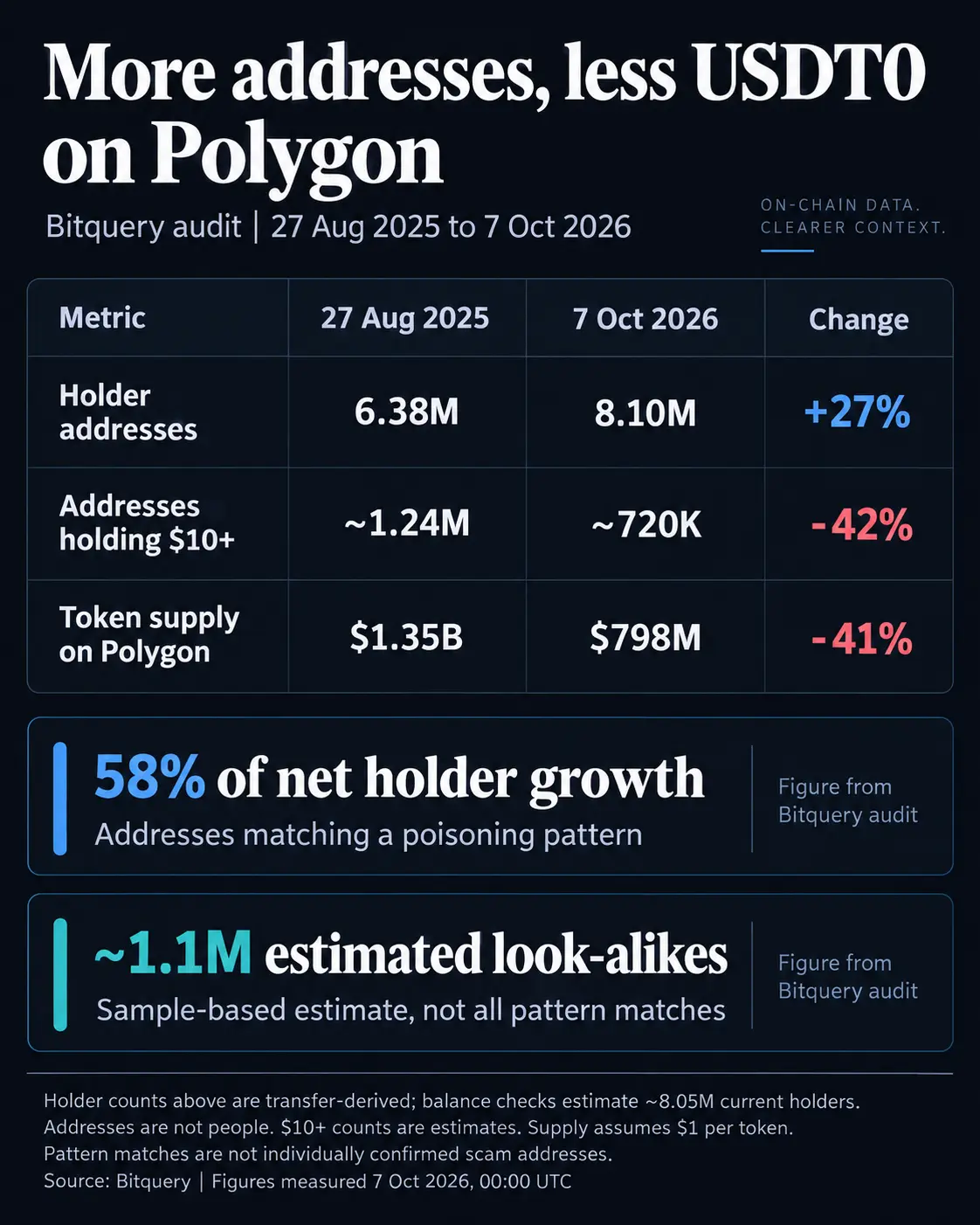
According to a detailed investigative report published on Oct. 7 by blockchain analytics firm Bitquery, addresses exhibiting characteristics of scam patterns accounted for roughly 58% of the net growth in Polygon’s USDT0 holder count since August 2025. The findings challenge the narrative of explosive, organic user acquisition promoted by the network and underscore growing concerns within the broader crypto industry regarding how on-chain metrics are measured, interpreted, and presented to the public.
The investigation revealed that approximately 998,000 out of the 1.71 million net new addresses added to the Polygon network over a preceding 13-month period displayed specific behavioral patterns associated with address-poisoning scams. This alarming proportion calls into question the quality of adoption figures that have been widely circulated across the digital asset space, demonstrating how sophisticated spam and scam vectors can inflate core network performance indicators.
The surge in questionable addresses occurred against a backdrop of declining capital and user engagement across other key metrics on the network. Over the same timeframe analyzed by Bitquery, the total supply of USDT0 on Polygon experienced a sharp 41% contraction, dropping from $1.35 billion down to $798 million. Simultaneously, addresses holding meaningful balances—specifically those with at least $10 worth of the asset—fell by 42%, declining from approximately 1.24 million to roughly 720,000.
Further compounding concerns about token distribution and holder quality, Bitquery’s data showed that 48% of current USDT0 holders controlled less than a single cent’s worth of the stablecoin. Moreover, an overwhelming 65% of the recorded holder addresses had neither sent nor received the token during the entire preceding year, indicating that a vast majority of these wallets are dormant or exist solely to inflate numerical counts.

The analytics firm also identified approximately 1.42 million total addresses matching an address-poisoning pattern throughout the network’s history. Through rigorous sample-based verification methods, researchers estimated that at least 1.1 million of these represent active scam look-alikes designed to deceive everyday users.
Address poisoning has become an increasingly prevalent vector in the cryptocurrency ecosystem. In this form of deception, bad actors generate wallet addresses that closely mimic legitimate payment destinations—often sharing matching initial and final characters with a user’s frequent transaction partners. The scammers then broadcast tiny, negligible amounts of tokens to potential victims’ wallets. When the victim later attempts to transfer funds by hastily copying an address from their recent transaction history rather than verifying it character by character, they inadvertently select the fraudulent look-alike address, leading to irreversible financial losses.
These poisoned addresses frequently retain fractional token balances left behind by the initial dusting transaction, which technically allows them to register as active token holders in standard blockchain indexing queries. Bitquery explicitly cautioned that its classification model is probabilistic in nature and did not attempt to quantify the total financial losses suffered by users targeted by these specific scams on the Polygon network.
The structural composition of Polygon’s holder base is also tied to the network’s historical upgrades. The current landscape reflects Polygon’s transition in August 2025 from legacy bridged USDT to native USDT0, an upgrade executed in collaboration with LayerZero to lower fees and deepen liquidity while preserving existing token balances and underlying smart contract addresses. Data indicates that approximately 67% of current USDT0 holders originally received Tether prior to this architectural migration.
Polygon’s Payments Ambitions Face a Measurement Problem
The revelations from the Bitquery investigation arrive at a critical juncture for Polygon, which has increasingly positioned its infrastructure as a premier stablecoin payments network. The network has been aggressively competing for market share among institutional payment processors, global fintech firms, and cross-border settlement services seeking high throughput and minimal transaction costs.

This strategic positioning has coincided with notable increases in raw transaction activity. Just prior to the release of the analytics report, blockchain analytics platform Growthepie highlighted that Polygon had successfully processed a higher volume of wallet-to-wallet stablecoin transactions over a seven-day window than Ethereum’s mainnet, outpacing the combined totals of rival layer-2 networks Base and Arbitrum.
While that particular metric successfully isolates peer-to-peer transfers by excluding complex decentralized finance smart contract calls, transfers generated by automated actors, including those executing address-poisoning campaigns, can still artificially inflate overall transaction counts and activity metrics.
Despite the contraction observed in USDT0 supply and meaningful holder addresses, broader stablecoin usage on the network remains diverse. Data from DeFiLlama indicates that Polygon maintains approximately $2.93 billion in total stablecoin capitalization. Circle’s USDC commands the lion’s share of this liquidity, holding approximately $1.62 billion and accounting for roughly 55.29% of the network’s stablecoin market. Meanwhile, Tether retains its position as the network’s second-largest stablecoin, with its supply hovering around $795 million, representing roughly 27% of the total stablecoin ecosystem on Polygon.
The divergence between Polygon’s expanding aggregate stablecoin liquidity and the specific contraction observed in USDT0 capital supply highlights the complex dynamics governing multi-chain asset deployments. However, the new investigative data emphasizes that raw holder counts alone are no longer a reliable barometer of network health or genuine retail adoption, leaving protocol developers and analytics firms alike to grapple with the persistent challenge of filtering out malicious noise from legitimate on-chain growth.