
Kraken IPO and TradFi Inflows Could Fuel Next Phase of Crypto Market, Says Tapiero
As the cryptocurrency market navigates a complex macroeconomic landscape following record-breaking milestones earlier in the season, industry leaders are weighing the factors that could define the next stage of market growth. A potential initial public offering (IPO) next year by major cryptocurrency exchange Kraken is emerging as a pivotal development that may attract fresh capital from traditional finance (TradFi) investors, bridging the gap between legacy institutional markets and digital assets.
The discussion surrounding institutional inflows comes at a volatile time for the wider digital asset economy. Bitcoin recently recorded an all-time high price above $126,000 on Oct. 6, capturing global attention and driving optimism across retail and institutional segments alike. However, the market has yet to fully recover from a massive $19 billion liquidation event that rippled through the industry just days after that historic peak, catching many leveraged traders off guard and dampening immediate momentum.

At the time of writing, the world’s largest cryptocurrency was changing hands at $87,015 per coin, reflecting a 6% decline over a two-week period, according to data from CoinGecko. Despite this notable cooling-off period and the severity of the recent liquidations, seasoned market participants argue that the broader structural trend remains intact. Dan Tapiero, founder and CEO of 50T Funds, asserted that the current Bitcoin bull market is "still mid-stage." Tapiero added that corporate milestones such as Kraken’s anticipated IPO, alongside an increasing number of mergers and acquisitions (M&As) within the sector, could provide the necessary tailwinds to accelerate the onboarding of new capital from traditional financial institutions.
The momentum behind Kraken’s public market debut has been building steadily. The exchange announced on Nov. 18 that it had successfully raised $800 million in funding, pushing its overall valuation to an impressive $20 billion. Reports surfaced earlier in November indicating that the platform had confidentially filed for a United States initial public offering, positioning itself to test public market appetite for crypto-native businesses following the regulatory shifts and market maturation seen over recent years.
Crypto industry watchers are divided over the bull cycle’s continuation in 2026
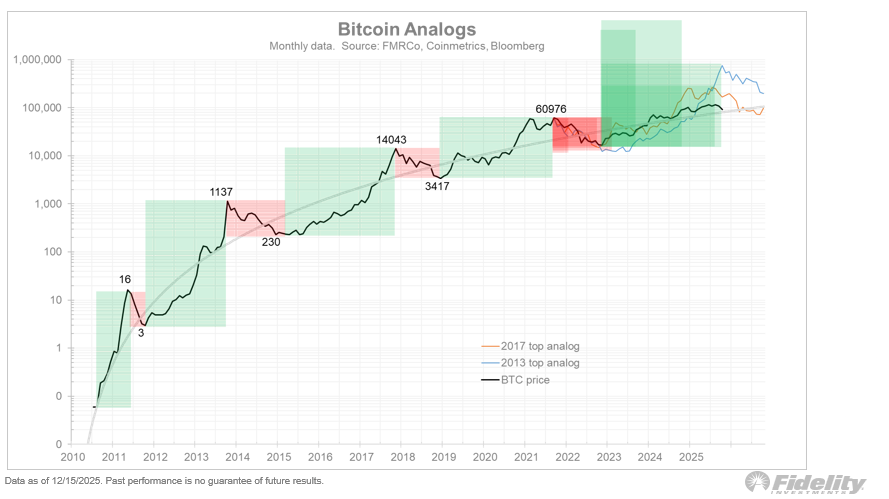
While executives like Tapiero remain optimistic about the medium-term trajectory of the market, not all analysts and macroeconomists are convinced that the current bull cycle will maintain its upward momentum straight through the coming years. Jurrien Timmer, director of global macroeconomic research at Fidelity, has struck a more cautious chord, expressing expectations for a challenging year of downside for Bitcoin in 2026.
Tapiero’s bullish outlook contrasts sharply with the views shared by Timmer, who anticipates that a prolonged correction or consolidation phase could drag Bitcoin down to a local market bottom around $65,000.

“Bitcoin winters have lasted about a year, so my sense is that 2026 could be a ‘year off’ (or ‘off year’) for Bitcoin. Support is at $65-75k,” Timmer wrote in a post on the social media platform X.
Market dynamics, however, are increasingly viewed through a lens that extends beyond traditional historical patterns. According to Jimmy Xue, co-founder and chief operating officer of Axis—an onchain quantitative yield platform managing $100 million in live capital—while Bitcoin’s historical four-year halving cycle provided the "initial rhythm" for the asset class, contemporary market movements are now dictated by much broader fundamental drivers. These include shifting global liquidity conditions and the continued pace of sovereign adoption by nation-states and major financial entities.
"It’s not surprising to see institutional caution as we close out 2025," Xue noted, acknowledging that Fidelity’s call for a potential pullback serves as a "valid reminder that volatility is still on the table." Nevertheless, the executive cautioned against painting the future with too broad a brush. "However, framing 2026 purely as a year of downside might be missing the forest for the trees," Xue told Cointelegraph.
Elaborating on his macroeconomic perspective, Xue explained that if global liquidity continues to loosen, the projected $75,000 support level might actually end up establishing a higher low within the framework of a longer, structural super-cycle. He suggested that the traditional four-year cycle is actively "evolving into a broader secular trend" that is fundamentally dictated by overarching macroeconomic forces rather than isolated internal market mechanics.
This division in outlook is also reflected in the positioning of sophisticated market participants. The industry’s most successful traders by historical returns—frequently tracked and analyzed as "smart money" traders on Nansen’s blockchain intelligence platform—have increasingly tilted their strategies toward betting on short-term market declines. According to Nansen’s blockchain analytics, smart money accounts have recently maintained a net short positioning across most of the leading cryptocurrencies. Notable exceptions to this defensive stance included positions centered around the Avalanche token and the native coin associated with memecoin launchpad Pump.fun, indicating selective pockets of risk appetite amid a generally cautious overarching market sentiment.