
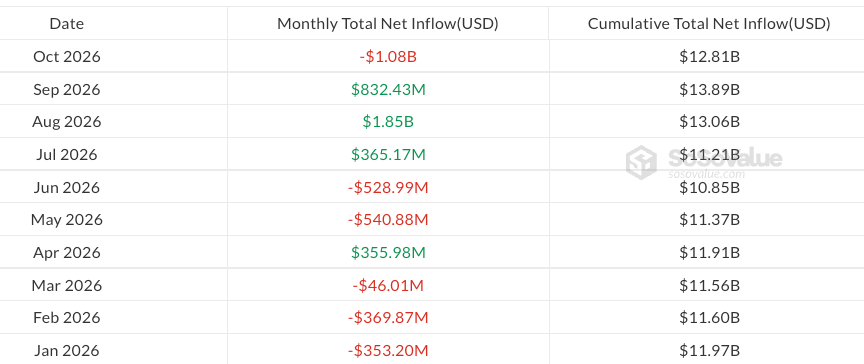
The macroeconomic and regulatory pressures bearing down on digital asset investment products have intensified sharply, with United States spot Ether exchange-traded funds (ETFs) suffering a punishing cash drain that has now surpassed the $1 billion threshold for the month of October. According to market data compiled by SoSoValue, net outflows from these regulated vehicles have climbed to a staggering $1.08 billion since the month began. This dramatic turnaround marks the single largest monthly net outflow recorded by spot Ether ETFs since November 2025, easily overshadowing the brief optimism that defined the late-third-quarter market environment.

The heavy capital flight seen over the past several weeks has completely wiped out the positive momentum generated just a month prior. In September, spot Ether ETFs managed to pull in a healthy $832 million in net inflows as institutional and retail investors positioned themselves for a potential autumn market rally. However, the subsequent reversal in October has dismantled those gains entirely. Following a modest $26 million addition on Tuesday, the cumulative year-to-date net inflows for the entire suite of US spot Ether ETFs have plummeted to approximately $485 million. With nearly a week and a half of trading still remaining in the month, market participants are watching closely to see whether the bleeding will accelerate or stabilize before the monthly candle closes.
This unprecedented wave of redemptions has unfolded in tandem with a broader corrective phase in the underlying asset’s price action. Ether has faced persistent downward pressure throughout October, sliding approximately 9.7% from an opening price near $2,700 down to roughly $2,438 at the time of publication. When viewed through a wider lens, the broader trajectory for the world’s second-largest cryptocurrency has been remarkably subdued over the course of the year. According to performance metrics from CoinGecko, ETH is down nearly 18% on a year-to-date basis, reflecting a stark divergence from the peak enthusiasm that surrounded the initial approval and launch of these spot investment products in the United States.
In contrast, the market dynamics surrounding United States spot Bitcoin ETFs have told a somewhat different, albeit more tempered, story during the same trading windows. Bitcoin investment vehicles have experienced a more resilient capital retention profile, though they have not been entirely immune to the broader cooling trend affecting digital assets. On Tuesday, spot Bitcoin ETFs recorded a net inflow of $23 million, adding to a significantly larger wave of $527 million in net inflows captured at the start of the week on Monday. Despite this strong start to the weekly trading cycle, the cumulative picture for October shows that Bitcoin funds have experienced mild net outflows totaling about $67 million since the month began.
Despite the minor monthly setback, the year-to-date performance metrics for spot Bitcoin ETFs remain noticeably more robust than their Ether counterparts. Total net inflows for US spot Bitcoin products since the beginning of the year stand at roughly $809 million, according to SoSoValue data. The underlying cryptocurrency itself has similarly demonstrated greater relative strength amid shifting market conditions. Trading at approximately $82,954 at the time of publication, Bitcoin has experienced a relatively mild decline of just 2.2% since October 1, and is down a modest 5.3% on a year-to-date basis. This comparative stability has continued to draw distinct interest from traditional financial institutions, as evidenced by ongoing product expansions and filings by major asset managers within the Bitcoin ETF ecosystem.