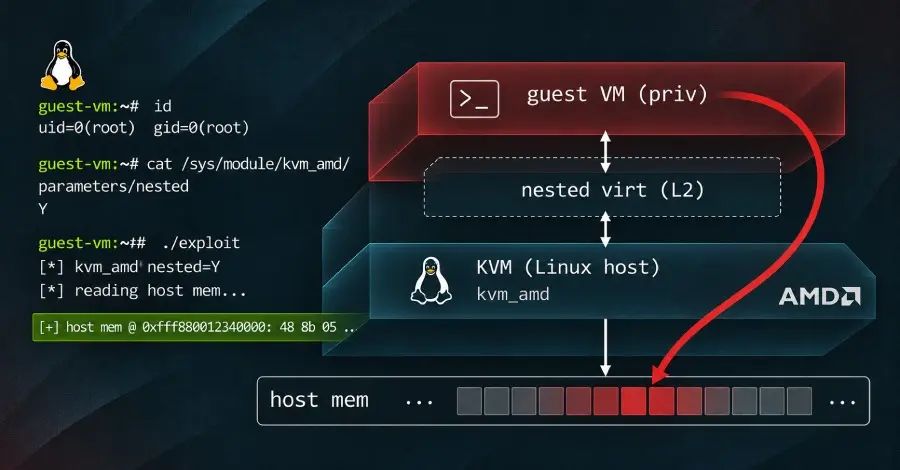
A severe vulnerability discovered within the Kernel-based Virtual Machine (KVM) hypervisor embedded in the Linux kernel has brought cloud infrastructure security into sharp focus. Security researchers successfully exploited the flaw—tracked officially as CVE-2026-99312—to read approximately 127 GB of a cloud server’s physical memory directly from inside a virtual machine running on DigitalOcean.
The security defect specifically impacts hosts powered by AMD processors that have nested virtualization enabled. On shared multi-tenant servers, such a lapse in memory isolation means that sensitive data belonging to adjacent customer virtual machines, as well as critical host-level operations, could theoretically be exposed to unauthorized inspection.
Swift Remediation and Immediate Mitigations
Upstream patches addressing the vulnerability were released on Tuesday, coinciding with the public disclosure of the research findings the following day. Prominent cloud providers moved quickly to secure their infrastructure, deploying live patches across their server fleets. DigitalOcean informed its Droplet customers that no direct action was required on their part due to these rapid server-side updates. However, independent system operators and enterprises managing their own KVM infrastructure on AMD hardware face the responsibility of updating their host kernels or disabling nested virtualization to eliminate the risk.
The vulnerability was originally uncovered by Oren Yomtov, a security researcher affiliated with Terra Security. Yomtov responsibly reported the flaw through the provider’s bug bounty program, allowing the organization to verify the exploit’s viability on its own systems and treat it as a high-priority risk. Following the initial report, Linux KVM maintainers were notified on October 21, and a comprehensive code fix was successfully merged into the mainstream development branch by November 2.

During initial testing on a dedicated Droplet, the researchers observed that the exploit immediately returned the host’s kernel version banner, quickly followed by roughly 127 GB of raw host RAM mapped in a read-only state. Subsequent verification tests conducted on the researchers’ private, bare-metal AMD server—isolated from other customers—demonstrated even deeper control. In that scenario, the guest virtual machine successfully wrote 32 custom bytes into a live page of the host kernel’s memory, a modification that was independently verified by a specialized witness module loaded directly into the host kernel.
Both experimental test scenarios required initial root access inside a virtual machine completely controlled by the researchers. Consequently, a malicious actor would need to attain an equivalent foothold—namely, pre-existing control over a guest VM residing on a vulnerable host—rather than merely possessing external network access to the target system.
Platform Nuances and Severity Disagreements
Crucially, KVM hosts running on Intel-based processors remain entirely unaffected by this issue. The vulnerable code path exists exclusively within KVM’s implementation of nested virtualization routines for AMD architectures. Furthermore, many cloud service providers surveyed during the research phase were found not to be vulnerable simply because they had not enabled nested virtualization features on their AMD hardware infrastructure.
Industry tracking by virtualization platform vendor VirtFusion indicates that there are currently no verified reports of the flaw being exploited in the wild outside of controlled research environments. No public exploit code has been released, and security teams currently lack specialized guidance for detecting historical attempts or indicators of compromise on legacy systems.
Meanwhile, industry definitions regarding the severity of CVE-2026-99312 have sparked notable debate among security organizations. The Linux kernel’s CVE team assigned the vulnerability a CVSS score of 8.8 out of 10, highlighting a high impact across confidentiality, integrity, and availability. In contrast, Red Hat’s preliminary security assessment rated the issue as moderate with a score of 5.6, categorizing its primary operational impact strictly around potential denial-of-service conditions. Despite these differing metrics, major cloud operators handling shared architectures treated the flaw with critical urgency.

Technical Root Cause Analysis
In-depth technical analyses published by Terra Security shed light on the exact mechanics of the vulnerability. KVM traditionally isolates each virtual machine using a nested page table, a memory structure responsible for translating a virtual machine’s internal memory addresses into the physical memory spaces of the underlying host. The processor locates this critical table via a specific pointer maintained for each individual virtual CPU.
The breakdown occurs when a nested virtual machine—a VM running inside another VM—receives a processor reset signal known as an INIT. During this specific event sequence, KVM inadvertently skips the routine process of restoring the outer virtual machine’s pointer. This omission leaves the pointer actively referencing a block of memory that the kernel has already freed and marked for reuse.
Once the host kernel inevitably reallocates and reuses that freed memory page, a malicious guest can populate it with custom entries of its own design. The processor then follows these forged table entries as if they were legitimate, effectively granting the guest access to arbitrary physical memory pages across the host. This mechanism is precisely how the guest gained read access to 127 GB of server RAM that was never allocated to it. The definitive software fix ensures that KVM properly resets this critical memory management state whenever an INIT signal is processed.
Interestingly, historical code analysis revealed that the flaw was inadvertently introduced by an earlier security fix. A patch deployed in 2022 to resolve a completely different nested virtualization issue—tracked as CVE-2022-3344—successfully redirected a reset path back to the outer virtual machine’s control block but overlooked the page-table pointer. This silent oversight remained embedded within the Linux kernel code for nearly four years. This discovery echoes previous findings by the same research team, colloquially referred to as PatchSlop, which demonstrated that security patches themselves can occasionally introduce secondary kernel vulnerabilities.
Mitigation and Remediation Strategies

Because the vulnerability resides entirely within the host hypervisor layer, simply updating the operating systems running inside individual virtual machines provides no protection. A host system continues to run vulnerable code until its underlying kernel is updated and the machine is fully rebooted.
Upstream fixes were officially incorporated into stable kernel release 7.3.5, as well as long-term support branches 6.18.64 and 6.12.118, according to official Linux CVE announcements. Because the affected code dates back several years—having entered the 6.1 kernel in 2022 and propagated into earlier 5.15 and 6.0 releases—numerous legacy kernel lines and downstream distribution builds remain exposed.
Major Linux distributions are actively working to backport and distribute the fixes, though many vendor repositories still reflect vulnerable statuses as security teams evaluate downstream impacts. Debian security trackers show ongoing vulnerability across stable releases with fixes restricted to unstable branches, while Ubuntu advisories rate the issue as high severity while pending official package releases. Similarly, Red Hat identifies Enterprise Linux 9 and 10 kernels as affected with patches deferred, while designating Enterprise Linux 8 as unaffected.
For administrators managing their own infrastructure, the immediate and most reliable protection involves installing patched host kernels followed by a system reboot. If an immediate reboot or kernel upgrade is unfeasible, operators can disable nested virtualization as an interim workaround. While this completely closes the attack vector, it disables the ability for tenants to run nested virtual machines, a limitation administrators should communicate to affected users beforehand.
Because nested virtualization is frequently enabled by default within the kernel’s kvm_amd module, unpatched hosts remain exposed unless administrators have explicitly altered the configuration. This latest disclosure adds to a growing catalog of hypervisor isolation challenges reported throughout the year, following the disclosure of a 16-year-old shadow memory management flaw affecting both Intel and AMD platforms, and the PwnEscape vulnerability in Linux networking code that surfaced in October.