Financial services giant JPMorgan Chase has officially confirmed a data breach affecting its systems, stemming from a security compromise at one or more third-party vendors utilized by the institution. The disclosure, which arrived following widespread speculation regarding the security of several major global financial firms, highlights the persistent and growing risks associated with supply chain vulnerabilities in the modern banking sector.
The incident was first acknowledged on the morning of November 19, 2026, when JPMorgan took to the social media platform X (formerly Twitter) to address concerns regarding the security of its customer information. The bank stated that it believes malicious actors successfully accessed specific marketing data held by external vendors. According to the institution, this information may include customer names and email addresses.
In its public statement, JPMorgan emphasized that the breach did not result in any disruption to its core banking services. "There is no disruption to our services. Where appropriate, we will contact affected customers directly and offer support, including complimentary credit monitoring," the bank announced. The company also moved quickly to clarify that this security incident is entirely separate from a service outage that occurred on November 16. That earlier disruption, the bank noted, was the result of an internal software bug within its on-premise hardware systems and was not related to the subsequent cyber-attack. Chase, the consumer and retail banking arm of the JPMorganChase group, mirrored these assurances in a statement released on its own social media channels shortly thereafter.
The Rise of the N0n Ransomware Group
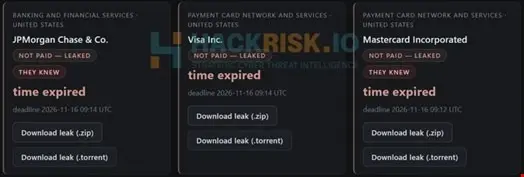
The confirmation of these breaches follows a series of bold claims made by a relatively new and aggressive ransomware entity known as "N0n." The group, which first emerged on the threat landscape in September 2026, recently listed JPMorganChase, alongside major payment processors Visa and Mastercard, on its public-facing data leak site.
The N0n group has quickly distinguished itself through its confrontational tactics. According to various reports, the group had issued extortion demands to these financial giants, setting a 48-hour deadline for payment. When these demands were not met, the group claimed to have published sensitive data belonging to customers of all three organizations. The publication of this data serves as a pressure tactic often employed by modern ransomware gangs, designed to force victims into compliance by threatening both the privacy of their clients and the public reputation of the firms themselves.
Impacts on the Payment Ecosystem
The fallout from the incident has touched multiple segments of the global financial infrastructure. Reuters reported that both Visa and Mastercard have confirmed that they, too, experienced data breaches linked to third-party compromises. The scale and nature of these breaches vary significantly between the affected parties. Visa, in an effort to reassure its global user base, explicitly stated that no payment or transaction data was compromised in the attack.

Mastercard’s response provided further detail, with a spokesperson clarifying that the breach was limited in scope. The impact on Mastercard was confined to non-payment information associated with a small, specific subset of cardholders who were enrolled in a particular benefit program. By segmenting the data, these firms are attempting to distinguish between highly sensitive financial credentials—such as credit card numbers and CVV codes—and less sensitive, though still private, contact information like names and email addresses.
As of the current reporting, none of the specific third-party vendors involved in these compromises have been publicly named. This lack of transparency makes it difficult to determine whether the incidents are linked through a single common point of failure—such as a single software provider or service bureau used by all three financial giants—or if they are the result of separate, targeted attacks against different vendors in the financial supply chain.
Nature of the Leaked Data
The implications for customers are beginning to come into clearer focus. A report from the Wall Street Journal indicated that personal information belonging to thousands of customers across the three financial institutions was included in the data dump published by the N0n group.
Among the more concerning revelations was the exposure of 16,000 email addresses linked to JPMorgan’s invitation-only Reserve card program. This elite tier of banking is typically reserved for high-net-worth clients, specifically those with $10 million or more in managed assets. The exposure of this specific group of high-profile clients underscores the potential for targeted phishing campaigns or social engineering attacks, as the attackers now possess verified contact information for individuals known to have significant financial resources.
Analyzing the Threat Landscape
The emergence of N0n as a significant player in the cyber-extortion space has drawn attention from cybersecurity analysts. The group is notable for its specific threat to destroy a victim’s backup infrastructure if extortion demands are not met, a move that significantly escalates the risk to business continuity for any organization that falls into its crosshairs.
However, experts are urging a measured response to the group’s claims. Rafe Pilling, senior director of threat intelligence at the Sophos Counter Threat Unit, has cautioned that while the N0n group is undoubtedly causing real harm to the individuals whose data has been exposed, some of its broader claims regarding major brands should be scrutinized with skepticism.

"In several cases, the data appears to have come from third-party providers running marketing, loyalty, or concierge programs, rather than from the brands’ own networks," Pilling explained. "That still matters to the individuals whose data has been exposed, but it’s very different from saying criminals have broken into Visa or JPMorgan and are moving around inside their systems."
Pilling’s assessment highlights a critical distinction in modern cybersecurity: the difference between a breach of a primary financial institution’s hardened, highly secured core network and the compromise of a peripheral vendor. While large banks invest heavily in cybersecurity, the vast ecosystem of vendors they rely on—ranging from marketing firms to logistical support providers—often represent a weaker link in the security chain. For threat actors like N0n, these vendors provide an easier entry point to harvest information that can still be leveraged for extortion, even if the primary financial systems remain untouched.
Looking Ahead
The incident serves as a stark reminder of the complexities of modern digital supply chains. Financial institutions are increasingly interconnected with a vast array of third-party service providers, each of which represents a potential attack surface. As organizations continue to outsource non-core business functions, the task of maintaining uniform security standards across all vendors becomes exponentially more difficult.
For customers of JPMorgan, Visa, and Mastercard, the immediate focus remains on vigilance. While the institutions have promised support and credit monitoring for those affected, the exposure of email addresses and names remains a primary risk factor for future phishing attempts. Security experts advise that customers remain alert for suspicious communications, particularly those that appear to come from their banks, as threat actors often use leaked data to craft highly personalized and deceptive messages.
As the situation develops, the financial sector is expected to face renewed pressure to conduct deeper audits of their third-party relationships. The N0n group’s activities, while relatively new, have already demonstrated that they are capable of forcing high-profile companies to publicly address their security vulnerabilities, highlighting the ongoing tension between operational outsourcing and the preservation of client data security. The investigation into the exact source of these breaches continues, with further details expected to emerge as the affected firms and law enforcement agencies work to piece together the full scope of the compromise.