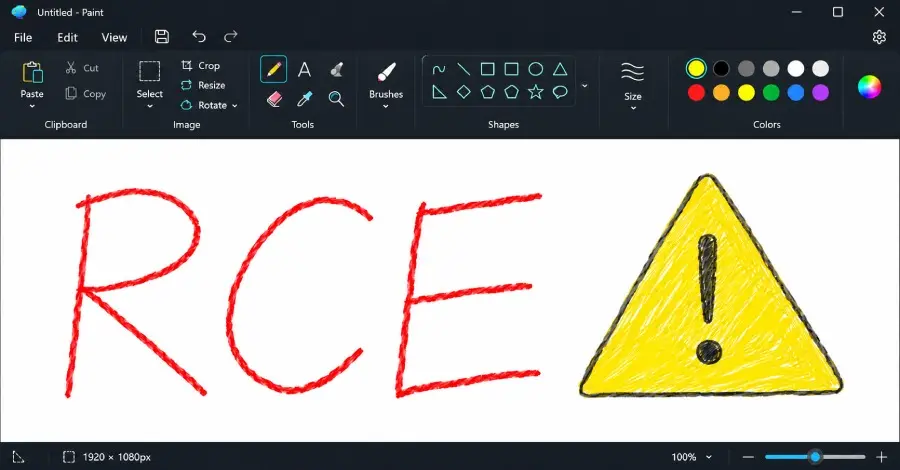
A critical security update addressing a remote code execution vulnerability in Windows Paint, officially designated as CVE-2026-83844, is now rolling out globally via the Microsoft Store. Unlike traditional Windows security patches that arrive through the standard Windows Update utility, this specific flaw requires users and system administrators to rely on the Microsoft Store application delivery mechanism to secure their systems.
Security researchers and IT administrators tracking the rollout have confirmed that the patched build, numbered 11.2609.401.0, has successfully propagated across multiple international regions. The update was verified as the newest available version of Windows Paint across ten distinct countries checked by industry analysts, signaling that Microsoft’s deployment pipeline is actively pushing the remediation to user devices worldwide.
The underlying vulnerability itself is classified as an out-of-bounds read flaw. According to security advisories published by Microsoft, the security defect carries a CVSS severity score of 8.1, placing it firmly in the "Important" tier. The flaw has the potential to allow an authenticated or unauthenticated attacker, depending on the network vector, to execute arbitrary code remotely over a network connection. However, Microsoft’s technical advisory notes that a successful exploit requires an attacker to possess a deep and sophisticated understanding of the target system’s architecture, mitigating some of the immediate danger from unsophisticated threat actors.
At the time of its initial disclosure on October 13, the vulnerability was not known to be publicly disclosed, nor had security researchers observed any active exploitation in the wild. This proactive discovery has allowed Microsoft and the broader security community time to coordinate responses before malicious actors could weaponize the flaw.
The rollout timeline, however, has highlighted some of the complexities associated with modern Windows application architecture and Store-based app updates. Earlier in the week, Brian Vitko, a researcher associated with device-management software maker RFF, examined the Microsoft Store application catalogs across six different countries. His preliminary checks revealed that the newest available version of Paint in those regions was build 11.2605.81.0, which did not yet include the security fix for CVE-2026-83844.
Fortunately, subsequent testing showed that automated systems function as intended. Vitko’s test virtual machine eventually transitioned to the secure, patched build automatically through the Microsoft Store’s background auto-update mechanism. While this automated transition is encouraging for consumer devices, enterprise environments and tightly controlled corporate networks often restrict or manage background application updates, leaving the broader timeline for complete enterprise saturation uncertain.

Which Build Counts as Fixed
Navigating the verification process for this vulnerability has introduced some administrative confusion, primarily due to discrepancies between Microsoft’s official security advisory documentation and the Common Vulnerabilities and Exposures (CVE) records.
Microsoft’s official security advisory explicitly designates build 11.2609.401.0 as the definitive fixed version. Conversely, the official CVE record published by the company, along with the National Vulnerability Database (NVD) entry maintained by the United States government, initially characterized Windows Paint as affected only in versions falling below 11.2605.91.0.
This technical discrepancy matters significantly for enterprise vulnerability scanners. Automated security scanning tools that rely strictly on standard CVE database feeds would technically treat any installed Paint build from version 11.2605.91.0 and upward as remediated. However, true compliance with Microsoft’s internal advisory requires systems to reach build 11.2609.401.0 or later to ensure complete protection.
Adding to the administrative opacity, Microsoft’s advisory had previously listed build 11.2605.91.0 as the threshold for safety as recently as the preceding week, a detail highlighted by concerned systems administrators on Microsoft Q&A forums. Despite these shifting benchmarks, the revision history of the official security advisory continues to display only its original October 13 publication date, offering no explicit changelog notes explaining the upward revision of the minimum secure build number.
How to Check Every Copy of Paint
Because Windows Paint is distributed as a modern packaged application through the Microsoft Store rather than a traditional Win32 desktop program, auditing enterprise endpoints for compliance requires specialized administrative checks. Store-backed apps are installed independently for every individual user profile on a given computer. Furthermore, Windows maintains a provisioned master copy of the application template on the operating system image, which is automatically replicated to any new user account created on that machine in the future. Consequently, checking only the currently signed-in user’s profile can easily create a false sense of security by missing older, vulnerable installations hidden within secondary user accounts or the system provisioning store.

To assist system administrators in mapping out their exposure, administrative tools have been developed to query deep system registries. Using administrative PowerShell scripts, IT professionals can execute targeted commands designed to inventory every single instance of Windows Paint deployed across all local user profiles, as well as inspect the master provisioned package baseline.
The first administrative command queries all user accounts on the machine to return the specific version numbers of Paint associated with each security identifier, while a secondary command inspects the online provisioned package repository to verify the baseline version that future users would inherit. Any discovered instance running a version older than the designated 11.2609.401.0 threshold represents an unpatched vector that requires updating.
Prior to the widespread distribution of the patched build through the Microsoft Store, preliminary mitigation strategies discussed within the administrator community centered around forceful removal. Security experts suggested that in environments where Windows Paint is completely non-essential to business operations, administrators could theoretically strip the application from all existing user profiles and purge the provisioned system copy to eliminate the attack surface entirely. However, because such aggressive removal strategies carry potential administrative side effects and were largely untested against this specific deployment pipeline, relying on the automated Microsoft Store update remains the preferred remediation path.
Attack Conditions and Exploitation Status
The mechanics of how CVE-2026-83844 might be leveraged in an attack point toward network-based vector delivery. According to Microsoft’s technical advisory documentation, a potential attacker could exploit the vulnerability by transmitting a specially crafted data packet directly to an affected service over a network connection. While the advisory does not explicitly name the underlying background service handling the malformed input, it confirms that a successful attack could theoretically be executed without requiring user authentication or any form of interactive user assistance.
Despite the inherent severity of remote code execution flaws, the threat landscape surrounding this specific vulnerability remains stable. When checked by researchers, the vulnerability was notably absent from the Known Exploited Vulnerabilities catalog maintained by the U.S. Cybersecurity and Infrastructure Security Agency. This federal tracking list, which highlights security flaws with verified active exploitation in real-world cyberattacks, had been updated earlier in the week without incorporating CVE-2026-83844.
As automated background updates continue to push build 11.2609.401.0 to consumer and enterprise endpoints alike, system administrators are encouraged to verify their software inventories using PowerShell tooling to ensure that all hidden user profiles and provisioned system images are fully updated, mitigating any residual risk posed by the flaw.