Chaos Labs has officially parted ways with the Aave ecosystem after serving as the premier crypto lending protocol’s main risk service provider for three years. The high-profile departure comes on the heels of a budget dispute and deep-seated disagreements over how the decentralized finance protocol should manage structural, operational, and financial risks moving forward.
The split marks the end of a foundational era for the lending protocol, during which Chaos Labs played a critical role in shaping Aave’s back-end infrastructure. Since November 2022, the risk firm has overseen asset pricing, parameter adjustments, and overall risk mitigation across Aave V2 and V3 markets. Throughout this partnership, Aave experienced staggering growth, with its total value locked multiplying fivefold to reach approximately $26 billion. However, shifting visions for the future of the protocol ultimately brought the multi-year collaboration to an end.
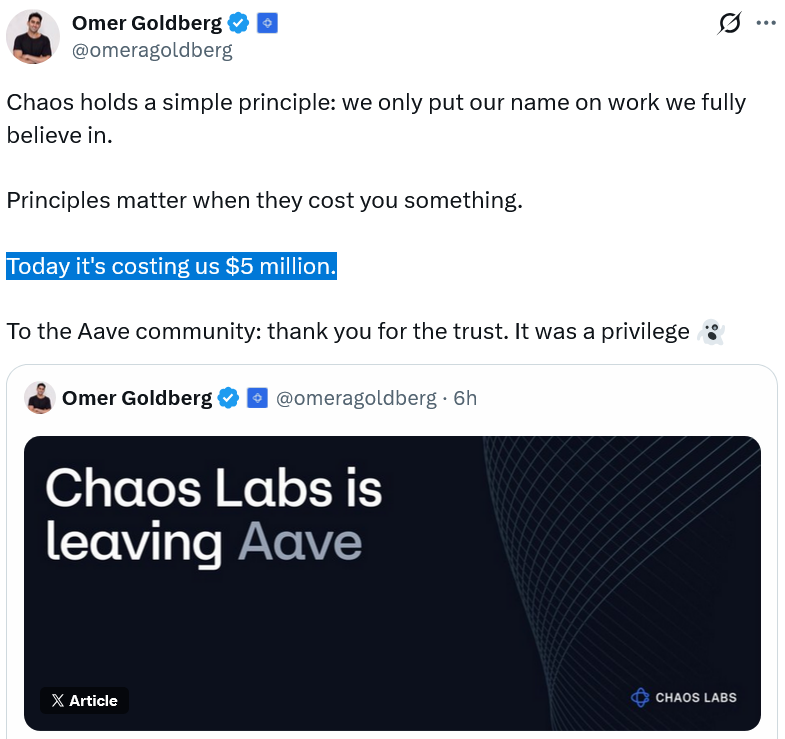
Omer Goldberg, the founder of Chaos Labs, announced the departure in a public post on X on Monday, shedding light on the motivations behind the firm’s exit.
“This decision was not made in haste,” Goldberg said. “We worked in good faith with DAO contributors. Aave Labs was professional and supported increasing our budget to $5m to retain us. However, we are leaving because the engagement no longer reflects how we believe risk should be managed.”
Goldberg pointed to an increasing misalignment between the parties regarding risk governance. He noted that the departure of several key Aave contributors had significantly increased the workload for remaining partners. Furthermore, he argued that the impending rollout and expanded functionality of Aave V4 would introduce substantial operational and legal burdens that would disproportionately fall on Chaos Labs’ shoulders.
Addressing the complexities of upgrading a massive decentralized liquidity protocol, Goldberg emphasized the immense logistical hurdles involved. “While Aave Labs is optimistic about a swift migration to V4, history suggests these transitions take months and even years,” Goldberg explained. “Until V4 fully absorbs V3’s markets and liquidity, both systems need to be operated and managed simultaneously. The workload during the transition doesn’t halve. It doubles.”

Weighing the severe liability associated with protocol security and potential failures, Goldberg highlighted the precarious legal landscape facing decentralized finance risk curators. “There is no regulatory framework, no safe harbor, and no settled law that answers the question of what a risk manager or curator owes when a protocol fails,” he stated. “If things work, the work is invisible. If things break, the blame is not.”
Because of these mounting pressures and strategic divergences, Goldberg confirmed that his team made the conscious choice to walk away from a lucrative financial arrangement. “We are walking away from a $5 million engagement,” Goldberg said.
Chaos Wanted Aave to Boot LlamaRisk and Chainlink: Kulechov
Aave Labs CEO Stani Kulechov offered a different perspective on the circumstances surrounding the departure, asserting that the split did not happen on entirely bad terms, though he detailed friction caused by Chaos Labs’ strategic demands. According to Kulechov, Chaos Labs had submitted a proposal seeking to become the sole risk provider for the ecosystem, a move that would have effectively forced out competing partners—a compromise that Aave leadership and the decentralized autonomous organization were unwilling to accept.
Following that request would have forced Aave to terminate its relationship with fellow risk protocol partner LlamaRisk, thereby dismantling the protocol’s established two-layer economic risk model. Kulechov added that Aave was similarly unwilling to integrate Chaos-built price oracles to replace services provided by Chainlink, citing Aave’s long-standing track record with Chainlink’s infrastructure, which protocol users are currently more comfortable utilizing at scale.
Kulechov also claimed that Chaos Labs was already exploring ways to wind down its risk consultancy services before the dispute escalated, though Aave had actively offered to double its payment to $5 million in an effort to retain them. Cointelegraph reached out to Chaos Labs for additional comment on these claims.
Despite the abrupt exit of a core infrastructure partner, Kulechov reassured the community that Chaos Labs’ departure has not caused any operational disruption to the Aave protocol, its underlying smart contracts, token listings, or broader network integrations.
Moving forward, Aave leadership confirmed that the protocol will continue collaborating closely with LlamaRisk to ensure a seamless transition and preserve its vital two-layer economic risk model.
Broader Governance Friction and Protocol Milestones
The departure of Chaos Labs occurs against a backdrop of heightened community sensitivity surrounding risk management. These concerns were amplified earlier in March when a user suffered a $50 million loss in a trade while interacting directly with Aave’s user interface. In response to the incident, Aave announced plans to introduce an "Aave Shield" protection feature designed to help deter users from engaging in excessively high-risk trades.
The friction with Chaos Labs also mirrors a broader, protocol-wide governance feud over funding distributions and revenue control. Discussions within the community have frequently centered on how much financial backing and autonomy Aave Labs should receive compared to the broader decentralized autonomous organization.
Even as internal debates and structural transitions play out, Aave continues to hit historic adoption milestones. In late February, the protocol officially crossed the $1 trillion mark in cumulative lending volume, securing a groundbreaking first for the decentralized finance industry.