
Mantle tokenholders have overwhelmingly backed a pivotal governance proposal authorizing a credit facility of up to 30,000 Ether, valued at approximately $68 million, dedicated to the Aave Decentralized Autonomous Organization (DAO). This significant step forward aims to advance ongoing remediation efforts connected directly to the substantial bad debt left in the wake of the damaging April rsETH exploit, which sent shockwaves through the decentralized finance ecosystem.
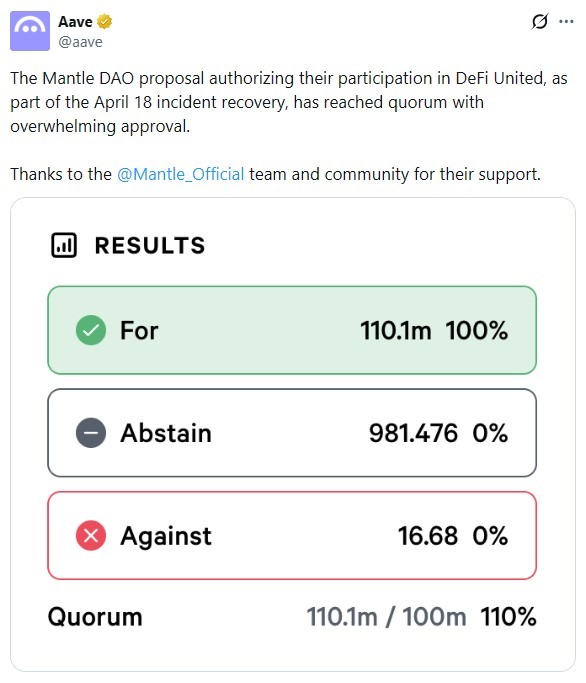
The successful measure, formally designated as proposal MIP-34, crossed the finish line after securing the necessary backing during a rigorous seven-day Snapshot vote that officially concluded on Friday, according to updates from the DAO governance platform Snapshot. Under the terms approved by the community, the authorization empowers the Mantle Foundation to actively negotiate and subsequently execute definitive agreements with Aave DAO regarding the provision of a substantial loan originating straight from the Mantle Treasury. However, market participants should note that the credit facility remains strictly subject to Aave successfully implementing its broader recovery plan, alongside both participating parties finalizing the ultimate legal and financial terms of the arrangement.
This newly sanctioned credit facility is deliberately intended to help address the severe multi-faceted impact that the rsETH security incident inflicted upon Aave V3. According to details outlined within the proposal itself, the malicious actor behind the exploit successfully deposited a staggering 89,567 unbacked rsETH tokens onto the Aave lending protocol. Following this maneuver, the attacker borrowed roughly $190 million worth of Wrapped Ether (WETH), wrapped staked Ether (wstETH), and various stablecoins. This unauthorized activity rapidly generated a massive potential bad debt burden for the protocol, with preliminary estimates placing the shortfall anywhere between $123.7 million and $230.1 million.

The outcome of the governance vote arrives at a critical juncture when the fallout from the rsETH exploit has progressively evolved past the initial liquidity shock into a much broader, highly calculated remediation phase. By stepping forward with this substantial financial backing, Mantle is effectively positioning its robust treasury as a vital safety backstop. Meanwhile, the core contributors and governance participants at Aave continue working diligently behind the scenes to absorb the bad debt, stabilize lending operations, and restore long-term market confidence in their decentralized lending markets.
Aave WETH Market Cools After Post-Exploit Squeeze
The introduction of the Mantle credit facility is designed to comprehensively address the capital shortfall that not only burdened the protocol’s balance sheet but also created severe, persistent liquidity stress across a wide spectrum of Aave’s lending markets.
A comprehensive report published on Thursday by Galaxy Research detailed how the rsETH exploit aggressively pushed Aave’s Wrapped Ether market into an unusually prolonged and painful squeeze. According to their findings, WETH utilization rates remained persistently elevated above the 99% threshold for a grueling 12.7 consecutive days immediately following the security incident.
Across the full analysis horizon, WETH utilization stayed structurally elevated and remarkably close to the absolute 100% ceiling, maintaining a staggering average of around 99.6%. The market only began showing marginal signs of relief by the end of the observed snapshot period, easing downward to approximately 98.47%, as highlighted by Galaxy’s analytical team.
In decentralized lending, exceptionally high utilization means that the vast majority of a supplied asset has already been borrowed out by market participants, leaving very little idle liquidity available for regular users seeking immediate withdrawals. In Aave’s specific case, Galaxy noted that the WETH market remained under intense structural strain because total asset supply contracted at a much faster pace than total borrows declined, thereby locking utilization near full capacity even long after the initial security shock had passed.
Fortunately, the market has since cooled significantly from the near-100% operational levels described in the Galaxy analysis. Up-to-date data sourced from Aavescan showed that Aave’s Ethereum V3 WETH market operated at a more manageable utilization rate of about 91.6%. This current distribution reflects roughly 2.02 million WETH supplied to the protocol against approximately 1.85 million WETH actively borrowed by users navigating the platform’s liquidity pools.