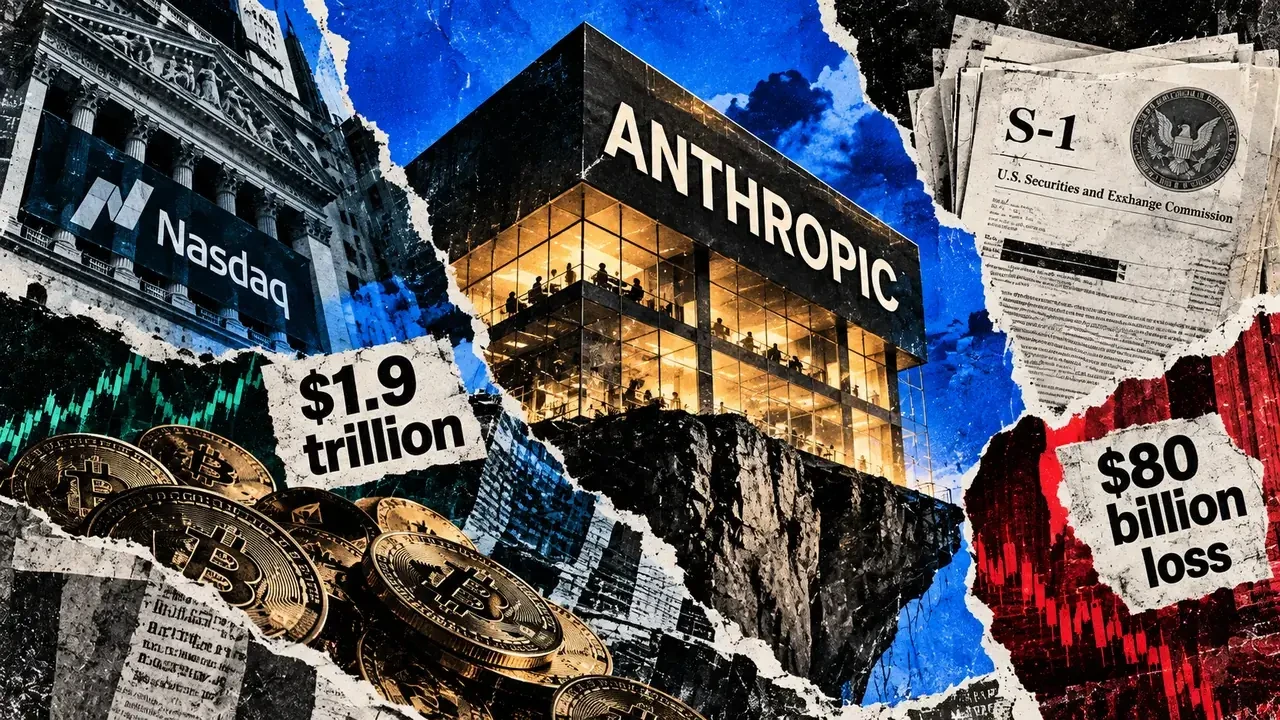
Artificial intelligence pioneer Anthropic has officially filed for an initial public offering on the Nasdaq exchange, marking a monumental milestone for the generative AI sector as it reports a breakthrough quarterly operating profit and confronts massive infrastructure obligations.
The developer behind the Claude AI assistant submitted its Form S-1 registration statement to the US Securities and Exchange Commission, seeking a public listing under the ticker symbol ANT. The high-profile offering is being led by financial heavyweights Goldman Sachs and Morgan Stanley, positioning the debut to become one of the largest public offerings in United States financial history. While Anthropic has not yet disclosed its proposed share price or the exact size of the offering in its regulatory filings, market expectations increasingly point toward an official trading debut sometime in November.
The official filing arrives against a backdrop of immense speculation regarding the company’s financial scale. Even before the public markets formally price the equity, alternative forecasting venues and crypto trading platforms have attempted to value the enterprise. Crypto trading platform Liquid reported that Anthropic’s implied valuation hovered near $1.88 trillion following the announcement, down roughly 2% immediately after the news broke. Meanwhile, Better Markets quoted an indicative pre-IPO share price of $2,967.92, which corresponds to an estimated valuation of $1.43 trillion under its specific pricing methodology.
These astronomical valuations have sparked intense debate among investors and market analysts over what Anthropic’s public market debut could signify for the broader technology sector and the sustainability of current artificial intelligence valuations.
Simon Dedic, the founder of Moonrock Capital, expressed expectations that the company will commence public trading by mid-November. Dedic noted that the blockbuster listing could either signify the absolute top of the current artificial intelligence market cycle or establish itself as one of the largest wealth-creation events in the history of private markets. According to Dedic, an offering of this unprecedented magnitude has the potential to unlock a substantial volume of capital accumulated by early-stage investors and long-standing employees. This massive release of liquidity could eventually redirect substantial investment capital back toward emerging startups and alternative asset classes.
This assessment touches upon a broader question occupying the minds of institutional investors: how much of the immense wealth generated during the ongoing artificial intelligence investment boom will eventually flow into other sectors, including digital assets and cryptocurrency markets.
Despite the widespread speculation, Anthropic has not yet confirmed its official trading date or its finalized offering valuation. Furthermore, the actual timing and scale of any secondary shareholder sales will depend heavily upon the strict regulatory and contractual restrictions attached to existing equity holdings.
Anthropic’s Profitability Gains Face Massive Infrastructure Obligations
To properly contextualize the extraordinary valuations circulating across traditional and alternative markets, the company’s financial disclosures filed with the SEC provide a much clearer analytical foundation.
Anthropic reported generating $16.3 billion in revenue during the first half of 2026. This represents a staggering surge compared to the approximately $1.16 billion recorded during the same period a year earlier, reflecting year-over-year revenue growth of roughly 1,300%. Highlighting this rapid acceleration, social investment platform Social Capital pointed to data from the IPO filing showing that quarterly revenue climbed dramatically from $376 million in the first quarter of 2025 to an astonishing $11.6 billion by the second quarter of 2026.
This approximately 31-fold increase in revenue over a five-quarter span was accompanied by profound improvements in the company’s operational efficiency. During the first quarter of 2025, Anthropic spent approximately $2.51 on computing power and underlying infrastructure for every single dollar of revenue it generated. By the second quarter of 2026, that operational cost had declined dramatically to about 48 cents per dollar of revenue.
This dramatic efficiency gain enabled the company to record $974 million in operating profit during the June quarter alone, successfully reversing a substantial $1.67 billion operating loss recorded in the preceding three-month period.
However, despite the positive operating margin, the company reported a massive $66.3 billion net loss for the quarter. This headline-grabbing figure was largely driven by noncash financing adjustments, including a $59.6 billion charge resulting from the revaluation of convertible notes as Anthropic’s enterprise valuation climbed higher. Those complex accounting adjustments also contributed heavily to its $80.7 billion net loss for the first half of the year, which included $72.4 billion in fair-value adjustments linked to convertible notes, derivatives, and related financial instruments.
Prominent venture capitalist Nic Carter described the overall financial results as robust and improving, arguing that the headline net loss heavily obscures genuine improvements in Anthropic’s core operating performance. Nevertheless, Carter questioned whether a valuation approaching $1.5 trillion can be rationally justified by approximately 22 times annualized third-quarter revenue.
At the same time, Melvin, an analyst at Milk Road AI, argued that the company’s improving operational profitability—bolstered by approximately $131.7 billion in cash and short-term investments—fundamentally challenges prevailing assumptions that frontier artificial intelligence developers must continuously raise external capital simply to sustain their daily operations.
Yet, despite these substantial financial reserves, Anthropic’s immense infrastructure commitments introduce a significant element of financial vulnerability. The company has entered into formal agreements with major technology titans including Amazon, Google, Microsoft, and other computing providers, involving hundreds of billions of dollars in potential expenditure spread across several years.
Among these massive obligations, its arrangements with SpaceX alone could reach as high as $120.5 billion through 2029, though these contracts do contain specific cancellation provisions that take effect after initial noncancelable periods expire.
This heavy financial exposure is particularly critical because approximately 80% of Anthropic’s revenue during the first half of the year was derived from consumption-based services. This commercial model allows enterprise customers to reduce their active spending much faster than the company can unwind many of its long-term infrastructure commitments.
In its regulatory filing, Anthropic explicitly warned that any unexpected softening in customer demand could leave the company unable to meet its minimum payment obligations. Such a scenario could potentially trigger commercial defaults under key business agreements as well as accelerated repayment requirements under related financing structures. To guard against these risks, the company has actively expanded its revolving credit commitments to $15 billion and faces a strict minimum quarterly liquidity requirement of $5 billion starting at the end of 2026.
Beyond its operational and infrastructure hurdles, the upcoming initial public offering is positioned to create another major market event well after the initial bell is rung. Simon Dedic and other market observers have raised questions regarding what thousands of newly wealthy employees and early investors intend to do with their capital once contractual restrictions preventing them from selling their shares eventually expire.
The prospectus filed by Anthropic outlines an unusual, highly staggered lock-up structure designed to manage post-IPO liquidity. This framework allows certain categories of shareholders to sell limited portions of their holdings starting from the very first trading day, with additional tranches scheduled for release at subsequent intervals.
Under this structure, certain employees may be permitted to sell a portion of their shares immediately, while other venture investors face mandatory holding restrictions lasting as long as 180 days. Meanwhile, the company’s co-founders and key major stakeholders face the longest restrictions, stretching up to 365 days, albeit with specified provisions for early release under certain conditions.
This carefully calibrated approach could help spread potential shareholder selling pressure across several months rather than concentrating a massive wave of stock liquidations around a single, highly volatile lock-up expiration date.
However, because the official registration filing has not yet established the final offering size or the total share count, the precise dollar value of stock that will ultimately enter public circulation at each distinct stage remains undetermined as market participants await the November debut.