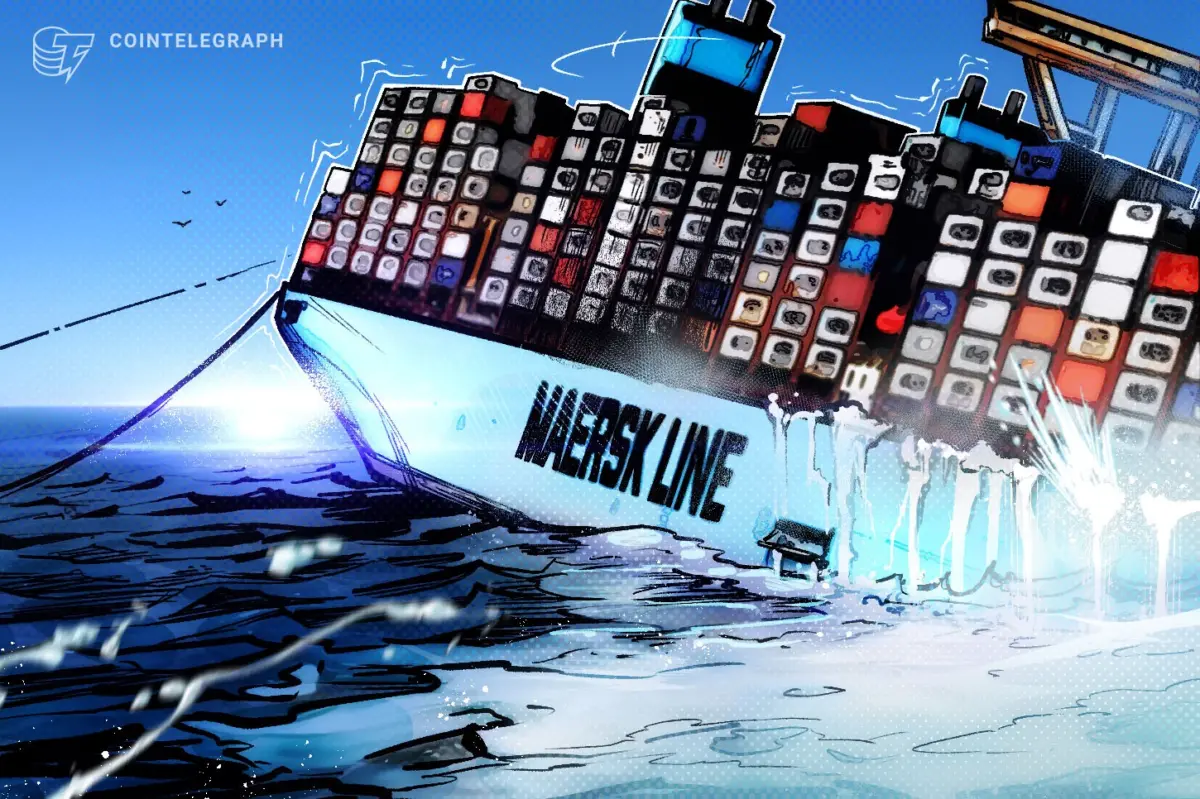
The corporate blockchain graveyard continues to expand, welcoming another high-profile casualty to its ranks. Blockchain projects across various sectors continue to experience failure rates in excess of 90%, and it seems that with every passing moment, more and more supposedly successful mainstream companies are forced to add their underperforming distributed ledger initiatives to the scrapheap. One of the most recent and glaring examples of this trend is shipping giant A.P. Moller-Maersk, which officially announced the termination of its heavily publicized TradeLens offering—a global trade platform built on IBM’s enterprise blockchain technology.
Launched with immense fanfare and high expectations from industry stakeholders, TradeLens was designed to streamline global supply chains, digitize shipping documentation, and create a single, immutable source of truth for international trade partners. Yet, despite the backing of two corporate heavyweights and years of development, the platform ultimately shuttered, joining a long list of corporate blockchain trials that failed to achieve sustainable commercial viability.
Industry analysts and innovation experts point out that these high-profile failures were not entirely unpredictable. In many cases, these abandoned initiatives could have been avoided if corporate decision-makers had more closely observed established lessons in innovation diffusion, organizational psychology, and technology adoption frameworks. Examining why initiatives like TradeLens stumble provides vital context for understanding the broader friction between enterprise systems and decentralized technology.
Lesson 1: Innovation Is Not Monolithic
One of the most fundamental mistakes legacy corporations make when approaching emerging technologies is treating innovation as a monolithic concept. In the eyes of many traditional executives, innovation is simply a checkbox or a singular destination. Unfortunately, business associations, mainstream business media, and elite business schools often perpetuate this misconception by producing an endless parade of innovation lists and corporate awards that reinforce the flawed idea that all innovation functions in the exact same way.
Decades ago, Clayton Christensen’s landmark book, The Innovator’s Dilemma, served as one of the first major attempts in modern business literature to distinguish between different types of innovation. While Christensen’s work was immensely helpful in launching a broader corporate conversation around technological disruption, a more granular framework for categorizing technological change comes from organizational theorists Rebecca Henderson and Kim Clark. They identified four distinct types of innovation: incremental, modular, architectural, and radical.
While certain enterprise applications may comfortably fit into the modular or architectural categories, blockchain technology is, at its core, fundamentally disruptive. Because disruptive technologies are specifically engineered to replace existing frameworks, entrenched interactions, and traditional intermediary institutions, the most successful early applications and innovations almost always emerge from smaller, agile startup firms rather than established institutional giants like IBM, Maersk, or other Fortune 100 corporations. Large enterprises are often structurally ill-equipped to nurture technologies designed to upend the very systems upon which their traditional business models depend.
Lesson 2: Complexity Is an Innovation Killer
Complexity remains one of the most reliable killers of technological adoption, a dynamic that rings especially true for modular and radical innovations. Decades ago, communication scholar Everett Rogers highlighted the clear inverse relationship between the perceived complexity of a new technology and the willingness and ability of users or organizations to adopt it.
In the context of enterprise blockchain, this complexity extends far beyond the technical architecture of the application itself. It encompasses internal corporate decision-making processes, the radical level of structural change required for organizational adoption, and the sheer volume of new knowledge that employees and external partners must acquire just to implement the system.
Industry experts have repeatedly underscored the immense operational difficulties of implementing projects on the scale of TradeLens. Observers frequently note that the underlying technology is notoriously complex, demands significantly more computing power, and is considerably more expensive to run than traditional, centralized databases. Compounding the technological hurdles of the IBM-Maersk shipping project was the deeply bureaucratic and complex nature of the two massive multinational corporations involved, where aligning thousands of stakeholders across global supply chains proved to be an insurmountable obstacle.

A compelling parallel can be drawn from the previous major wave of digital innovation: the rise of social media. During that era, it was not the established media conglomerates or legacy telecommunications giants that built the foundational tools, technologies, and platforms that drove early adoption and cultural integration. Instead, the breakthrough products were forged by startups—nimble organizations characterized by short decision-making cycles, minimal internal friction required to adapt, and corporate cultures capable of assimilating new knowledge almost instantaneously.
Given these enduring economic and organizational dynamics, initial successful innovative breakthroughs utilizing blockchain technology are far more likely to be found in simplistic, targeted applications. These solutions are typically developed by much smaller, highly entrepreneurial firms focused on replacing or reshaping straightforward processes regarding how work gets executed, products are manufactured, or transactions are facilitated between transacting parties.
Lesson 3: Different Innovation Types Require Different Levels of Risk Tolerance
Another critical differentiator among the four types of innovation is the distinct level of risk tolerance required for an organization to act as an effective innovator. The risk-tolerance threshold required for incremental innovation is remarkably low, whereas radical innovation demands a significantly higher, often existential, appetite for risk.
Crucially, risk tolerance in this context is not merely about evaluating the statistical probability that an isolated project might fail. Accurately assessing innovation risk requires organizations to look closely at the likelihood of catastrophic organizational failure—meaning that if the new adoption or innovation collapses, the entire enterprise risks failing, rather than just absorbing the financial loss of a single failed department or software pilot.
A classic illustration of high-risk, non-traditional innovation outside of the technology sector is Billy Beane’s famous application of sabermetrics to roster construction and player management for the Oakland Athletics in the early 2000s. This modular innovation strategy posed a high degree of personal and organizational risk that no other major league baseball franchise was willing to embrace at the time.
While failure for the team would not have meant literal corporate extinction—the franchise would not have ceased to exist as a major league organization—the potential professional and financial costs were extraordinarily high. Beane risked losing his job alongside his entire coaching staff. A dissatisfied, alienated fan base could easily have punished the organization by staying home and halting merchandise purchases, leading to a massive, crippling drop in revenue.
Blockchain, by contrast, operates firmly in the realm of radical innovation. It requires a vastly higher level of risk tolerance for both innovation and institutional adoption—specifically, a corporate willingness to risk it all on an unproven paradigm. Companies that merely tinker around the edges through incremental or architectural innovation, maintaining an exit strategy where they can simply walk away if the project falters, are statistically far more likely to experience continued blockchain failures during this formative stage of the technology’s lifecycle.
Despite these growing pains and high-profile setbacks, blockchain and other decentralized technologies continue to hold profound promise for the much-needed evolution away from centralized production and concentrated corporate power. The ultimate challenge facing the industry moving forward is aligning time, capital, and human resources with established lessons in innovation diffusion, giving this technological revolution its strongest possible foundation for long-term success.
Lyall Swim serves as the chief innovation officer for Atlas Network. He holds a doctorate in education with an emphasis in organizational leadership from Pepperdine University, alongside a bachelor’s degree in communications and an MBA from Brigham Young University.