The connected vehicle landscape has once again been thrown into the spotlight after two prominent security researchers revealed a sophisticated vulnerability chain that could allow attackers to completely take over customer accounts for two major car brands. By exploiting weaknesses in third-party identity management software and poor deployment configurations, the researchers demonstrated they could gain total remote access to connected cars—unlocking doors, starting engines, and silently hijacking user profiles without the vehicle owners ever realizing they were compromised.
The findings, published late last week by security experts Shubham Shah and Sam Curry, center around how mobile applications authenticate users and handle sensitive customer data. According to their technical analysis, both automobile brands relied on ForgeRock—an identity management platform now part of Ping Identity—to manage customer logins. However, it was not a flaw in the core software product itself that created the vulnerability, but rather how the automakers deployed and configured the platform on their servers.
The Attack Vector: Default Credentials and Exposed Consoles
The investigation began when Shah and Curry analyzed the login applications used by the car manufacturers. They discovered that both brands routed customer authentication through the same identity platform, which operates using two distinct components: a primary login service and OpenIDM, a module responsible for maintaining customer records and user databases.
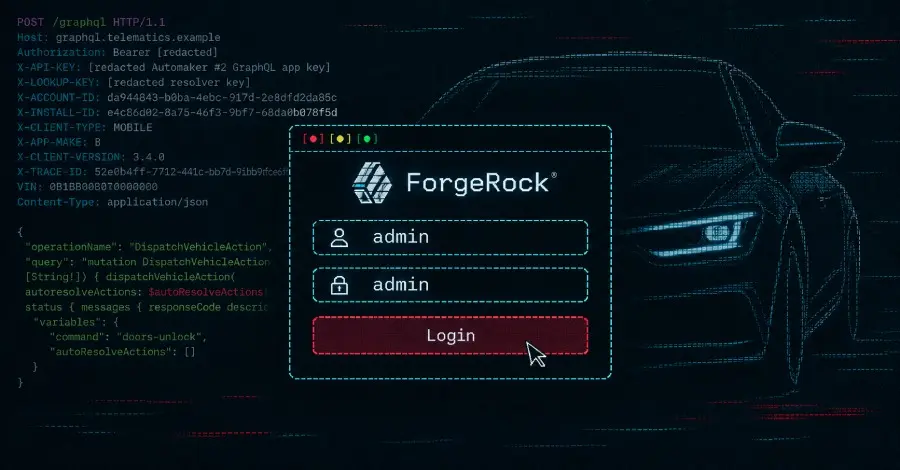
OpenIDM comes equipped with a built-in administrator console powered by the Apache Felix framework. Because this console stores its authentication credentials separately from the rest of the enterprise system, ForgeRock’s official production hardening guides explicitly instruct operators to either completely remove the console or secure it heavily before pushing the system live. Despite these explicit warnings, the servers hosting the automakers’ identity systems still retained the developer tool, complete with its factory-default credentials: the word "admin" for both the username and the password.

While the administrative console was technically blocked from direct access via the open internet, a critical discrepancy in how edge-security proxies and backend Java servers interpreted web requests allowed the researchers to bypass the perimeter. By appending encoded forward slashes and specialized characters to the URL, the security edge treated the incoming web traffic as a harmless static file. Simultaneously, the backend server interpreted the exact same request as a direct path to the administrative console. Once the path was bypassed, the default administrator credentials granted the researchers full entry.
Escalating Privileges and Controlling the Vehicle
Once inside the administrator console, the researchers utilized a built-in scheduler tool designed for automation. This feature allowed them to run small, custom scripts that executed arbitrary code directly on the identity server. This move successfully bypassed the system’s remaining perimeter blocks from the inside, giving the researchers a command prompt on the very machine responsible for storing customer login records for both automotive brands.
With administrative privileges established on the server, the researchers demonstrated the catastrophic impact of the flaw. They modified the email address and password of a target user account, allowing them to sign into the mobile application normally as if they were the legitimate owner. Upon logging in, the app issued the exact same valid access tokens that legitimate customers use for their daily driving routines.
These access tokens served as digital keys to the vehicles. Utilizing the application’s native vehicle command features, the researchers successfully unlocked the doors and started the engine of a test vehicle while the consenting owner stood nearby observing the demonstration. Afterward, they shut down the engine and locked the doors again.

The researchers tested the full attack chain exclusively in February 2026 using their own vehicles and consenting owners in the United States. Following responsible disclosure practices, they reported the vulnerability to the affected manufacturers, and both systems were patched and secured approximately two hours after the notification was delivered.
Global Scope and Silent Exploitation
Following their initial findings in the United States, Shubham Shah investigated the digital infrastructure powering the same car brands in Australia, uncovering a secondary, distinct attack vector. In the Australian deployment, administrative credentials for the identity server had been inadvertently left directly within the mobile application’s source code—leftover artifacts intended for a preliminary testing environment.
Combined together, the two attack chains demonstrated that malicious actors could potentially target connected vehicles across the United States, Canada, and Australia. While the Australian systems have also been addressed, the researchers did not publicly specify the exact timeline for when those fixes were deployed.
A particularly concerning aspect of the vulnerability was the complete lack of indicators visible to the vehicle owner. When the researchers altered the account credentials to generate new session tokens, the original owner was not logged out of their smartphone application. Furthermore, attackers could reroute account-related notifications and security alerts to their own devices, ensuring that the legitimate vehicle owner remained entirely unaware of the breach. To maintain security during their investigation, the researchers carefully restored the original email addresses and passwords after concluding their authorized tests.

A Pattern of Connected Vehicle Vulnerabilities
Because the incident stemmed from deployment errors and unhardened administrative tools rather than a zero-day software flaw, there was no Common Vulnerabilities and Exposures (CVE) identifier or formal vendor advisory issued. However, the event serves as a stark reminder for enterprise identity and cybersecurity teams to audit their production environments against established hardening standards, particularly regarding leftover developer consoles and default credentials.
Shah and Curry are well-known within the cybersecurity community for uncovering high-profile vulnerabilities in the digital ecosystems surrounding modern automobiles. Over the years, their research has exposed critical web and API weaknesses affecting major automotive manufacturers including Honda, Kia, and Subaru. Notably, a Subaru flaw reported previously by the team exposed owner accounts and vehicle controls through connected-car APIs, while a broader study in 2023 highlighted systemic web vulnerabilities across sixteen different automotive brands.
As modern vehicles become increasingly software-defined and reliant on cloud-based identity platforms, the security of backend authentication servers remains just as critical to road safety as physical mechanical components.