
As the wider cryptocurrency markets transition from months of bearish red charts to bullish green territory, the decentralized finance (DeFi) lending sector is experiencing a significant resurgence. This recovery follows a particularly dismal second quarter that rattled investor confidence and exposed fragile interconnections across the decentralized ecosystem.
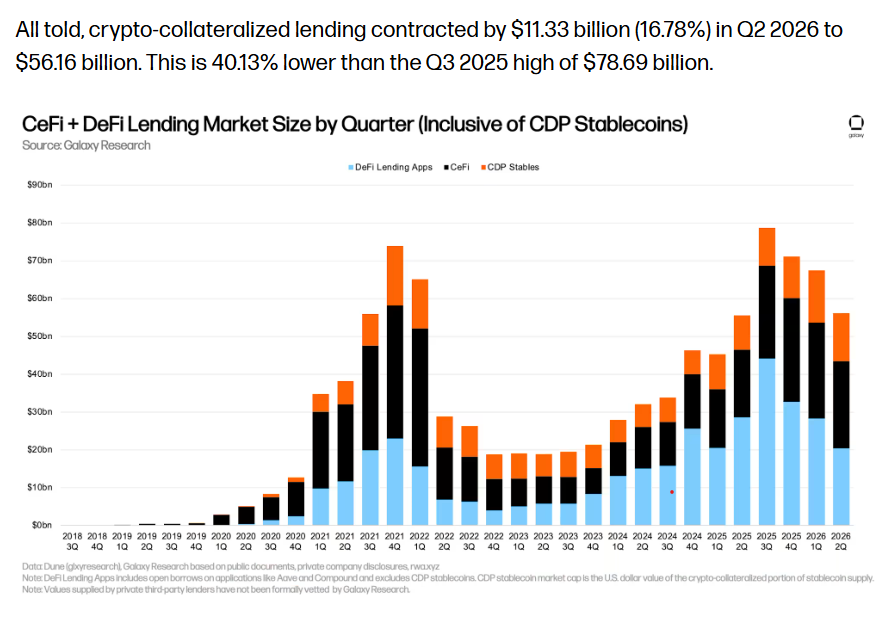
Data compiled and published by Galaxy indicates that a staggering $11.33 billion left the crypto lending sector during the second quarter. This massive capital flight was driven only partially by broader market conditions; a major catalyst was a severe crisis of investor confidence. This crisis was triggered by the high-profile Kelp DAO hack in April, an exploit that abruptly left users of Aave—widely regarded as one of the most robust and trusted protocols in the decentralized finance space—unable to access their Ethereum holdings.
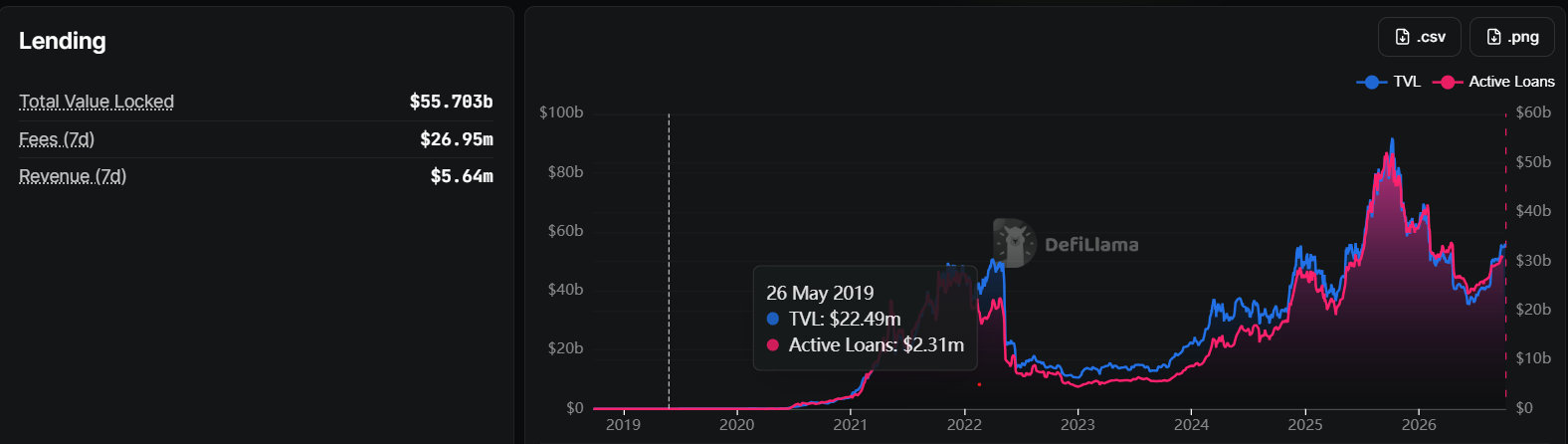
However, market dynamics have shifted notably since the beginning of July. Total value locked (TVL) across decentralized lending protocols has surged by more than 55%, climbing back to sit comfortably around the $56 billion mark. While this rapid influx of capital signals renewed market health and investor appetite, it also means the financial honeypot has grown substantially larger. This expansion brings a critical question to the forefront of the industry: Can users truly trust interlinked DeFi lending protocols in an era defined by AI-assisted hacks and sophisticated exploits? In today’s financial landscape, an exploit targeting any single minor protocol can easily trigger a cascading series of devastating effects across all other protocols connected to it through shared liquidity, wrapped tokens, or cross-chain bridges.
Stani Kulechov, the founder and chief executive of Aave Labs, acknowledges that systemic risk management has quickly become the top priority for protocol developers and risk committees alike.
"When a protocol accepts a token as collateral, it is also accepting that token’s bridge, its verifier configuration, its oracle and its issuer’s operational security," Kulechov notes.
That precise reality is what dragged Aave into the crosshairs of the Kelp DAO incident earlier this year.
An Expanding Attack Surface
The vulnerabilities inherent in modern decentralized finance architectures became glaringly apparent in April when hackers successfully exploited a Kelp DAO cross-chain route. During the attack, malicious actors minted 116,500 unbacked restaked tokens known as rsETH, which had an approximate market value of $290 million at the time. A significant portion of these fraudulently generated tokens was subsequently deposited as collateral onto various Aave markets to borrow other high-value digital assets.
Even though Aave’s own core smart contracts were never directly breached or compromised during the exploit, the protocol suffered collateral damage in the court of public opinion and liquidity retention. In the immediate aftermath, Aave deposits plummeted by approximately $15 billion as cautious users withdrew funds to mitigate potential exposure. The protocol’s governance and risk management teams were forced to take swift defensive action, temporarily freezing its rsETH and wrsETH markets to prevent further systemic contagion.
Reflecting on the fallout, Kulechov explains that Aave has fundamentally shifted toward a much broader, more holistic approach to security and asset onboarding.

"We rebuilt our approach around that wider view," he says, emphasizing that modern security protocols can no longer afford to stop at the boundary of a smart contract. He adds that traditional security audits and code reviews historically "missed the risk sitting in the bridges, verifier networks and other infrastructure an asset depends on."
For everyday users and institutional participants alike, navigating this landscape requires a sophisticated assessment of how exposed a given protocol is to both internal code vulnerabilities and external infrastructural risks.
"Every wrapper, bridge and oracle between the lender and the underlying asset is another place a loan can go wrong," points out Thomas Wu, the chief financial officer of Bitcoin-backed lending platform Ledn.
Similarly, Sid Powell, co-founder and chief executive of crypto credit platform Maple, argues that serious, professional lenders should always operate under the conservative assumption that any borrower can fail at any given moment, working backward from that worst-case scenario.
"What am I holding, where is it, can I see it in real time, and how quickly can I get to it if something breaks?" Powell asks, highlighting the operational rigor required in modern crypto credit markets.
When Security Fails, Containment Matters
As protocol developers look for ways to fortify their systems, risk mitigation has expanded far beyond basic smart contract auditing. Sam MacPherson, the chief executive of decentralized lender Spark, explains that his team evaluates a comprehensive matrix of factors before supporting any asset. Beyond reviewing smart contracts, Spark analyzes governance design, operational security standards, underlying collateral quality, liquidity management frameworks, and dependencies spanning the broader blockchain ecosystem.
Spark’s proactive risk assessment actually predated the April Kelp exploit. In January, the platform began systematically phasing out rsETH support on SparkLend after concluding that its low utilization rate and minimal revenue generation simply did not justify the elevated systemic risks introduced by supporting the asset.
Aave has implemented comparable governance mechanisms to continuously monitor ecosystem health. Kulechov notes that every asset listed on Aave is subjected to a rigorous re-review on a quarterly basis, as well as an immediate reassessment "after any material change" in the asset’s underlying infrastructure. Furthermore, Aave has already initiated an orderly wind-down process across six different blockchain networks that failed to meet the platform’s stringent chain-level security standards.
"No protocol can control the entire ecosystem, but it can control how much of that risk it takes on and how quickly it responds," Kulechov asserts.
While stopping exploits before they happen remains the ultimate goal, MacPherson stresses that robust protocols must also establish clear, tested procedures for containing damage if the worst-case scenario materializes.
"Preventing losses is only part of the challenge," MacPherson says. "Protocols also need to demonstrate how a loss would be contained if something does go wrong."
The Margin for Human Error
Beyond code vulnerabilities and bridge exploits, human error remains one of the most pervasive yet frequently overlooked threats to crypto lending operations. Shawn Owen, the founder and chief executive of SALT Lending, points out that the operational layer is often where the most severe vulnerabilities lie.
"A lot of the biggest losses have come down to key management, access controls or someone getting socially engineered, and a smart contract audit won’t catch any of that," Owen explains.
Substantial risks also emerge when decentralized lenders deploy client assets into third-party yield-generating strategies. The crypto lending industry learned this hard lesson during the devastating market unwind of 2022, when prominent centralized lenders such as Celsius, Voyager, and BlockFi imploded after accumulating risks that their customer base either did not understand or never agreed to take.
To minimize its overall attack surface and protect client assets, Ledn deliberately avoids deploying user capital into external yield-generating protocols, choosing instead to store client Bitcoin with qualified, highly regulated custodians. Wu emphasizes that every additional financial transaction or protocol integration creates another vector for potential failure, meaning that minimizing moving parts directly correlates to enhanced security.
"The only way to take those risks off the table is to keep client Bitcoin in segregated custody, with tight controls and as few movements as possible," Wu states.
At the same time, market pressures can easily compromise lending discipline. Powell warns that when capital deposits flow into a platform faster than managers can find high-quality, productive places to deploy them, the intense pressure to maintain attractive yield metrics can easily drive poor decision-making.
"So they take on a little more risk to get there. Maybe the collateral standards get looser, or they lend to a borrower they’d have turned down a year ago," Powell explains. "The managers who hold up in a downturn are usually the ones who were willing to say no to capital when they didn’t have a good place to put it."
Can AI Make Lending Safer?
Amid growing industry anxiety surrounding AI-assisted cyberattacks, malicious automated scripts, and reports of autonomous agents escaping human oversight, artificial intelligence is also emerging as a valuable tool for bolstering crypto lending safety.
Aave, for instance, has integrated AI-assisted testing alongside its conventional security pipelines. During a recent testing phase, the platform used mutation testing to deliberately inject hundreds of artificial bugs into its V4 smart contracts to evaluate its testing frameworks. Impressively, the automated test suites successfully caught 271 out of the 304 injected vulnerabilities.
However, artificial intelligence is far from a silver bullet. In a comprehensive security review covering its V3 and V4 codebases, three distinct AI security tools generated a combined 71 security findings. Following rigorous manual reviews by human engineers, only 20 of those findings were verified as valid issues. The remaining 51 false positives clearly demonstrated why human security experts and auditors will likely remain indispensable to the industry for the foreseeable future.
"AI is very good at breadth and speed," Kulechov observes, "but around 70% of the raw findings were false positives, so expert judgment stays essential."
Moreover, artificial intelligence represents a classic double-edged sword for the cryptocurrency ecosystem. As autonomous AI agents increasingly take on the responsibility of managing capital on-chain, their specific permissions, data inputs, and internal decision-making logic themselves become critical attack surfaces that require rigorous protection.
As the crypto lending sector rebounds and expands once again, the fundamental challenge facing developers and institutions extends far beyond writing secure code. The primary task is ensuring that every interconnected component of the modern financial puzzle is thoroughly understood, continuously monitored, and systematically contained the moment something unexpected goes wrong.