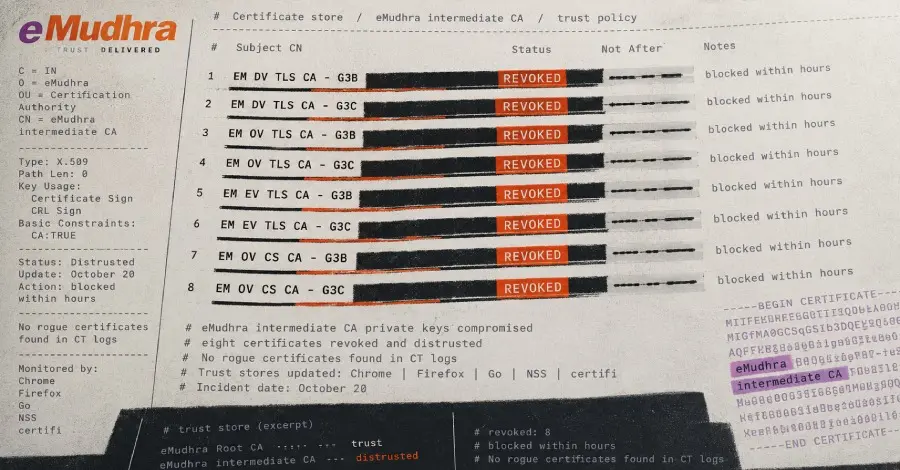
The global digital certificate ecosystem faced a severe integrity crisis following the confirmation that the private keys of eight intermediate certificate authority (CA) certificates belonging to eMudhra have been compromised. The breach, which was independently confirmed on October 20 by Mozilla and Google’s Chrome Root Program, immediately triggered emergency actions across major browser vendors, programming language maintainers, and cryptographic tool developers worldwide. Because intermediate CAs hold the cryptographic authority to sign digital certificates that browsers and operating systems inherently trust, the exposure of these private keys meant that an unauthorized entity could theoretically generate valid, trusted certificates for any website on the internet, potentially facilitating large-scale man-in-the-middle attacks, traffic interception, or phishing campaigns.
The unfolding crisis began when an independent security researcher privately disclosed the compromise to root programs on the evening of October 17. Moving with exceptional urgency, engineering teams at Google and Mozilla verified the findings within hours and swiftly deployed emergency blocks to neutralize the threat before malicious actors could exploit the exposed credentials. According to the Chrome Root Program, a review of Certificate Transparency logs confirmed that no fraudulent TLS certificates chaining to the six affected web-facing intermediates had been logged prior to the implementation of the emergency browser blocks. Consequently, these rogue credentials could not have been trusted by default in Chrome or any other modern browser enforcing strict Certificate Transparency policies. Despite this fortunate timeline, profound questions remain regarding how the sensitive keys left eMudhra’s secure infrastructure, precisely when the breach occurred, and whether any entities other than the initial researcher managed to acquire copies of the keys.
The compromised cryptographic assets directly mirror a set of mysterious high-priority blocks implemented in Go’s emergency security releases on October 20. Go’s maintainers deployed the fix via their URGENT track—a protocol strictly reserved for severe threats to the integrity of the software ecosystem or active, in-the-wild exploitation—though the project’s official security notes did not explicitly name eMudhra at the time. The eight cryptographic hash values embedded directly into Go’s updated codebase matched the compromised certificates down to the byte.
What Was Compromised
eMudhra, a prominent Certificate Authority based in India that distributes digital certificates under the emSign brand through various international subsidiaries in the United States and the Netherlands, maintains trusted roots across major ecosystems including Mozilla, Google, and Apple. The eight compromised certificates span both web server authentication and code-signing operations. Six of the compromised TLS certificates were originally issued by the "emSign Root TLS CA – G3" and trace their trust chain back to the "emSign ECC Root CA – G3," a foundational root embedded within the Chrome and Apple trust stores, as well as Mozilla’s until the October 20 revocation.

A comprehensive inventory published by Dennis Jackson, a cryptography engineer at Mozilla, revealed an additional layer of complexity: each of the eight compromised certificates exists as a duplicate copy featuring the exact same public key, but cross-signed by Sectigo under its legacy "AAA Certificate Services" root. Fortunately, Chrome’s robust architecture prevented the two code-signing certificates from presenting an active threat, as the browser’s TLS verification engine is fundamentally restricted from building validation paths through intermediates constrained exclusively to code signing.
The discovery of the keys originated from a security researcher identified by Mozilla solely as "Wayne." The researcher verified possession of the compromised material by cryptographically signing a specific message—"We have a problem here – Wayne"—using each of the eight compromised private keys, subsequently submitting these cryptographic proofs to the respective root programs. Jackson later cataloged these signatures and certificates on a dedicated public disclosure page.
Who Is Protected, and How
The rapid response orchestrated by browser vendors and ecosystem maintainers prevented widespread exploitation, though the nature of the remediation varied widely across different software platforms. The Chrome Root Program received the initial researcher report at 18:05 UTC on October 17 and deployed an emergency CRLSet update to neutralize the six TLS intermediates by 19:45 UTC. Mozilla received the alert shortly after at 20:06 UTC, successfully pushing a OneCRL block to Firefox installations operating under standard settings by 22:59 UTC. Because both CRLSets and OneCRL operate as dynamic revocation lists fetched automatically by the browsers, end users required no manual software updates or system restarts to receive protection.
Chrome’s defensive implementation targeted the underlying public keys rather than the static certificate identifiers, allowing the browser to automatically catch and neutralize the Sectigo cross-signed duplicates as well. This mechanism mirrors the advanced defensive strategy deployed earlier in the month against rogue certificates targeting Google domains. Meanwhile, eMudhra officially revoked all eight certificates. Apple enacted system-wide blocks on October 19, Microsoft followed on October 20, and remaining global trust stores were formally notified of the breach.
The Sectigo cross-signed copies did not expand the attack surface for modern browsers like Chrome or Firefox, given that both applications had already deprecated trust in Sectigo’s AAA Certificate Services root for web traffic back in April 2025. However, older or alternative software ecosystems faced a much more difficult path to remediation, as many applications consuming TLS certificates—ranging from compiled Go binaries to network tools relying on Python’s certifi bundle—historically lacked built-in mechanisms to check real-time revocation data, continuing to trust certificate chains blindly until their core software or root certificate bundles were explicitly modified.

To address these vulnerabilities across the broader software supply chain, a cascade of emergency software updates was rushed out on October 20. Go released versions 1.27.3 and 1.26.10, incorporating a hardcoded filter in its standard library that explicitly rejects any certificate chain containing one of the eight compromised keys across native, macOS, and Windows system-verifier pathways. Firefox released version 158.0.1 alongside extended support releases to protect offline installations. Concurrently, cryptographic libraries and package maintainers—including Mozilla’s NSS, Python’s certifi bundle, Rust’s webpki-roots, and Homebrew’s ca-certificates formula—issued emergency updates that either blocked the specific key hashes or dropped the compromised emSign root authorities entirely from their trusted bundles.
While these drastic root-removal measures effectively severed trust in the compromised authority, they carried unintended collateral damage. Removing foundational roots from software bundles instantly disrupted legitimate web servers and services that still relied on valid certificates chained to those authorities, forcing operators to transition to alternative certificate paths to restore service availability.
What Happens to eMudhra
The long-term operational future of eMudhra within the global Public Key Infrastructure remains uncertain as root program operators evaluate the severity of the security lapse. On October 20, Mozilla formally removed the emSign ECC Root CA – G3 from its Network Security Services (NSS) library. Google announced that Chrome will purge the same root in an upcoming version of its root store while actively reviewing the compliance and security status of eMudhra’s remaining root, emSign Root CA – G1, citing the gravity of the incident.
Critical questions regarding the vector, timing, and exact methodology of the key extraction remain unanswered. Mozilla indicated that it is actively collaborating with eMudhra, fellow root program administrators, and downstream trust stores to conduct a thorough root cause analysis, promising further public disclosures as investigations proceed. As of October 20, eMudhra’s official trust-services repository contained no public advisories addressing the compromise.
Filippo Valsorda, maintainer of the standard library cryptography packages for Go, defended the decision to hardcode the compromised key hashes directly into the language’s source code. He noted that because Linux and other operating system root stores are frequently too fragmented or poorly maintained for dynamic revocation checks to reach localized applications reliably, embedding the compromised keys directly into the software binary remained the only viable option to protect developers and end users from immediate cryptographic impersonation risks.