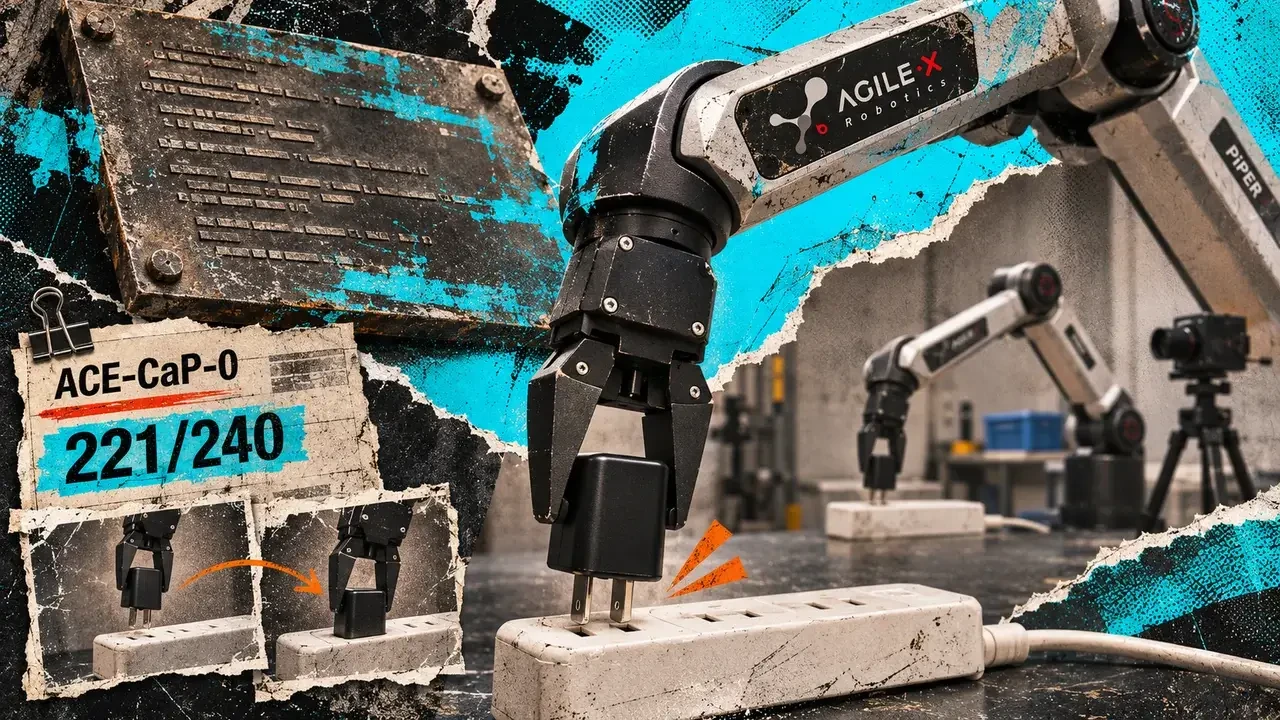
Robotic systems are taking a significant step toward greater autonomy following a new research breakthrough that demonstrates how sophisticated physical tasks can be executed using AI-generated code without requiring an artificial intelligence model to oversee every micro-decision in real time. According to a study published on November 12 by the researchers behind ACE-CaP-0, robot control programs developed by Anthropic’s Claude Opus 5.5 coding agent successfully completed 221 out of 240 physical evaluation trials across a diverse suite of physical manipulation tasks.
The findings mark an important milestone in the intersection of artificial intelligence and robotics, suggesting that task-specific motor and cognitive skills can be successfully crystallized into static code. Rather than relying on a continuous, real-time feedback loop from a large language model or an overarching AI system during execution, the robots operated using compiled, deterministic programs. These programs successfully integrated live sensor data and perception inputs to adapt to minor variations in the environment, yet their core decision rules remained entirely fixed.
The newly detailed ACE-CaP-0 method addresses a fundamental challenge in robotics: bridging the gap between high-level AI reasoning and the reliable, repeatable execution of physical tasks. While modern AI models possess remarkable problem-solving and coding capabilities, deploying them directly to control physical hardware in real time often introduces latency, unpredictability, and high computational costs. By shifting the paradigm so that the AI acts as a developer rather than an active controller, the researchers achieved a striking 92.1% overall success rate across eight distinct physical tasks, with each program frozen and subjected to 30 rigorous evaluation trials without any further code modifications.
Experimental Setup and Task Performance
The physical evaluation environment utilized a standardized hardware setup featuring two Agilex PIPERX robotic arms paired with a multi-camera vision system. This configuration tested the limits of the AI-developed programs across a variety of dexterous and practical challenges, ranging from delicate household maneuvers to industrial packaging operations. The tasks included inserting an electric charger, uncapping bottles, packing shoes, and handling bread packing, among others.
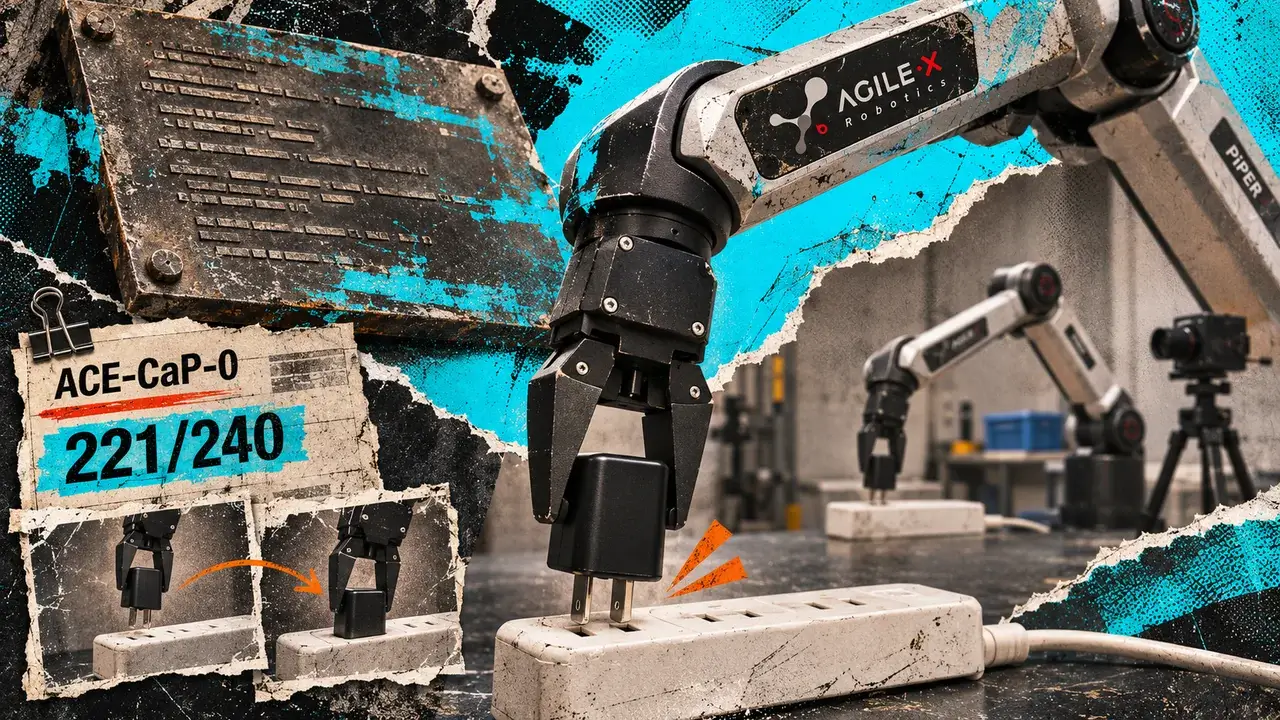
Performance across the board demonstrated high reliability, though success rates varied slightly depending on the complexity and precision required by the specific task. The most successful benchmark was charger insertion, which achieved a flawless 100% success rate across all 30 evaluation trials. At the other end of the spectrum within this specific test suite, bread packing yielded the lowest success rate, yet still performed strongly at 25 successful trials out of 30. Furthermore, the mean physical execution times recorded across the various tasks ranged efficiently from 0.97 minutes to 2.27 minutes per run, highlighting both the speed and stability of the frozen control programs.
Throughout the evaluation phase, neither human supervisors nor the original AI coding agent remained in the execution loop. The programs operated autonomously, demonstrating that task execution can be effectively decoupled from the resource-intensive development phase. This separation ensures that once a robotic routine is successfully written and validated, it can be deployed repeatedly in local environments without incurring the ongoing latency or API costs associated with real-time generative AI inference.
Human Assistance During the Development Phase
While the execution phase was entirely automated, the development process relied on a collaborative framework combining autonomous agent capabilities with targeted human guidance. During the programming phase, the Claude Opus 5.5 coding agent actively wrote, executed, inspected, and revised its software implementation using immediate physical feedback from the robotic test bed. When encountering complex physical dynamics that were difficult to resolve purely through code logic, the agent was permitted to request textual advice or physical demonstrations from human operators.
These human-provided demonstrations supplied vital contextual data, including video feeds, precise robotic arm trajectories, and key joint poses that helped the coding agent refine its algorithms. To maintain experimental rigor, the development protocol enforced strict boundaries on human intervention, allowing a maximum of only ten human-assisted scene resets per task. Importantly, scene resets utilized strictly for gathering initial demonstrations were excluded from this ten-reset budget, ensuring the metric focused strictly on iterative troubleshooting rather than extensive hand-holding.
In addition to physical testing and human feedback, the coding agent was also equipped to leverage simulated experiments whenever digital environments could help resolve complex development questions. The research team conducted comparative analyses to evaluate the impact of utilizing on-demand simulation during the programming phase. The results revealed a notable performance delta: in a charger-insertion comparison, development supplemented by on-demand simulation produced a program that achieved a 100% evaluation success rate, compared to 86.7% for development conducted without simulation support.

However, this performance enhancement introduced distinct economic and computational trade-offs. Developing the program with on-demand simulation required approximately 2.6 hours of processing time and consumed 1,090,000 output tokens. In contrast, the simulation-free development run took longer at 3.7 hours but consumed fewer resources, utilizing approximately 730,000 output tokens. Because these initial figures leave total development costs and human labor overhead partially unresolved, the researchers have emphasized the need for comprehensive accounting frameworks that factor in the total effort required for demonstration collection and simulation overhead.
Implications for Autonomous Robotics
The successful deployment of ACE-CaP-0-generated programs underscores a shifting landscape in how software is engineered for physical machines. By demonstrating that complex physical skills can be successfully translated into persistent, reusable code modules, the study provides tangible evidence of a viable pathway toward scalable robotic autonomy.
Repeating rigorous evaluation trials is a necessary step to measure how a specific program performs under controlled conditions, but the researchers note that establishing how consistently the underlying development process can produce equally capable programs across entirely new domains will require broader, multi-run testing. As the field looks toward future iterations, subjecting these automated routines to novel environmental conditions and broader operational variables will be critical to determining just how widely such AI-crafted code can be reused.