
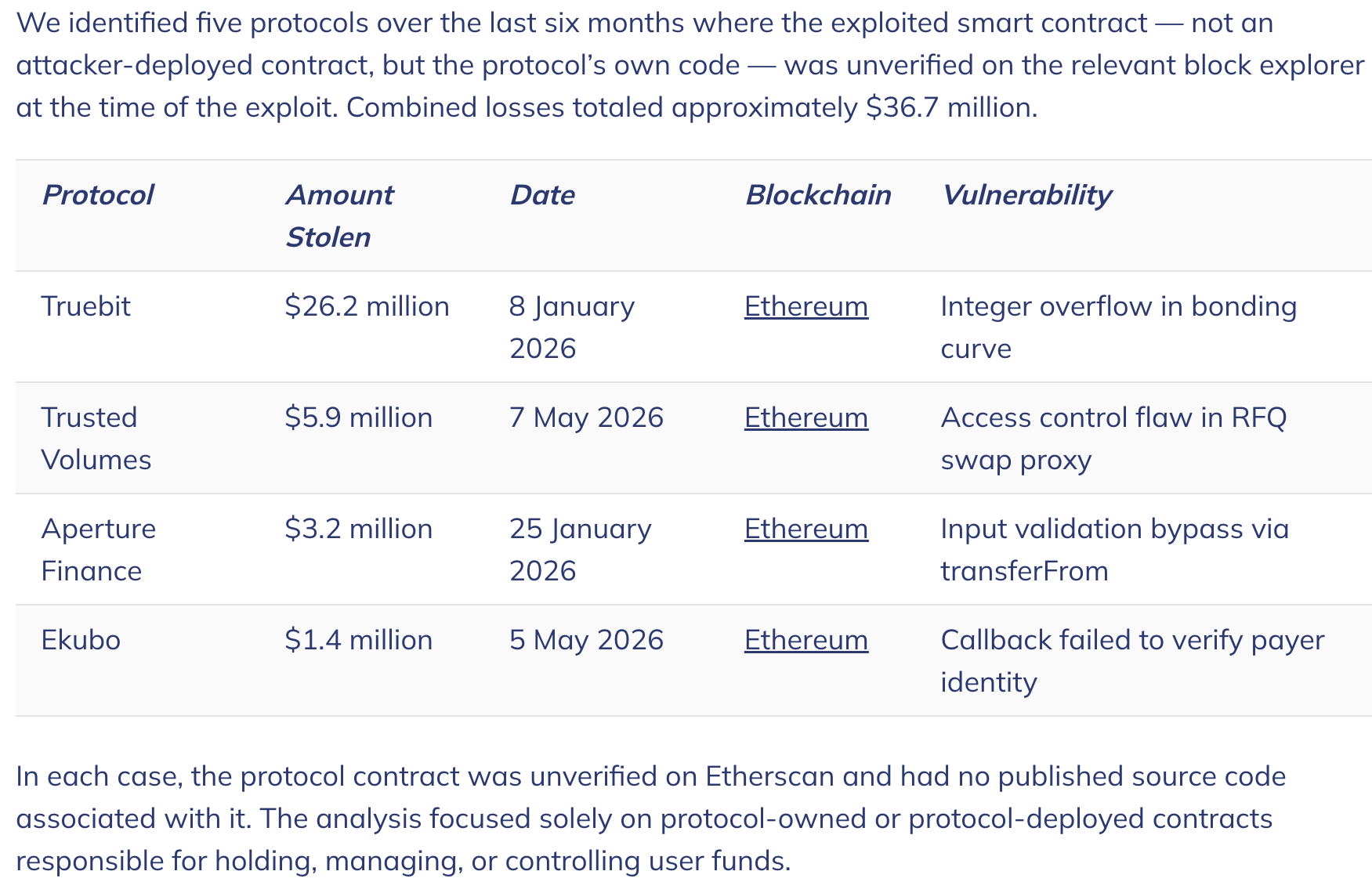
Unverified smart contracts have been linked to at least $36.7 million in losses across four distinct decentralized finance (DeFi) exploits over the past six months, according to a recent report from blockchain intelligence firm Chainalysis. The findings highlight a troubling shift in tactics among malicious actors, who are increasingly focusing their efforts on protocols whose underlying source code is not publicly available on blockchain explorers.
For years, the practice of keeping smart contract code private has been debated within the blockchain community. While some developers viewed it as an added layer of protection against opportunistic copycats and predatory actors, security researchers have consistently warned that obscurity is a poor substitute for rigorous, transparent auditing. The new Chainalysis report suggests that this longstanding assumption in DeFi is rapidly collapsing, largely driven by technological advancements that make hidden code easier to dissect than ever before.
The largest single incident documented in the report involved Truebit, which suffered a staggering $26.2 million loss after an attacker successfully exploited an integer overflow vulnerability. Crucially, the vulnerable contract had remained unverified on the Ethereum blockchain since it was deployed in 2021. Alongside Truebit, the report identified three other protocols that fell victim to similar attacks: Trusted Volumes, Aperture Finance, and Ekubo.
In each of these security breaches, the affected contracts shared a critical common denominator: they were not verified on a blockchain explorer. This lack of verification meant their source code was entirely inaccessible for independent review by security researchers, academic auditors, and white-hat hackers. Furthermore, this lack of transparency typically excluded the protocols from participating in many major bug bounty programs, leaving user funds exposed without the benefit of crowdsourced vulnerability detection.

According to Chainalysis, the rapid evolution and deployment of advanced decompilation tools and artificial intelligence have fundamentally altered the threat landscape. Historically, reverse-engineering unverified smart contract bytecode to discover exploitable flaws required specialized expertise, demanding that a skilled reverse engineer spend days or even weeks meticulously analyzing a single contract. Today, however, AI and automated tooling have streamlined this process, allowing attackers to partially automate the reverse-engineering pipeline across large batches of unverified contracts simultaneously.
This technological leap challenges the core premise of relying on "security through obscurity." Protocols that choose to keep their code hidden are finding that this defensive strategy is losing its effectiveness as automated tools bridge the gap between closed-source opacity and exploit execution. Chainalysis has strongly recommended that DeFi projects return to foundational security best practices, urging developers to prioritize source code verification, expand bug bounty coverage, and implement real-time monitoring tools to detect anomalous contract behavior before catastrophic losses occur.
DeFi Security Concerns Persist After Record April Losses
The sobering findings regarding unverified contracts arrive against a backdrop of broader, escalating security challenges across the entire cryptocurrency sector. The broader ecosystem has faced intense scrutiny following a wave of high-profile security incidents that have shaken investor confidence and forced protocol developers to urgently reevaluate their risk management frameworks.
According to aggregated data from DeFiLlama, malicious actors stole an astonishing $629.7 million through various exploits in April alone. This figure marked the highest monthly total recorded since February 2025, underscoring the relentless ingenuity and financial capacity of cybercriminals targeting decentralized financial infrastructure.
The vast majority of April’s devastation was driven by two monumental breaches. KelpDAO suffered a crippling $293 million exploit, while Drift Protocol was simultaneously hit by a $280 million attack. Combined, these two incidents accounted for more than 80% of all funds stolen during the month, dealing a severe blow to the liquidity and stability of the affected ecosystems.
Although overall financial losses from crypto exploits fell sharply in May—with blockchain security firm CertiK reporting a comparatively modest $68.3 million stolen—the systemic fallout from April’s record-breaking attacks continued to reverberate through the summer. In June, blockchain intelligence platform Arkham revealed that the attacker responsible for the KelpDAO breach had successfully laundered nearly all of the approximately $220 million in unfrozen stolen funds, demonstrating the persistent challenges law enforcement and security teams face in recovering assets once they enter mixing protocols and cross-chain bridges.
The catastrophic scale of the KelpDAO exploit also triggered a widespread industry-wide reaction. Numerous DeFi protocols began urgently reviewing and overhauling their underlying security infrastructure. Among them, projects such as Solv Protocol publicly announced comprehensive strategic shifts, including plans to migrate their operations to Chainlink’s robust cross-chain infrastructure following intensive internal security audits.
These operational adjustments coincide with growing regulatory and technological warnings regarding the malicious application of artificial intelligence. Earlier this month, artificial intelligence company Anthropic revealed that out of 832 accounts it banned for severe policy violations over a one-year period, 560 had utilized AI systems to assist in preparing cyberattacks. These prohibited activities included writing sophisticated malware and identifying critical code vulnerabilities, painting a clear picture of how automated technologies are actively empowering threat actors across both traditional cyberspace and the burgeoning blockchain economy.