
Ripple USD, the stablecoin issued by XRP coin creator Ripple, was originally introduced and marketed to the market as a strictly "enterprise-focused" digital asset. However, despite initial positioning that pointed exclusively toward institutional utility, the stablecoin has steadily gained significant traction among everyday retail users across the broader decentralized finance ecosystem.
Ripple officially rolled out the Ripple USD (RLUSD) stablecoin in late 2024. During the initial launch phase, Ripple CEO Brad Garlinghouse strongly emphasized its institutional focus, carefully distinguishing RLUSD from competing stablecoins that were built primarily to cater to retail traders and consumers. Yet, as time has progressed, the landscape surrounding the asset has shifted noticeably. With increasing adoption of RLUSD by self-custodial wallets such as Xaman, alongside key infrastructure integrations with platforms like Transak, the stablecoin is proving that its real-world utility extends far beyond corporate balance sheets and institutional settlement corridors.
Reflecting on this organic market shift, executives within the XRP Ledger ecosystem have noted the unexpected blending of target audiences. While RLUSD may have initially entered the market under an enterprise-focused narrative—largely due to the inherent technical strengths of the XRP Ledger, such as high transaction speeds, cost-efficiency, and deterministic finality—the ecosystem is witnessing genuine, measurable traction on the retail side of the ledger as well.
Controversy Over RLUSD’s Enterprise Focus
The trajectory of Ripple USD has been a subject of intense discussion and debate within the cryptocurrency community since well before its official release. Initial reports concerning the development of an enterprise stablecoin by Ripple surfaced months ahead of its formal debut in December 2024. As early as October of that year, Ripple CEO Brad Garlinghouse took to social media to publicly characterize the upcoming asset as the definitive "gold standard for enterprise-grade stablecoins," signaling an intention to capture institutional market share rather than compete directly for retail volume.
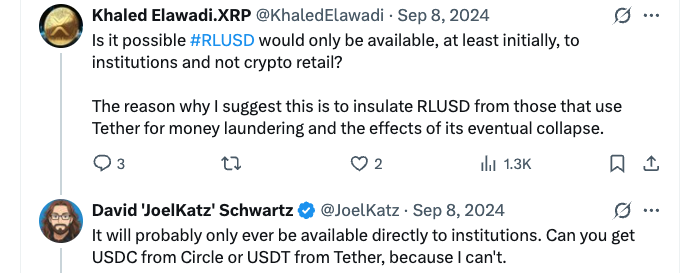
Further fueling the perception of corporate exclusivity, Ripple Chief Technology Officer David Schwartz suggested during public discussions that RLUSD would "probably only ever be available directly to institutions." These remarks sparked widespread debate across the digital asset industry, with many analysts and community members concluding that the stablecoin was intentionally designed to be locked behind corporate compliance barriers, remaining inaccessible to individual retail participants.

When Ripple finally issued its official press release announcing the launch of RLUSD on December 16, 2024, the corporate messaging carefully omitted any explicit mention of retail use cases. Instead, the announcement focused heavily on the stablecoin’s initial day-one availability across major institutional and regulated consumer gateways, including platforms like Uphold, Bitso, and MoonPay, leaving the door open for how the market would ultimately choose to utilize the asset.
RLUSD Competes Directly with Circle’s USDC
Market observers note that despite the initial branding and executive commentary, the fundamental mechanics of the stablecoin have allowed it to break out of its corporate containment. Industry participants point out that while the underlying infrastructure was meticulously engineered to meet stringent institutional compliance and utility demands, the practical application has evolved differently.
The marketing head at Transak noted that while RLUSD was indeed designed with high-grade enterprise utility in mind, its underlying issuance and redemption infrastructure inherently supports both institutional and retail accessibility. Because the mechanics of minting and burning the stablecoin allow for broad integration, the asset has naturally bled into broader financial applications.
Industry analysts suggest that RLUSD currently operates much like any general-purpose stablecoin in the global digital asset economy. In doing so, it has positioned itself as a direct competitor to established market leaders, most notably Circle’s USDC, across every segment of the market. This market evolution highlights a recurring truth in the evolution of financial technology: the initial marketing narrative or the identity of the issuer matters far less than what a financial instrument actually becomes useful for once it enters the open market—a reality that typically only becomes clear long after the initial launch dust has settled.
Most RLUSD Issued on Ethereum, but Holders Prefer XRPL
A fascinating dynamic has emerged regarding the technical distribution and user preference for RLUSD. Industry insiders have pointed out a distinct structural gap between the blockchain network where the vast majority of the stablecoin is minted and the network where the actual human users prefer to hold and transact with it.
According to comprehensive data from RWA.xyz, RLUSD issued on the Ethereum blockchain accounts for an overwhelming 88% of the stablecoin’s current market capitalization, which sits at approximately $557 million. By comparison, less than 12% of the total circulating supply is minted directly on the XRP Ledger.
However, this capital concentration tells only part of the story. When examining actual user distribution, the narrative flips dramatically in favor of Ripple’s native technology. The vast majority of individual RLUSD holders—representing more than 90% of the stablecoin’s total user base of over 34,000 distinct wallets—choose to keep their assets on the XRP Ledger. This leaves only about 10% of the user base interacting with the stablecoin on Ethereum.
Industry representatives attribute this ongoing preference to the foundational positioning of the ledger itself. The XRP Ledger has been marketed and optimized as an enterprise-grade chain since its inception, prized for its raw speed and reliability. Even as retail users increasingly adopt the stablecoin for daily transactions, the foundational identity of the network remains tightly bound to its corporate and institutional strengths. Observers emphasize that the emergence of robust retail participation is viewed as a major success for the ecosystem, one that coexists peacefully with the continued institutional positioning of both the XRP Ledger and RLUSD.
As the stablecoin market continues to mature and regulatory frameworks around digital currencies evolve globally, Ripple has continued to monitor the grassroots expansion of its flagship stablecoin. While the company’s official communications have historically emphasized corporate payments and institutional liquidity management, the organic shift toward self-custody wallets and decentralized retail usage suggests that Ripple USD may ultimately play a dual role in the future of digital finance, bridging the traditional corporate banking sector with everyday peer-to-peer transactions.