
Ripple USD (RLUSD), the stablecoin issued by prominent blockchain enterprise Ripple, was initially rolled out under a strict "enterprise-focused" narrative. However, it has quickly transcended its original corporate positioning to gain substantial traction among everyday retail cryptocurrency users.
Officially introduced to the market in late 2024, Ripple’s stablecoin immediately drew attention from industry observers. Ripple CEO Brad Garlinghouse consistently highlighted its institutional focus during the rollout, positioning RLUSD as a distinct alternative to competing stablecoins that primarily cater to retail consumers.
Despite this deliberate corporate messaging, recent adoption trends tell a different story. The integration of RLUSD into self-custodial wallets like Xaman, alongside major accessibility expansions through on-ramp and off-ramp platforms like Transak, demonstrates that the asset is steadily breaking out of strictly corporate boundaries.
Reflecting on this unexpected shift, the chief operating officer at XRPL Labs and Xaman noted that while RLUSD may have launched with an enterprise-focused narrative—largely due to the intrinsic strengths of the XRP Ledger (XRPL) such as speed, cost-efficiency, and transaction finality—the market is undeniably witnessing real, organic traction on the retail side.
Controversy Over RLUSD’s Enterprise Focus
The journey of RLUSD began well before its official winter launch. Initial reports concerning the stablecoin surfaced in late 2024, prompting widespread speculation across the digital asset ecosystem. In October, Ripple CEO Brad Garlinghouse publicly championed the asset, referring to it as the "gold standard for enterprise-grade stablecoins."

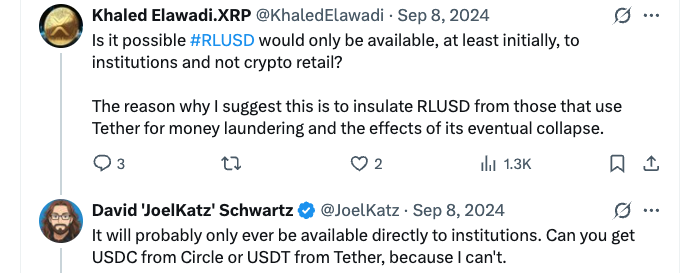
The corporate exclusivity narrative was further amplified by Ripple Chief Technology Officer David Schwartz. In statements made during the developmental and pre-launch phases, Schwartz suggested that RLUSD would "probably only ever be available directly to institutions." These remarks sparked intensive debate within the crypto community regarding whether Ripple intended to gatekeep the asset, keeping it entirely out of the hands of everyday retail investors.
When Ripple finally formalized the launch of RLUSD on Dec. 16, 2024, the official corporate communications noticeably omitted any direct mentions of retail use cases. Instead, the announcement focused heavily on its initial availability across major compliant platforms designed to handle institutional and high-volume liquidity, including Uphold, Bitso, and MoonPay.
RLUSD Is a Direct Competitor to Circle’s USDC
Despite the corporate-centric rhetoric surrounding its debut, market realities have proven far more expansive. Last week, Harshit Gangwar, the head of marketing at Transak, weighed in on the asset’s dual nature, explaining that while RLUSD was indeed engineered with enterprise-grade utility in mind, the underlying infrastructure supporting its issuance and redemption naturally accommodates both institutional and retail accessibility.
Echoing this sentiment, Huma Finance co-founder Erbil Karaman pointed out that RLUSD currently functions operationally just like any other general-purpose stablecoin. Consequently, it has positioned itself as a direct competitor to established stablecoins across all market segments, most notably Circle’s USDC.
Karaman emphasized that this market evolution underscores a fundamental truth about the digital asset sector: what ultimately matters is not who issues a stablecoin or how it is initially marketed, but rather what it actually becomes useful for in practice—a reality that only becomes entirely clear after the product faces real-world adoption.
Most RLUSD Is Issued on Ethereum, but Holders Prefer XRPL
A fascinating dynamic has emerged regarding the distribution and user preferences surrounding RLUSD. Addressing how the stablecoin is utilized across different blockchain ecosystems, Kiuru of XRPL Labs pointed out a striking structural gap between the volume of RLUSD issued on Ethereum and the actual number of users who prefer the native XRP Ledger (XRPL).
According to data compiled by RWA.xyz, the vast majority of RLUSD—accounting for approximately 88% of the stablecoin’s current $557 million market capitalization—has been issued on Ethereum. By comparison, less than 12% of the total circulating supply originates directly from the XRP Ledger.
However, user demographics invert this narrative entirely. The overwhelming majority of RLUSD holders—representing more than 90% of the total 34,160 active users—reside on the XRPL. This leaves only about 10% of the asset’s total user base interacting with the Ethereum-issued versions, according to data cited from a June social media post by prominent community member Vet.
Kiuru attributes this ongoing preference to the historical perception and technical architecture of the network. He noted that Ripple continues to promote the ecosystem largely through an enterprise lens, which is a natural consequence of the XRPL being positioned as an enterprise-grade chain since its inception, prized for its high throughput and rapid finality. At the same time, Kiuru views the expanding retail adoption as a major win for the network, noting that the robust positioning of the XRPL and RLUSD in the enterprise sector is not being compromised by everyday user participation.
Cointelegraph reached out to Ripple for official commentary regarding the accelerating retail adoption of RLUSD, but had not received a response by the time of publication.