
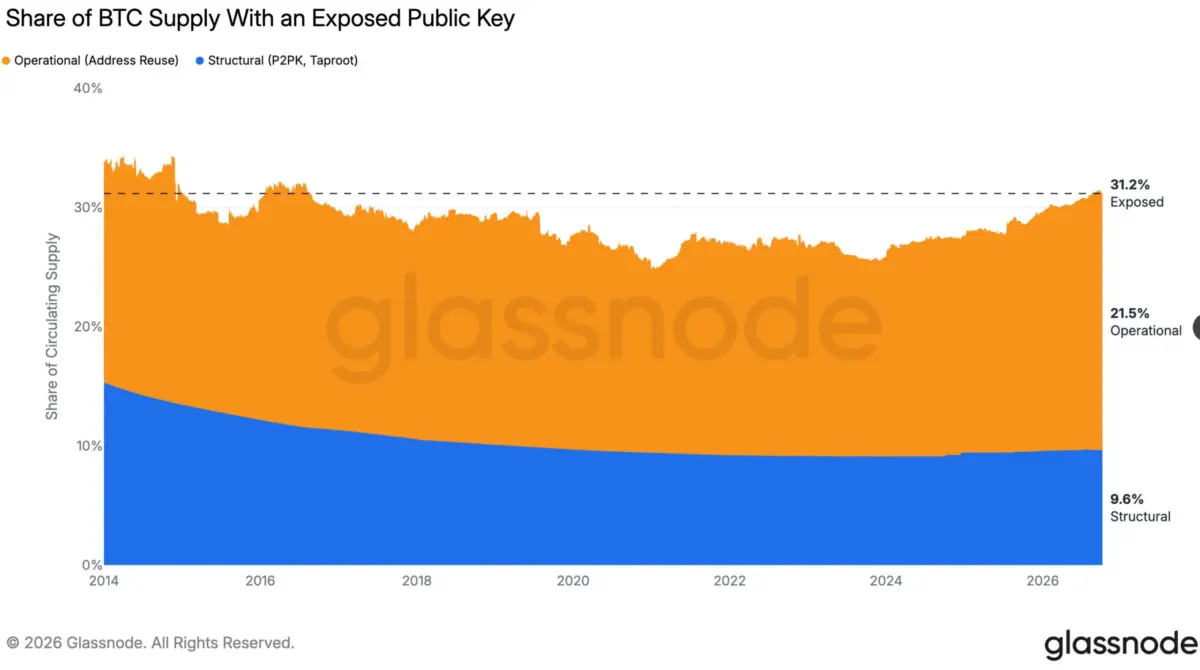
More than 6 million Bitcoin now sit behind public keys already visible on-chain, underscoring the expanding scale of digital assets potentially vulnerable to future technological breakthroughs in artificial intelligence and quantum computing.
According to latest figures shared by Glassnode co-founder Rafael Schultze-Kraft, the volume of circulating Bitcoin tied to exposed public keys has risen significantly, renewing urgent industry debates regarding long-term cryptographic security. At current market valuations, with Bitcoin trading at $82,487.18, these exposed holdings represent a massive portion of the broader digital asset economy.
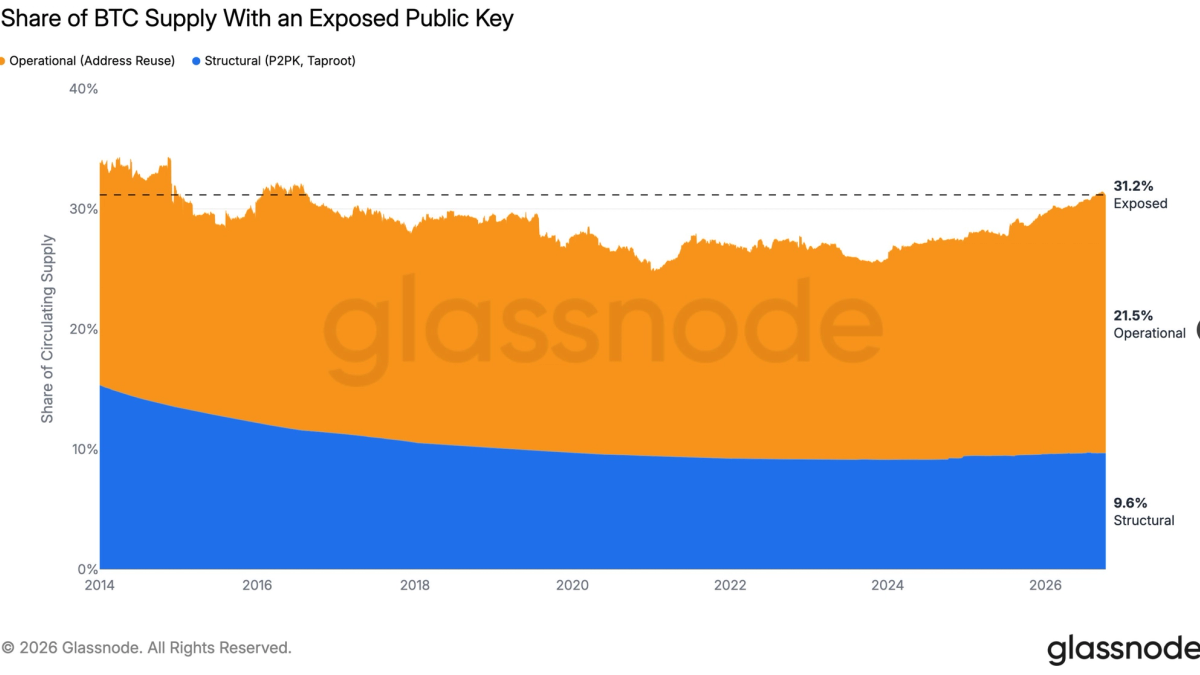
The data indicates that coins tied to visible public keys now account for 31.2% of the total circulating supply. This figure marks an increase of roughly 5 to 6 percentage points above the cyclical low point reached in 2023. Schultze-Kraft highlighted that the exposed supply has grown by 222,000 BTC—valued at approximately $18.2 billion—since the analytics firm published its comprehensive report on the matter in May. During that same timeframe, the total supply of newly minted Bitcoin grew by a mere 64,000 BTC, meaning the growth rate of exposed keys vastly outpaced overall network emission.
A major driver of this recent accumulation is institutional and exchange-level activity. Centralized cryptocurrency exchanges accounted for 123,000 BTC of that increase, bringing their cumulative holdings behind visible public keys to a staggering 1.79 million BTC. However, the degree of exposure varies drastically across individual platforms and custodians, reflecting diverse operational architectures and internal wallet management practices.
Among major trading platforms, Coinbase maintains a relatively conservative profile, with its exposed share standing at just 10%. In sharp contrast, Binance reports an exposed share of 83% across the balances it manages on behalf of users. Other prominent institutional custodians and financial platforms exhibit an even wider spectrum of exposure. Asset management giant Fidelity holds approximately 375,000 BTC, with a remarkably low exposure rate of only 2%. Grayscale’s share sits at a moderate 49%, while retail-focused platforms show near-total exposure, with Revolut registering 99% and Robinhood reaching 100%. Meanwhile, sovereign holdings belonging to the governments of the United States, the United Kingdom, and El Salvador show zero exposure under Glassnode’s analytical methodology.
Public keys can become exposed on the Bitcoin blockchain through several mechanisms. The most common is address reuse, where a user transacts multiple times from the same receiving address. Additionally, public keys appear directly in specific legacy and modern output types, including early pay-to-public-key scripts and modern Taproot implementations. Under standard operational conditions, these keys are protected by the underlying cryptographic hash functions until a transaction is signed and broadcast. However, theoretical threats suggest that if a sufficiently advanced quantum computer were developed, or if a mathematical breakthrough occurred, an attacker could potentially reverse-engineer the elliptic curve cryptography to derive the corresponding private keys directly from the exposed public keys.
This structural vulnerability has taken on renewed urgency following recent warnings from prominent figures within the broader blockchain ecosystem. Ethereum researcher Justin Drake recently urged the cryptocurrency industry to prepare for a defensive posture he termed "bunker mode." Drake cautioned that the rapid evolution of artificial intelligence introduces an unpredictable vector to cryptographic security. In a worst-case scenario, he argued, advanced machine learning models could potentially discover mathematical shortcuts capable of breaking wallet cryptography in a matter of months rather than years, potentially accelerating threat timelines long before large-scale quantum computers become commercially viable.
As the cryptocurrency market continues to mature and institutional participation deepens, the growing concentration of exposed public-key capital highlights ongoing challenges for network security. While developers continually research and discuss potential post-quantum cryptographic upgrades for Bitcoin, the immediate figures from Glassnode demonstrate that address hygiene and wallet architecture remain critical considerations for custodians, exchanges, and individual holders alike.