The cybersecurity landscape is facing an escalating threat as new intelligence reveals the true scale and longevity of the "PolinRider" campaign, a sophisticated state-sponsored operation linked to North Korean threat actors. Security researchers have uncovered that this malicious activity may have originated as far back as February 2025, utilizing innovative blockchain-based command-and-control mechanisms, compromised developer accounts, and stealthy supply chain worms to infiltrate corporate cloud environments and developer workstations globally.
Recent findings published by software supply chain security firms SafeDep, Apiiro, and OpenSourceMalware highlight how the PolinRider campaign has evolved. Initially spotted planting Python loaders deep within public GitHub repositories, the operation has systematically leveraged stolen credentials to rewrite legitimate commits made by developers, embedding malicious code while preserving original author signatures, timestamps, and commit messages.

According to comprehensive telemetry from Apiiro, the PolinRider loader has been detected in at least 7,609 GitHub repositories owned by 2,330 distinct accounts, primarily impacting software developers. High-profile victims of these automated supply chain incursions include open-source projects and platforms such as Neutralinojs, InstaWP Connect, and fxhash. A particularly aggressive surge occurred between late October and early November of 2026, during which the loader was forcefully pushed to more than 2,000 repositories in a matter of days.
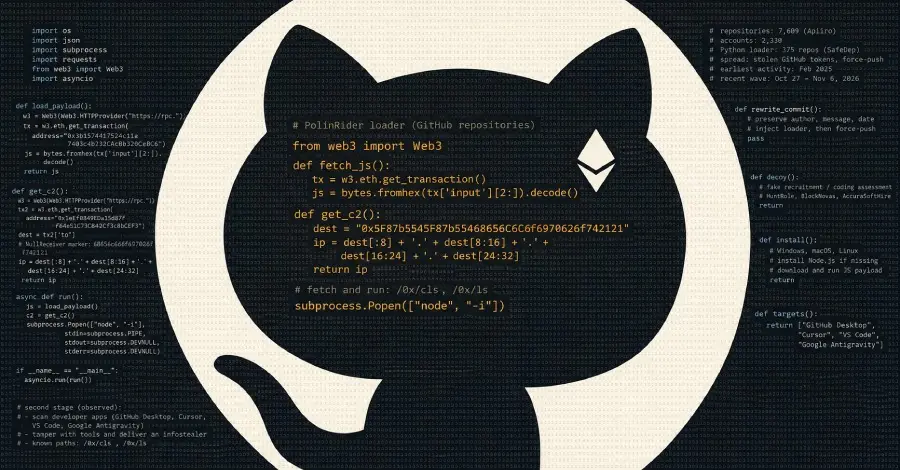
The mechanics of the PolinRider loader showcase an advanced level of technical sophistication designed to evade traditional security controls and network monitoring. Security researchers at SafeDep detailed how a compact 58-line Python loader typically hides inside small utility packages or configuration files like conftest.py. When the Python environment imports the file, the loader executes a query against a specific Ethereum wallet address controlled by the threat actors.
Rather than relying on a static, easily sinkholed command-and-control server, the loader reads the most recent transaction sent by the Ethereum wallet to itself. It decodes the input data of that blockchain transaction as JavaScript and executes it dynamically using Node.js. This decentralized architecture means that taking down a traditional web server does not disrupt the campaign; a single blockchain transaction can instantly redirect every active loader to a new infrastructure endpoint.

The executed JavaScript code then queries a secondary cryptocurrency wallet to locate the active command-and-control server, subsequently passing the next stage of the payload into a detached interactive Node.js environment via a standard node -i process. SafeDep identified this specific tactic, known as NullReceiver, by spotting a distinctive marker within the fabricated destination wallet addresses that consistently translates to the ASCII string "helloipbot!!" on the blockchain.
Once the initial loader establishes a foothold on a victim’s machine, it reaches out to retrieve an encrypted second-stage Node.js payload. This secondary payload is engineered to scan the infected host for widely used developer applications and Integrated Development Environments, including GitHub Desktop, Cursor, VS Code, and Google Antigravity. The malware actively tampers with these frequently used tools to ensure persistent execution of attacker-controlled code and to deploy information-stealing software capable of harvesting environment secrets, browser passwords, cookies, and local cryptocurrency wallet data.
Industry analysts emphasize that PolinRider operates as a specialized sub-cluster running in parallel with the long-running, social-engineering-focused campaign known as Contagious Interview. While Contagious Interview typically relies on deceptive job interviews and fake technical assessments to trick developers into compromising their own systems, PolinRider capitalizes on that initial access to automatically propagate through code repositories, transforming legitimate open-source projects into unwitting distribution vectors for state-sponsored malware.

Palo Alto Networks Unit 42 noted in previous threat intelligence reports that while ordinary cybercriminal groups deploy supply chain worms primarily for opportunistic financial theft, North Korean state-sponsored threat actors increasingly use open-source software registries and source code repositories as primary initial access vectors to infiltrate corporate enterprise and cloud environments. By compromising a single maintainer account or registry scope, these threat actors can convert trusted dependencies into automated distribution networks, affecting downstream users on a massive scale.
Further investigation into the historical timeline of the campaign by OpenSourceMalware revealed that the roots of PolinRider extend significantly deeper than previously understood. Researchers discovered a targeted attack from May 2025 that predates the earliest previously documented victims by eight months. That historical campaign compromised nine software packages within a span of ninety minutes by hijacking legitimate maintainer accounts to push poisoned updates.
These early samples utilized a precursor technique known as EtherHiding to fetch a JavaScript downloader called JADESNOW. That downloader subsequently delivered InvisibleFerret—a Python-based backdoor frequently associated with Contagious Interview campaigns—alongside a Socket.IO remote access trojan and a Python credential stealer. Security analysts Paul McCarty and Jenn Gile pointed out that the infection likely persisted on the original maintainer’s machine across a span of many months, given that subsequent push activities in 2026 originated from the same compromised local environment using the developer’s verified credentials.

Security experts note that the worm-like propagation scripts used by PolinRider effectively roll back system clocks, fold malicious payloads into the tip of recent commits, and execute force-pushes using authentic developer credentials. Because the infection process can trigger simply by opening a compromised project directory within modern development tools like VS Code or by running a standard build script, mitigating the threat requires rigorous repository auditing, stringent access control management, multi-factor authentication enforcement, and continuous monitoring of software supply chain dependencies.