
Decentralized finance (DeFi) protocols could soon gain a powerful new line of defense against exploits, hacks, and systemic errors under a newly announced security mechanism developed by Phylax Systems. The system is designed to stop malicious transactions before they ever settle on the blockchain, potentially thwarting devastating exploits orchestrated by advanced hackers, including state-sponsored entities like North Korean cyberattackers and United States-sanctioned actors.
However, the technology has also sparked intense debate across the Ethereum community. While the tool offers a promising shield against multi-million-dollar drains, critics and industry experts warn that it could inadvertently introduce smart contract freezing risks and exacerbate centralization pressures within Ethereum’s block-building market. As the debate over digital asset security versus decentralization intensifies, security researchers, legal experts, and protocol developers are weighing whether the risks posed by such a system are acceptable in pursuit of a safer blockchain ecosystem.
A Security Mechanism with a Potential Freeze Risk
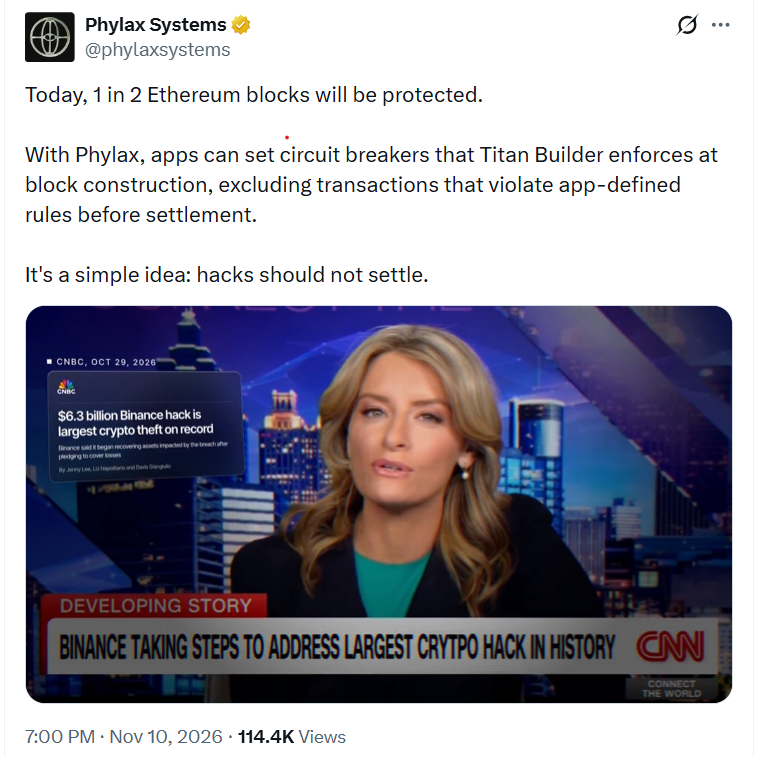
Announced on Nov. 10, the new system is the result of an integration between Phylax and Titan Builder, a prominent block builder that Phylax states currently produces roughly one out of every two Ethereum blocks. The collaboration allows decentralized applications to define specific rules that automatically exclude transactions which could produce harmful outcomes during the block construction process. Rather than relying on reactive monitoring systems or emergency governance interventions after an attack has already been initiated, Titan checks incoming transactions against these pre-defined application rules before including them in its blocks.
The core mission behind the initiative, according to Phylax’s public statements, is simple: to stop users from losing money to hacks, exploits, and human or smart contract errors within the DeFi landscape. In a blog post explaining the technology, Phylax outlined a hypothetical scenario involving a vulnerable lending or liquidity vault that might mistakenly release $1 million to a user whose deposited shares are only valued at $1,000. With the circuit breaker system operational, a pre-configured rule could cap the amount of funds leaving the vault in a single transaction, effectively preventing the liquidity pool from being completely drained.
Proponents of the technology argue that similar safeguards could have limited the catastrophic losses seen in recent high-profile crypto exploits. Industry analysts have pointed to massive security breaches, such as the $6.3 billion Binance hack and the $380 million Bitget exploit, where malicious actors successfully drained exchange wallets and subsequently moved staggering amounts of digital assets through decentralized protocols to obfuscate their funds.

Despite the obvious appeal of stopping hacks before they settle, the system has encountered immediate pushback regarding its architectural implications. Digital assets lawyer Gabriel Shapiro warned in public commentary that applications utilizing the Phylax system could become effectively freezable if block builders stopped providing the required security attestations. According to Shapiro, smart contracts can be configured to reject transactions unless they are officially included in blocks from builders that have performed the necessary checks. If those builders were to halt their attestations, protected protocol functions could continuously reject legitimate user transactions until the builder services resumed.
Addressing these concerns, Phylax founder and chief executive Odysseas Lamtzidis explained that protocols can mitigate this risk by designing their systems to allow transactions to pass through even when the security checks are temporarily unavailable. He noted that the default behavior provided and recommended to protocols is a "fail-open" approach. Nevertheless, Lamtzidis acknowledged that this safeguard remains optional, leaving individual projects to decide whether they wish to prioritize network availability or strict security. He added that protocols retain full autonomy over whether their smart contracts are completely immutable or subject to modification via governance mechanisms.
In response, Shapiro argued that fail-open protections should be made mandatory by default, and any subsequent changes to these security safeguards should be subjected to mandatory time delays to prevent protocols from removing them hastily during a crisis.
Ethereum’s Builder Concentration Problem
Beyond the immediate operational risks of circuit breakers, the system has also brought renewed attention to the broader structural health of the Ethereum network, specifically concerning the heavy concentration of power within its block-building market.
Ethereum researcher Fan Zhang noted that while Phylax’s technology introduces compelling security benefits—particularly in an era where artificial intelligence bots are capable of identifying and exploiting code vulnerabilities faster than ever before—its practical implementation relies heavily on the existing centralization of block builders. Zhang stated that the technology has only become viable because of how concentrated Ethereum’s builder market has already grown.
At the same time, Zhang cautioned that introducing complex new code at such a critical juncture in the transaction processing pipeline introduces novel failure modes, including potential implementation bugs, as well as the risk of builder signing-key theft, loss, or impersonation. He expressed concern that efforts to enhance application-level security might inadvertently conflict with ongoing community initiatives aimed at decentralizing block builders.
Echoing these apprehensions, Ethereum researcher Sen Yang warned that if major protocols begin relying heavily on a small, select group of builders for security enforcement, it could grant those dominant builders an unfair competitive advantage. This dynamic, Yang suggested, could further exacerbate market concentration woes on the network. While Yang noted that Ethereum’s proposed enshrined proposer-builder separation (ePBS) upgrade—slated for inclusion in the upcoming Glamsterdam network upgrade—may reduce reliance on third-party relays, he emphasized that it does not directly resolve the underlying concentration of the builder market itself. However, he also pointed out that transactions excluded by a dominant builder could theoretically still be included by non-censoring builders, resulting in temporary transaction delays rather than permanent exclusion.
Where Does Security Become Censorship?
A central point of discussion surrounding the Phylax system is the fine line separating proactive security measures from involuntary censorship. Phylax maintains that its technology does not introduce a new governing authority over Ethereum transactions because the rules are defined entirely by the applications themselves. Lamtzidis emphasized that the technology is explicitly opt-in, comparing the automated checks to conditional statements already native to smart contracts, such as a traditional programming require statement. He argued that true censorship implies arbitrary decision-making or external coercion, neither of which applies to a developer-chosen protocol constraint.
Fan Zhang drew a similar distinction between applications voluntarily choosing to filter transactions and external entities forcing censorship onto unwilling participants. He noted that as long as applications willingly sign up for filtering, users retain the freedom to walk away and use alternative platforms, whereas externally forced censorship remains a clear violation of blockchain ethos.
Stefanie Boss, co-author of academic research focusing on censorship resistance and compliance behavior within Ethereum’s consensus mechanism, offered a pragmatic perspective on the risks. She noted that security rules targeting the harmful outcome of a transaction are generally viewed as less risky than rules targeting the identity of the person initiating the transaction. While acknowledging that the primary goal of making the network safer aligns with application values, Boss emphasized that rules could theoretically be repurposed to enforce sanctions or politically motivated exclusions. She concluded that while the immediate objective of preventing multi-billion-dollar hacks carries a much higher value than the harm caused by this type of transactional exclusion, robust safeguards must remain in place to ensure that these rules stay fair, transparent, and strictly dedicated to security.