
Lido’s decentralized autonomous organization is weighing a significant strategic move to counter what it describes as a severe market disconnect. The DAO is currently considering a one-off $20 million buyback of its governance token, an initiative designed to address a price dislocation that community members and contributors call “historically depressed” relative to Ether.
The proposal, which was officially submitted on Friday, seeks formal permission from the community to swap 10,000 Lido Staked Ether tokens, known as stETH, directly from the DAO’s treasury. At current market valuations, these assets are worth approximately $20 million. The target of the swap is the Lido DAO governance token, commonly traded under the ticker LDO. Proponents of the measure argue that the governance token is currently heavily undervalued by the open market, creating a rare window for the protocol to acquire its own native assets at a steep discount.
In the official governance proposal, contributors emphasized the severity of the current pricing dynamic. They noted that the situation goes far beyond standard market noise or cyclical volatility, describing it as a fundamental anomaly. According to the submission, this represents one of the most significant dislocations between LDO’s active market price and the underlying operational fundamentals of the protocol in the entire history of the token.
A token buyback program of this magnitude carries the potential to meaningfully influence the price action of LDO, which has suffered a dramatic downturn over the past few years. From its all-time high valuation, the token has fallen roughly 96%. The current discussion follows earlier attempts by community members to address the persistent downward pressure on the asset. Back in November, a Lido DAO participant pitched the idea of implementing an automated buyback mechanism designed to continuously support the token’s price stability. However, that particular automated proposal was never formally implemented or integrated into the protocol’s architecture, leaving the DAO to now consider this new, one-off strategic intervention.

Data from research shared within the governance forum illustrates the depth of the valuation gap. LDO is currently trading at a remarkably low discount relative to Ether, holding a ratio of roughly 0.00016 ETH per token. This metric places the governance token approximately 63% below its median ratio over the preceding two-year period.
This relative weakness persists even though Lido continues to maintain its position at the absolute forefront of the Ethereum liquid staking market. According to recent data compiled by Dune Analytics, the protocol commands a dominant 23.2% share of all staked Ether in the broader ecosystem. Lido’s overwhelming market dominance has been a frequent talking point across the decentralized finance sector, having previously been scrutinized by analysts and community members as a potential centralization risk to the security and decentralization of the underlying Ethereum network.
Market data from CoinGecko indicates that LDO is changing hands at around $0.30, marking a steep 95.9% decline from its peak of $7.30, which was established back in August 2021. With a circulating market capitalization of approximately $255 million, LDO currently ranks as the 141st largest cryptocurrency asset by total market value.
Defending the necessity of the treasury allocation, Lido DAO stated that the observed price dislocation is entirely unjustified by any proportional deterioration in the actual operational performance or output of the protocol.
Lido DAO Proposes Buying stETH in Batches
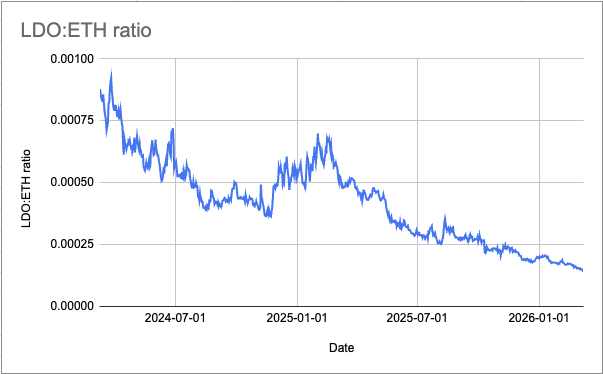
To execute the ambitious strategy without causing unnecessary disruption or slippage in the open market, the DAO has structured the proposed buyback into smaller, manageable tranches. Rather than executing a single, massive market order that could trigger artificial volatility, the plan outlines purchasing up to 10,000 stETH worth of LDO in individual batches of 1,000 stETH.
To ensure optimal execution and protect treasury assets, Lido DAO plans to utilize limit orders or implement a disciplined dollar-cost averaging strategy. This methodical approach is intended to shield the process from acute market volatility. Furthermore, the proposal includes built-in safeguards: each individual batch transaction would require explicit community approval and could be halted or paused by tokenholders at any point if market conditions shift unfavorably. Following the execution of each batch, detailed results and performance metrics would need to be formally reported back to the community before any subsequent tranches could move forward.
The timing of this treasury maneuver coincides with a broader financial report indicating a contraction in protocol revenues. Lido’s revenue fell by 23% to reach $40.5 million over the course of 2025. This contraction was primarily driven by a 23% drop in staking fee generation, which totaled $37.4 million for the year.
Despite the reduction in top-line revenue, Lido DAO argued that the protocol’s underlying fundamentals remain exceptionally robust. In financial summaries provided to the community, members noted that overall reward distributions declined by just 20% amid a broader, macro-driven market pullback across the digital asset sector. Additionally, operational costs improved by 13% in 2025 compared to the previous year, demonstrating enhanced operational efficiency.
Furthermore, Lido’s take rate—defined as the specific percentage of staked Ethereum rewards that the protocol retains as operational fees—actually increased from 5% to over 6.1%, signaling an improved capacity for fee capture despite a challenging external market environment. As the DAO moves forward with the governance discussion, tokenholders will ultimately decide whether deploying treasury capital into a major LDO buyback is the right course of action to close the widening gap between token valuation and protocol performance.