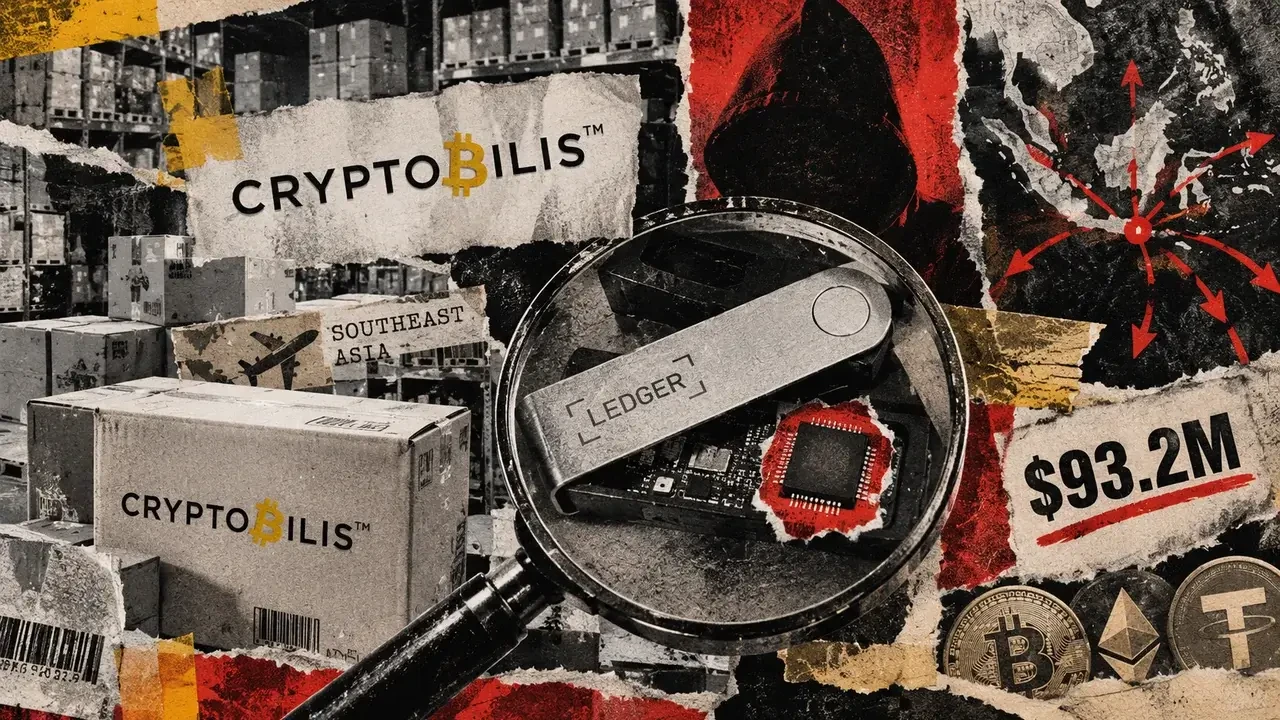
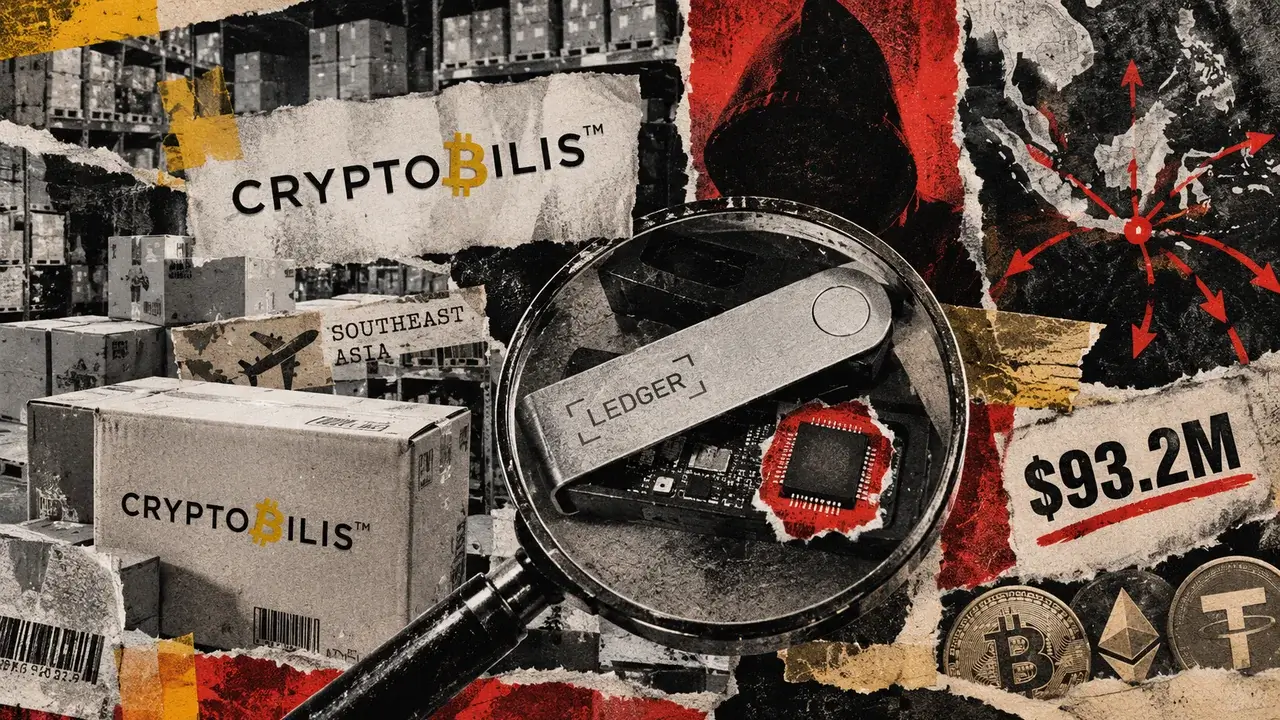
Popular hardware wallet manufacturer Ledger has officially confirmed that an unauthorized physical hardware implant was discovered inside a customer’s compromised device. The confirmation arrives as independent blockchain investigators and security researchers estimate that total suspected cryptocurrency thefts tied to the supply-chain breach have climbed to approximately $93.2 million.
In a public statement issued on Oct. 10, the hardware wallet manufacturer acknowledged that the troubling discovery directly involved a device belonging to one of the affected users. As the situation continues to unfold, Ledger noted that CryptoBilis, an authorized reseller operating within Southeast Asia, has proactively suspended all sales and distribution of its hardware wallet inventory while a comprehensive investigation remains underway.
The security incident initially came to light after a wave of customers reported unexpected cryptocurrency losses following the purchase of Ledger hardware devices through the regional reseller. Although the company has confirmed the presence of a malicious modification in at least one examined unit, Ledger has not yet disclosed the exact number of devices that may have been tampered with, nor has it formally established that the hardware implant was solely responsible for every single reported loss across the user base.
At the same time, the manufacturer emphasized that its core corporate security infrastructure, backend systems, and operational services have remained completely uncompromised throughout the ordeal, pointing instead to a localized supply-chain intervention targeting third-party retail channels.
Why an Implanted Wallet Can Pass Ledger’s Genuine Check
As the investigation expands, security experts have sought to understand how a physically modified hardware wallet could successfully bypass Ledger’s built-in validation mechanisms, such as the widely trusted Genuine Check feature.
Former Mt. Gox chief executive Mark Karpelès has been actively examining suspicious Ledger Nano X devices through Tibane Labs. The research firm has thoroughly documented an evolving series of hardware implants specifically engineered to intercept critical recovery phrases. The lab’s comprehensive report merges hardware analysis from earlier teardowns with two distinct specimen units that Tibane personally examined during the month of September.
According to the findings published by Tibane Labs, the malicious implants function by intercepting and monitoring the electronic data signals traveling internally between a wallet’s secure element chip and its visual display screen.
During the initial setup phase of any genuine Ledger device, the hardware generates a unique 24-word recovery phrase that allows the device owner to restore access to their digital asset holdings. Even though these sensitive words originate safely inside the hardware’s dedicated secure chip, they must inevitably pass through the device’s display circuitry to be rendered legibly on the screen for the user to write down.
Tibane Labs discovered that the modified hardware units contained unauthorized, additional microcontrollers cleverly integrated into the internal architecture. These hidden components were capable of reading the screen’s data stream in real time, successfully reconstructing the user’s secret recovery words, and then transmitting that sensitive credentials data externally via built-in cellular modems equipped with active SIM components.
Consequently, malicious actors were able to obtain the exact cryptographic credentials required to remotely reconstruct and empty a victim’s cryptocurrency wallet from afar, entirely bypassing the need to steal the physical device or compromise the cryptographic integrity of Ledger’s genuine secure chip.
Earlier iterations of these tampered devices utilized visibly altered wiring and smaller replacement batteries to create physical room inside the casing for the extra surveillance electronics. However, a far more advanced version examined by researchers in September featured a custom-engineered circuit board cleverly concealed directly beneath the screen. This sophisticated variant included a miniature LTE modem, a hidden antenna, and internal components whose identifying markings had been deliberately sanded off or removed.
Crucially, this newer version preserved the original factory battery and maintained a completely normal outward appearance, allowing it to easily pass visual inspection even after the outer casing was opened by an unsuspecting user.
Ledger’s official security documentation explicitly notes that the software-based Genuine Check feature is strictly designed to verify the cryptographic authenticity of the hardware’s secure element chip. The system is inherently incapable of detecting unauthorized physical modifications, such as covert spying implants, as long as the underlying secure element itself remains physically intact and responds correctly to cryptographic challenges.
It is worth noting that the two specific specimens analyzed by Tibane Labs were acquired independently through Japanese online marketplaces rather than directly from the implicated CryptoBilis storefront. Consequently, the research report does not definitively establish the exact hardware design utilized in the reseller-linked thefts, and Ledger has not yet publicly detailed the exact specifications of the implant found in the customer device it examined.
In light of these findings, Tibane Labs issued a stark warning to the crypto community: any recovery phrase that has ever been displayed on a compromised or untrusted device must be treated as permanently exposed. Simply replacing the compromised hardware while continuing to reuse the same recovery phrase would leave a victim vulnerable, as attackers would retain full access to the wallet. To remain safe, affected users must transfer their funds entirely to a newly initialized wallet featuring a completely fresh recovery phrase generated on a trusted, verified device.
Investigators Publish Separate Loss Estimates Above $90 Million
While security researchers dissect the hardware implications of the breach, financial and blockchain forensics firms have been tracking the staggering financial toll of the coordinated asset drains.
Galaxy Digital research executive Alex Thorn reported on Oct. 9 that cumulative losses had reached approximately $91 million, distributed across 477 distinct blockchain addresses spanning Bitcoin, Ethereum-related networks, and the Tron blockchain.
Thorn’s detailed analysis attributed the vast majority of the suspected thefts—approximately $64.5 million—to the Tron network, driven heavily by the drainage of roughly 64.3 million Tether tokens. Meanwhile, Bitcoin holdings accounted for another $17.7 million in losses, equivalent to roughly 213 BTC, while Ethereum and its associated layer networks contributed an additional $8.8 million to the total tally.
A separate, independent investigation conducted by blockchain analytics firm Bitquery, which received an updated assessment on Oct. 11, placed the figure even higher, tracking approximately $93.2 million in suspected thefts originating from 315 distinct wallets spread across six different blockchains. Because these prominent investigative firms utilized different sets of target addresses and distinct tracking methodologies, their aggregate totals vary slightly, and neither estimate attempts to calculate the exact number of physically tampered devices currently circulating in the wild.
Bitquery’s analytical deep dive also uncovered specific transaction patterns that strongly indicate the attackers had quietly gained unauthorized control over a multitude of individual wallets long before executing a synchronized, large-scale withdrawal operation on Oct. 9.
According to the firm’s blockchain telemetry, a striking cluster of 25 distinct Tron wallets signed the exact same token spending approval within a tight three-second window. This coordinated maneuver allowed the bad actors to sweep approximately $29 million worth of USDT within mere moments.
Furthermore, Bitquery identified a series of small, seemingly innocuous test transactions conducted across a roughly two-week period leading up to the major thefts. This preparatory activity indicates that the perpetrators meticulously tested their infrastructure well before the victims ever realized their funds were missing.
In its Oct. 11 status update, Bitquery reported that centralized stablecoin issuer Tether had successfully frozen approximately $10 million worth of the stolen USDT. Additionally, the analytics firm identified $5.35 million in stolen USDC that could potentially be frozen by issuer Circle, following on-chain movements that saw funds routed through privacy-enhancing protocols like Tornado Cash and the privacy-centric cryptocurrency Zcash.
Commenting on the broader industry implications, CryptoQuant analyst Darkfost suggested that security professionals should maintain vigilance by examining other regional hardware resellers for potential supply-chain exposure, while openly acknowledging that such widespread concerns remained speculative and were not yet supported by confirmed evidence.
In response to the mounting crisis, Ledger reiterated that it is actively communicating with affected users, cooperating closely with law enforcement authorities, and aggressively developing enhanced anti-tampering protections for its hardware ecosystem.
The company has strongly advised any customers who recently purchased hardware wallets from CryptoBilis to refrain from initializing or using those devices. Furthermore, users who have already completed the setup process on potentially vulnerable units are urged to immediately secure their capital by transferring all digital assets to a trusted device utilizing a freshly generated recovery phrase.