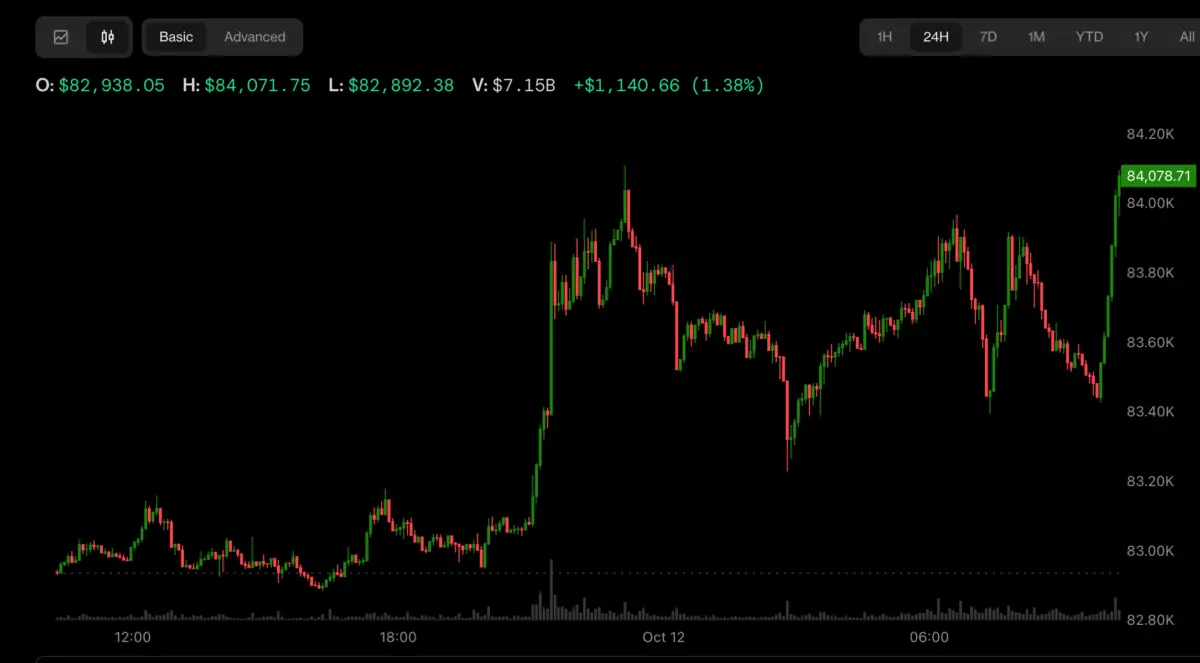
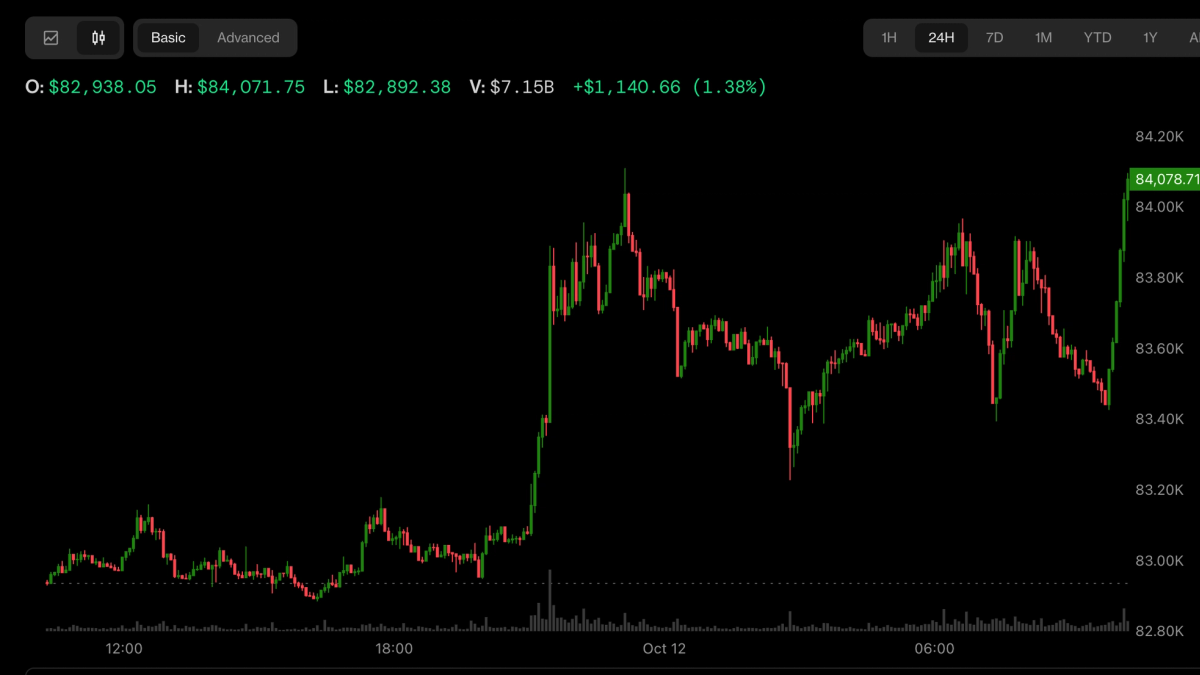
Bitcoin is holding firmly onto its weekend gains, reclaiming territory above the $84,000 threshold and managing to shrug off a wave of substantial exchange-traded fund outflows recorded over the previous week. The leading cryptocurrency by market capitalization managed to find its footing following a brief dip early Monday morning, demonstrating resilience amid shifting macroeconomic currents and easing energy markets.
As of early Monday, Bitcoin was trading near $84,050 according to market data, recovering from an intraday low of around $83,500. The movement brings the asset close to its strong Sunday peak of approximately $84,145. This stabilization has provided a welcome sense of relief to market participants who closely monitor the interplay between digital assets, traditional commodities, and institutional investment vehicles.
Beyond Bitcoin, the broader digital asset market displayed signs of a healthy and broadening recovery. Major alternative cryptocurrencies, including ether and XRP, experienced notable buying interest, pointing toward an expanding base of investor participation across the wider crypto ecosystem rather than a narrow concentration of capital. Market analysts observed that the positive sentiment was shared across a vast majority of the top digital assets over a 24-hour window.
Industry experts note that the market’s risk appetite has begun to stretch beyond the two largest cryptocurrencies by market capitalization. According to Purvang Mashru, lead analyst at BitDelta India, the recent recovery has successfully broadened across major virtual digital assets, with nine out of the top ten digital assets advancing within a single 24-hour period. Specific altcoins recorded notable outperformance during this upward push. Avalanche led the charge among major tokens with a 5.1% jump to $10.91, while Chainlink registered a 2.4% increase to reach $13.35. Meanwhile, other established tokens such as Solana added 1.2%, alongside positive gains for BNB, XRP, Dogecoin, and Cardano.
This broader market resilience arrived just as traditional commodity markets experienced a notable downturn. West Texas Intermediate (WTI) crude futures began the new trading week on a decidedly soft note, sliding 1.8% to trade at $90.28 per barrel. This downward movement served to effectively reverse a sharp spike witnessed earlier in the week on Thursday, a spike that had injected a fresh layer of geopolitical uncertainty and volatility into global financial markets.
The sudden cooling in fuel prices follows significant political developments on the international stage. Late last week, President Donald Trump announced that his administration had successfully reached an agreement with Russia to supply 300,000 metric tons of diesel fuel to both domestic and international markets. This diplomatic development represents a partial easing of longstanding United States sanctions previously imposed on Russian oil imports, altering supply expectations and easing immediate energy price pressures.
At the same time, President Trump claimed that representatives from Russia and Ukraine had agreed to an immediate "energy ceasefire" designed to halt strikes on critical civilian and energy infrastructure. However, the diplomatic landscape remains complex and contested. Ukrainian officials quickly clarified that Kyiv had not been consulted regarding any such arrangement, and subsequent reports confirmed that Russian military strikes targeting Ukraine’s energy grid have continued unabated. Despite the friction on the ground, the immediate impact on global oil benchmarks has been downward, creating a more favorable macroeconomic backdrop for risk-on assets like equities and cryptocurrencies.
Even with the supportive tailwind from declining oil prices, market observers remain acutely focused on institutional capital flows, particularly regarding the performance of U.S.-listed spot Bitcoin exchange-traded funds. Last week proved to be a challenging period for these financial products, which registered a massive net outflow of $681 million, marking the heaviest weekly withdrawal since June according to data compiled by SoSoValue. The vast majority of these redemptions were concentrated during the middle of the week, specifically on Wednesday and Thursday.
Market participants have been quick to analyze the implications of these large-scale institutional withdrawals. Vikram Subburaj, CEO of India-based Giottus Exchange, highlighted the inherent volatility currently dominating institutional investment channels. He noted that the heavy outflows observed on October 7 and 8 point toward a prevailing sense of cautious sentiment among institutional allocators, who appear to be reacting dynamically to shifting macroeconomic data and regulatory or monetary policy expectations.
Echoing these concerns, Mashru emphasized that the overarching global macroeconomic backdrop continues to present a demanding and complex environment for risk assets. Beyond the immediate ETF outflows, external financial pressures have weighed heavily on investor psychology throughout the month. Notably, U.S. Treasury yields surged to 24-year highs during the trading week ending October 9, creating intense competition for capital and putting pressure on non-yielding assets like Bitcoin.
As market participants look ahead, attention is shifting rapidly toward critical technical support levels and forthcoming economic data releases. Both Subburaj and Mashru pointed to the $82,000 price level as a vital line in the sand for Bitcoin. They stressed that market bulls must aggressively defend this crucial threshold in order to prevent deeper technical corrections and sustain the broader medium-term uptrend.
Furthermore, investors and traders are bracing for the next major macroeconomic catalyst on the horizon. All eyes are now turned toward the upcoming U.S. inflation data scheduled for release on October 14. This crucial economic report is expected to heavily influence Federal Reserve policy expectations, setting the tone for currency and commodity markets alike, and ultimately dictating the next decisive directional move for Bitcoin and the wider digital asset class.