Optimism is rapidly expanding its role as the dominant infrastructure operator for Ethereum-based layer-2 networks belonging to other major brands. In a significant shift for the decentralized finance ecosystem, Unichain—the Ethereum layer-2 network developed by Uniswap Labs—has announced plans to transfer its production sequencing, public node access, monitoring, and incident response directly to Optimism. This strategic migration, detailed in an October 9 announcement, marks another major milestone in Optimism’s evolving business model of running the technical machinery beneath application-focused ecosystems.
The planned rollout includes a testnet migration on October 13, followed by a mainnet transition on October 29. This move extends an operating strategy originally outlined by Jing Wang during Optimism’s Ink announcement. Under this framework, product teams focus entirely on building their applications and nurturing their respective communities, while Optimism manages the complex, heavy infrastructure behind the scenes. This division of labor mirrors Soneium’s agreement in September and Ink’s earlier plan in June, with all three prominent chains utilizing the standardized OP Stack architecture.
For everyday users, the implications of this trend stretch far beyond who picks up the phone during a network outage. While relying on a single, highly experienced provider can bring deep protocol expertise and coordinated maintenance, it simultaneously introduces a common organizational dependency across multiple independent brands. Ultimately, the security of user funds and the ability to get transactions included during a provider failure depend heavily on the deployed smart contracts unique to each individual chain, rather than the infrastructure provider alone.
Unichain Moves from Support Toward Operations
Before this latest transition, Unichain already maintained an operational relationship with Optimism under the OP Enterprise umbrella. According to Optimism’s enterprise documentation updated on July 31, Uniswap Labs previously operated Unichain with the assistance of the Mission Critical add-on. When read alongside the October migration notice, the change represents a clear expansion from receiving technical support to handing over full day-to-day responsibility for production operations.
Despite outsourcing its core infrastructure, Uniswap Labs has emphasized that the migration will preserve the chain’s original ID, contracts, balances, applications, and its core deployments of Uniswap v2, v3, and v4. Furthermore, Unichain is slated to remain a Stage 1 rollup, maintaining its permissionless fault proofs and existing contract-upgrade governance structure. In essence, the entity running the production environment changes, but the core chain parameters and upgrade authorities remain in the hands of the original creators.
This model is becoming a blueprint for other projects in the ecosystem. Soneium’s September 30 announcement formally assigned the Optimism Foundation and OP Labs to handle deployment, sequencer operations, node infrastructure, system upgrades, monitoring, and incident response. Soneium retains full control over its product roadmap and engineering direction, including ongoing development for the chain itself and its Tokenized IP products, though the announcement did not specify a final cutover date.
Ink established an even earlier version of this strategy. In a June 23 announcement, Jing Wang described an arrangement allowing the Ink Foundation to concentrate strictly on ecosystem growth while Optimism operated and continuously improved the underlying network. That plan targeted an August cutover for mainnet and testnet sequencers, remote procedure calls (RPCs), block explorers, monitoring systems, and incident response. A subsequent Optimism guide published on September 7 further confirmed that Ink’s infrastructure is operated directly by the Foundation through OP Labs.
The Reliability Promise Has an Operational Price
OP Enterprise serves as Optimism’s dedicated chain infrastructure and support service, and its tier definitions shed light on why this operating model carries significant weight. Under a Self Managed setup, the customer retains full control of the infrastructure, managing their own sequencers and nodes while Optimism merely supplies auxiliary support and monitoring. Conversely, under a Fully Managed arrangement, OP Labs takes direct control of the sequencer, batcher, proposer, chain infrastructure, and security patching.
These individual components perform distinct, vital functions within a layer-2 network. The sequencer is responsible for ordering incoming transactions, the batcher submits transaction data back down to the Ethereum mainnet, and the proposer submits formal claims regarding the resulting state of the chain. Offloading these operational roles to the protocol developer substantially reduces the internal coordination required by brand partners. While sequencing, data submission, and state proposals become the direct responsibility of the provider, Ethereum settlement and the smart contracts that accept final proofs remain separate layers of the architecture.
Service-level agreements accompanying these deals highlight the operational trade-offs. Soneium’s agreement promises a 99.9% monthly uptime target alongside round-the-clock on-call incident response. Meanwhile, the Mission Critical add-on advertises an even higher 99.95% uptime service-level agreement, guaranteeing a 15-minute initial response time for the most critical incidents and status updates every half-hour. Unichain’s earlier relationship explicitly incorporated this same robust add-on package.
Industry observers note that these figures represent strict service commitments rather than guaranteed improvements in overall uptime. The 15-minute target applies specifically to the initial human response; complete technical recovery can take considerably longer depending on the nature of the issue. The primary rationale for this outsourcing model is establishing a direct organizational pipeline between operating a live chain, identifying underlying protocol bugs, and swiftly applying necessary patches. However, the trade-off is that multiple high-profile branded chains are increasingly reliant on a single organization for sequencing, routine maintenance, and emergency incident handling.
Because these announcements do not disclose whether cloud hosting regions, signing keys, or other sensitive infrastructure elements are shared among these clients, a widespread technical problem at the provider level could theoretically impact multiple independent customers simultaneously, leaving correlated technical failures as a persistent structural risk.
Inclusion Survives Sequencing Failure; Exits Differ
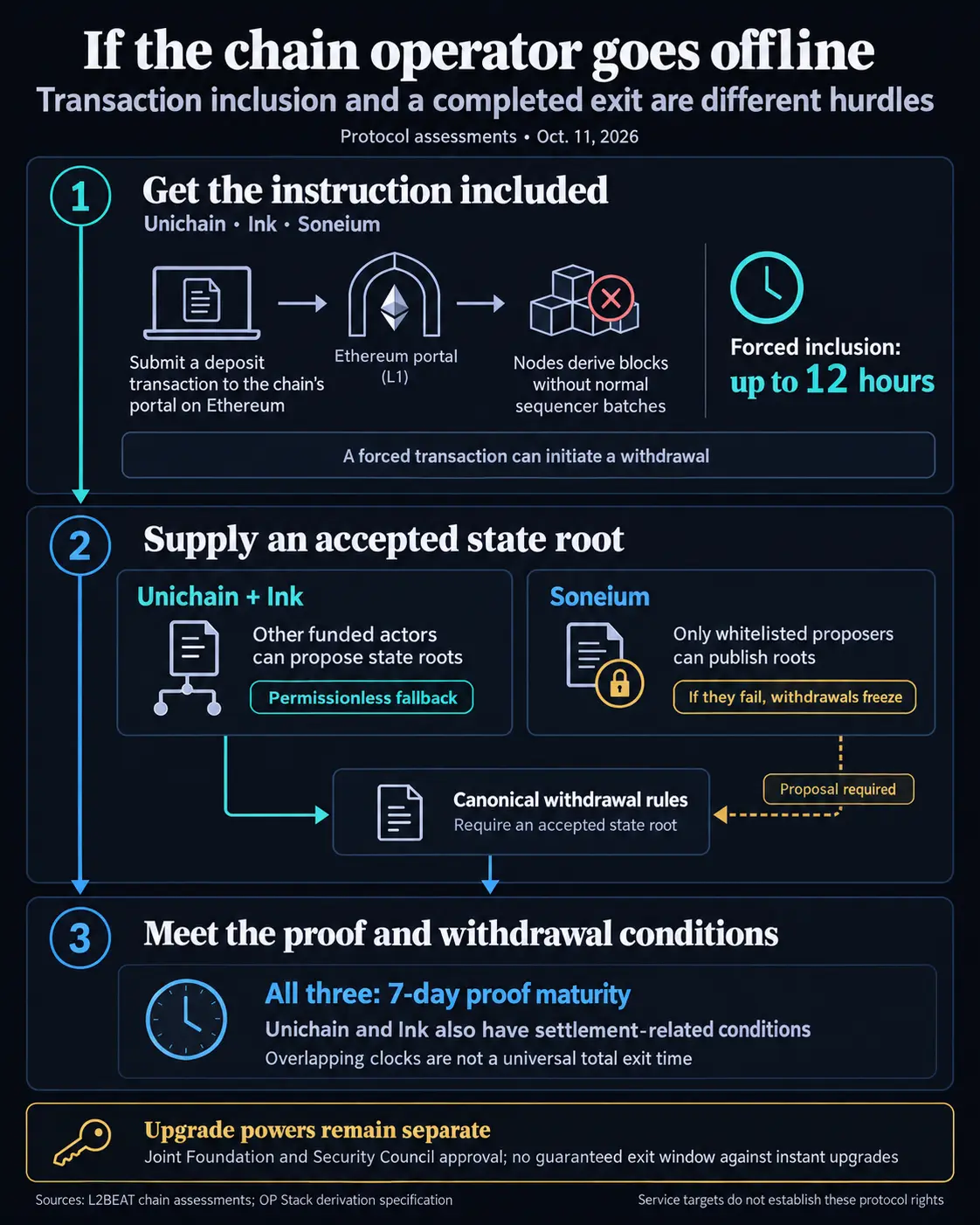
Despite the centralization of daily operations under Optimism, Ethereum maintains a robust fallback mechanism beneath the managed services. Current L2BEAT assessments track forced transaction inclusion directly through Ethereum for Unichain, Soneium, and Ink, allowing transactions to bypass a failing sequencer with a delay of up to 12 hours.
The technical specifications of the OP Stack outline how this safeguard functions. A user can submit a deposit transaction directly to the chain’s portal contract residing on Ethereum. Once the designated sequencing window expires, decentralized nodes can independently derive valid blocks containing those forced transactions without relying on normal sequencer batches. A successful forced transaction can also initiate a standard withdrawal process.
This mechanism preserves a reliable escape route around an unavailable or censoring sequencer. However, funds only become fully accessible on Ethereum after the withdrawal’s separate proposal and proof conditions are successfully satisfied, meaning permissioned dependencies can still arise along the way.
According to L2BEAT data, Unichain and Ink are classified as Stage 1 rollups, meaning other independent actors with sufficient funds can step in to propose state roots if the primary proposer fails. Their canonical exit paths allow external parties to perform the usual proposer’s work, provided that funded actors submit accepted roots and meet all applicable proof and withdrawal conditions.
Soneium operates under a different set of dependencies. Its current permissioned validation setup lacks a functional onchain dispute process, and only whitelisted proposers are permitted to publish state roots. If those designated proposers fail, user withdrawals can effectively freeze. While forced inclusion can successfully push a transaction into the derived chain, it cannot supply the missing withdrawal proposal authority required to unlock assets.
Furthermore, withdrawal assessments for Unichain, Ink, and Soneium all enforce a mandatory seven-day proof-maturity period. Unichain and Ink feature additional settlement-related conditions, including at least three-and-a-half days for root settlement and another three-and-a-half days following settlement. Because proof inclusion can sometimes precede settlement, these timeframes cannot be mechanically added together into a single universal withdrawal duration. Soneium retains its distinct withdrawal delays despite its validation mechanism lacking an active onchain challenge process.
Optimism Operations Do Not Erase Upgrade Powers
A critical distinction in this evolving landscape is that managing production operations, holding contract-upgrade authority, and controlling asset custody remain entirely separate questions. Uniswap has confirmed that its overarching governance arrangement will persist unchanged. Current L2BEAT evaluations show joint Foundation and Security Council approval required for upgrades across all three chains, with no mandatory time delay on regular upgrades and no guaranteed window for users to exit against those instant administrative powers.
Consequently, having an Ethereum-based fallback mechanism during a sequencer failure does not automatically guarantee users an opportunity to withdraw their funds before an unwanted contract upgrade takes effect. While Stage 1 architecture preserves meaningful operator-independent paths, it still retains powerful upgrade authorities at the top.
Unichain’s promised native interoperability remains a feature slated for a future release, while Soneium’s announcements have expressly excluded interoperability from its current scope. Ink’s initial plans described one-day withdrawals as part of an upcoming proof-system rollout, though its current withdrawal assessment still enforces the standard seven-day proof maturity period.
Outsourcing production operations represents a distinct phase of industry maturation, accompanied by ongoing questions regarding who ultimately maintains accountability when complex systems fail. With Unichain’s testnet migration scheduled for October 13 and its mainnet transition set for October 29, the successful completion of these milestones will further cement Optimism’s transition from a protocol developer into the premier operator of established production chains across the wider Ethereum ecosystem.