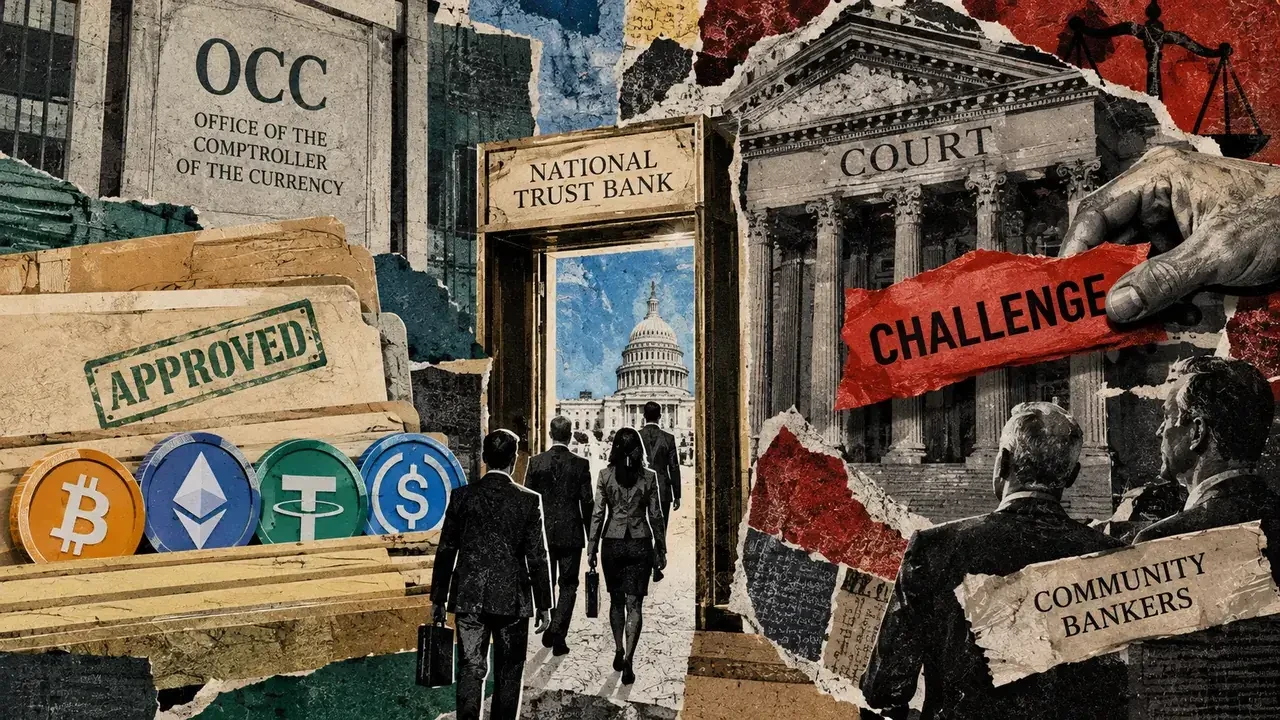
The Independent Community Bankers of America (ICBA) has taken formal legal action against the Office of the Comptroller of the Currency (OCC), filing a federal lawsuit in Washington on October 2. The legal challenge comes just two weeks after the federal regulatory agency granted approvals to three new national trust banks: Agora National Trust Bank, Catena Trust Bank, and Bastion Platforms.
According to reports from American Banker, the ICBA’s complaint asks the federal court to completely vacate the OCC’s national trust bank rule as well as Interpretive Letter 1176. The community banking advocacy group argues that the agency overstepped its statutory authority by significantly expanding limited-purpose trust charters to accommodate various fintech and cryptocurrency companies.
Data compiled by the ICBA indicates that the OCC has either approved or conditionally approved a total of 21 trust banks, with 13 of those entities directly tied to the cryptocurrency sector. This steady stream of approvals has alarmed traditional banking organizations, which view the trend as an unauthorized regulatory workaround to bring digital asset operations into the federal banking system under a much lighter supervisory framework than traditional insured institutions must endure.
Banks Lost the Applicant-by-Applicant Fight Against Crypto Firms
For months, traditional banking groups raised objections on a company-by-company basis as various digital asset firms sought federal charters. Despite these repeated protests, the OCC continued to greenlight applicants. A wave of crypto-linked national trust applications secured decisions in December, including entities such as BitGo, Fidelity Digital Assets, First National Digital Currency Bank, Paxos, and Ripple-linked applicants.
The momentum continued into the new year. Bridge, National Digital Trust, and Foris DAX—the parent company of Crypto.com—secured their approvals in February, followed by Coinbase in April and Laser Digital in May. The trend persisted into the autumn when Agora, Catena, and Bastion arrived on September 18, though several of these approvals remain conditional or preliminary.
The regulatory foundation for these approvals was laid when the OCC finalized its national trust bank rule in February, which officially took effect on April 1. The updated rule replaced the traditional statutory phrase “fiduciary activities” with broader phrasing drawn directly from the statute: “the operations of a trust company and activities related thereto.”
The OCC has consistently maintained that this linguistic update leaves its fundamental chartering authority intact. The agency argues that national trust banks have historically performed a range of nonfiduciary duties, including asset custody, pointing to 12 U.S.C. 24(Seventh) as the legal authority supporting nonfiduciary custody and related activities.
The ICBA’s legal challenge interprets the rule quite differently, arguing that it stretches a narrow, limited-purpose trust charter far beyond its intended boundaries. The lawsuit contends the rule improperly encompasses non-depository, non-fiduciary crypto businesses, subjecting them to a far more lenient regulatory regime than FDIC-insured depository institutions.
While lodging an objection to a specific company like Coinbase or Ripple asks the regulator to deny a single applicant, a federal lawsuit targeting the underlying rule forces a judicial review of the scope of authority governing every single charter that relies upon it.
The OCC Said a Court Would Decide
Anticipating legal pushback, the OCC explicitly cited the Supreme Court’s Loper Bright decision within its February rule. The agency noted that when a party with proper legal standing disputes whether the National Bank Act genuinely authorizes a national trust bank charter, the courts must exercise independent judgment to resolve the statutory question.
The ICBA’s lawsuit is precisely the form of review the OCC anticipated. Throughout 2026, the agency continued approving crypto trust charters while operating on the public record that a federal court would ultimately be required to settle their underlying legal basis.
The regulatory exposure for these firms varies considerably depending on their specific business plans. Plain fiduciary custody sits furthest from the heart of the legal dispute, whereas nonfiduciary custody, stablecoin issuance and reserves, payment processing, transaction settlement, asset conversion, and execution rest much closer to the center of the controversy.
Coinbase’s approved operational plan, for instance, covers digital asset custody executed in a fiduciary capacity alongside transactional services tied directly to those custodied assets. The OCC defended this structure as legitimate trust-company operations or related activities authorized under both its fiduciary powers and Section 24(Seventh).
Meanwhile, Agora’s business plan centers on dollar-backed stablecoin issuance, reserve maintenance, nonfiduciary custody, and comprehensive payment and settlement services. Catena’s model combines custody, investment management, and trust services with asset conversion, clearing, and execution. Bastion focuses on white-label stablecoin issuance, custodial wallets, conversion, and issuer services.
Other approved firms feature equally complex operational scopes. Foris DAX couples asset custody with trade settlement and staking capabilities, while Bridge’s initial approval encompasses custody, stablecoin issuance, orchestration, and reserve management.
In its court filing, the ICBA is seeking a complete vacatur of the rule alongside declaratory and injunctive relief. The ultimate impact on existing charters will depend heavily on the specific wording and scope of the judge’s final order, including how the ruling handles final approvals, conditional approvals, and individual business activities that might possess independent statutory support.
The regulatory pipeline remains active. In August, the OCC reported that it had received approximately 40 de novo charter applications over an 18-month period, with Comptroller Jonathan Gould noting that 23 of those submissions involved digital assets.
The agency’s public digital-asset licensing page lists numerous pending applicants, including Zero Hash, Dakota National Trust Bank, Payward (Kraken), Lorum National Trust Bank, EDX Trust, and PAYO Digital Bank. Whether the OCC will continue processing these pending applications under the same terms while a federal court deliberates the legality of the underlying rule remains an open and pressing question for each applicant.
Where the Court Crypto Test Leads
The outcome of this federal lawsuit carries profound implications for the future of digital finance infrastructure in the United States. If the federal court ultimately rules in favor of the OCC, the national trust bank structure will emerge as a firmly established, reliable federal pathway for institutional crypto custody and stablecoin infrastructure.
Major financial institutions hold massive growth expectations for the sector. JPMorgan has projected the market could reach $500 billion by 2028, while Coinbase’s internal models center on a staggering $1.2 trillion by the end of 2028. Standard Chartered expects the market to hit $2 trillion within the same timeframe, and Citigroup’s 2030 projections range from a conservative $1.9 trillion base scenario up to $4 trillion in its most optimistic outlook.
For context, FDIC-insured banks held approximately $20.7 trillion in total domestic deposits during the second quarter. Market projections ranging from $500 billion to $2 trillion represent roughly 2.4% to 9.7% of that traditional deposit base. For Bitcoin and the broader digital asset ecosystem, a victory for the OCC would significantly deepen bank-supervised custody and settlement-linked services tailored for institutional participants.
Conversely, should the court decide to vacate or narrow the national trust rule or Interpretive Letter 1176, the blow will land heaviest on business models built around stablecoin issuance, reserve management, nonfiduciary custody, asset conversion, payments, and transaction settlement.
Firms forced to adapt to an unfavorable ruling might be compelled to restructure their operations into separate corporate affiliates, state-chartered trust companies, or traditional partner-bank arrangements, while pending federal charters would likely face severely heightened regulatory scrutiny. While basic Bitcoin custody might remain viable under a narrowed interpretation, the federal charter would lose much of its flexibility regarding adjacent commercial services, such as asset conversion, execution, settlement, staking-like offerings, and collateral movement.
The broader economic stakes extend well beyond the cryptocurrency sector. The San Francisco Federal Reserve has estimated that the Treasury demand generated by stablecoin issuers could roughly double to reach approximately $400 billion by 2030, giving the resolution of this legal battle significant weight for traditional public debt markets as well.
Ultimately, the fundamental question of how much nonfiduciary market infrastructure can legitimately be housed inside a national trust bank has been placed squarely in the hands of a federal judge—landing precisely where the OCC predicted the debate would end up.