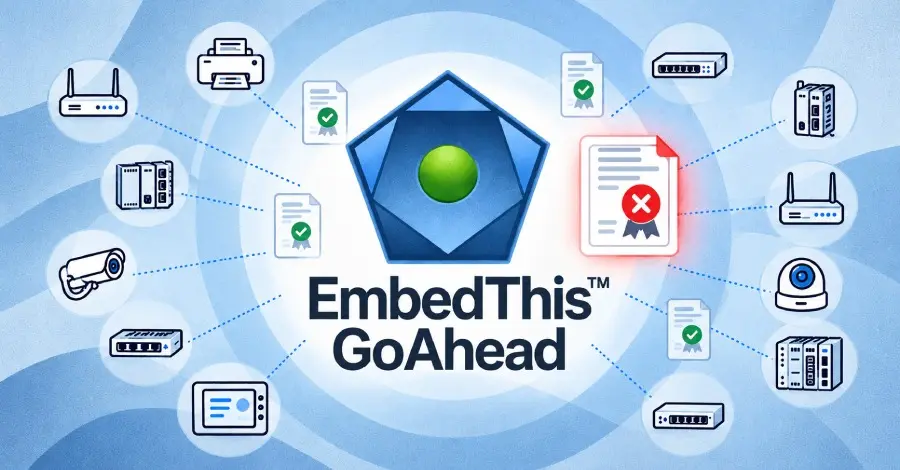
The widely utilized GoAhead embedded web server has received a comprehensive security update addressing multiple severe vulnerabilities, including a critical flaw in its OpenSSL backend that causes configured certificate revocation lists to be ignored. Discovered by security researchers and patched in version 6.1.1, the vulnerabilities affect millions of hardware devices worldwide, ranging from enterprise routers and industrial controllers to printers and network gateways.
Embedded in the firmware of countless connected devices, GoAhead serves as a lightweight web server managing administrative pages and local interfaces. Its developer, EmbedThis, estimates that the software runs in hundreds of millions of units globally. Because the server is typically embedded deep within proprietary device firmware, identifying vulnerable instances or applying patches depends entirely on the release cycles and update policies of individual hardware manufacturers.
The most prominent issue involves how the software handles client certificate validation when paired with the OpenSSL backend. According to security advisory details, the GoAhead web server successfully loads a certificate revocation list into its default TLS backend during startup without reporting any errors. However, the system fails to actually turn revocation checking on during runtime. Consequently, operators who intentionally configure mutual-TLS authentication with revocation lists to block compromised, stolen, or retired client certificates are left with a false sense of security.
In affected builds, a revoked client certificate will successfully pass authentication checks. The server completes the TLS handshake as though the certificate remains entirely valid, granting the presenting client whatever administrative or operational access that specific identity permits. Security researchers from FoxIO, who identified this flaw alongside two other TLS-related issues, tested GoAhead version 6.1.0 running against OpenSSL 3.6.2 and confirmed that revoked certificates were routinely accepted even when issuer checking was actively switched on.

This specific flaw, tracked under identifier CVE-2026-115881 and assigned a severe vendor rating of 9.1, requires a specific configuration to be exploitable. The target build must utilize the OpenSSL backend, mandate client certificates, maintain a trusted certificate authority bundle with issuer checking enabled, and have a revocation list explicitly configured. An attacker must also possess a certificate signed by a trusted authority that happens to be listed on the ignored revocation list. Builds compiled with the Mbed TLS backend are entirely unaffected by this issue, as that backend routes revocation checks through an independent code path.
Alongside the OpenSSL revocation bypass, security analysis uncovered two additional backend-specific TLS vulnerabilities, each impacting different software configurations and versions. The first of these affects builds linked against legacy versions of LibreSSL, specifically versions 3.2.x and 3.3.2 through 3.3.6. In these environments, if client certificates are required while issuer checking is disabled, the server erroneously accepts a client certificate chain that exceeds its standard 10-certificate length limit. Tracked as CVE-2026-115884 with a 7.4 severity rating, this flaw allows an attacker to present an over-long certificate chain and successfully complete the authentication handshake as a verified client without possessing a valid trusted key. Modern cryptographic libraries, including standard OpenSSL, BoringSSL, AWS-LC, and newer LibreSSL releases, correctly reject such oversized chains.
The third security issue involves the Mbed TLS backend, where a length calculation typo results in the server transmitting a 1-byte Diffie-Hellman value instead of the expected full 2048-bit parameter. Rated 5.9 by the vendor without an assigned CVE identifier, this flaw allows a passive network observer capable of recording the session traffic to compute the encryption key and decrypt communications. However, mainstream clients and robust cryptographic libraries such as OpenSSL, current versions of Go, Java, and major web browsers automatically reject keys of that diminutive size and fall back to stronger cryptographic exchanges, preventing the vulnerable session from completing. The vulnerability primarily impacts custom or embedded clients lacking minimum-size enforcement checks. Modern protocols such as TLS 1.3 and Elliptic Curve Diffie-Hellman Ephemeral sessions remain unaffected.
The structural nature of embedded software means that remediation is uniquely complex. Because the selection of TLS backends and compilation flags occurs at the time firmware is built, device owners have no visibility from the outside to determine which backend or vulnerable setting is active on their hardware. Furthermore, because GoAhead is distributed as source code to hardware vendors rather than directly to end-users, issuing a patch requires EmbedThis to provide the drop-in replacement package—designated as GoAhead version 6.1.1—to device makers, who must then rebuild their firmware packages, thoroughly test them, and push updates out to customers.

The security update released by EmbedThis goes beyond the TLS transport layer, addressing a total of 11 distinct advisories, three of which carry critical severity ratings. Among these additional patches is a significant login bypass vulnerability. On builds utilizing standard HTTP Basic or form-based authentication, an attacker who possesses knowledge of a valid username can successfully authenticate using any arbitrary password, provided the target user’s stored credential utilizes the newer Blowfish hashing format. This hashing algorithm was introduced into GoAhead as recently as version 6.1.0, and form-based login serves as the default configuration for built-in administrative interfaces.
Although EmbedThis coordinates its vulnerability disclosures to ensure patches are ready, research organizations such as FoxIO have released proof-of-concept material and network scanning fingerprints via tools like JA4Scan to help administrators identify GoAhead servers by their underlying TLS backend. Despite the broad footprint of GoAhead across devices manufactured by major global technology and industrial firms, no telemetry or public reporting has indicated that these vulnerabilities are actively being exploited in the wild.
In response to these discoveries, EmbedThis has urged device manufacturers to integrate the GoAhead 6.1.1 update into their upcoming firmware distributions. For system operators and administrators managing affected hardware, the vendor recommends immediately applying official firmware updates as they become available from equipment manufacturers. Following any system upgrade, administrators are strongly advised to terminate all active sessions, restart the web server daemon, and rotate any administrative passwords stored using the vulnerable Blowfish format to maintain the integrity of device management interfaces.