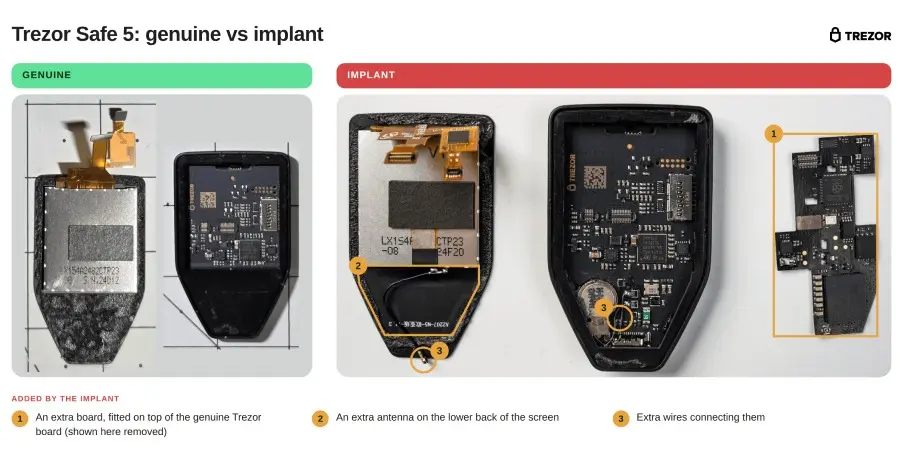
Hardware wallet manufacturer Trezor has confirmed that three Trezor Safe 5 cryptocurrency wallets purchased through the reseller CryptoBilis contained malicious physical modifications. According to the company, these devices were fitted with an unauthorized extra circuit board designed to covertly capture and exfiltrate user recovery phrases.
The security breach highlights growing concerns regarding supply chain security within the hardware cryptocurrency wallet industry. Trezor detailed the findings following a comprehensive laboratory examination of one of the compromised devices, alongside visual evidence provided by owners of the other two affected wallets. Fortunately, despite the sophisticated nature of the hardware tampering, the company has not received any reports of lost funds linked to these specific devices.
How the Hardware Implants Operate
According to Trezor’s engineering analysis, the malicious implant functions by intercepting sensitive information directly from the device’s visual interface. The extra circuit board is physically positioned between the Safe 5’s main board and its high-resolution screen. Crucially, the attackers did not alter the core device firmware, the secure operating system, or the Secure Element chip, allowing the wallet to appear functionally normal to the end user.
The hidden implant is engineered to capture the user’s recovery phrase during the initial wallet backup creation process. Furthermore, it records the recovery phrase if a user types or inputs it when restoring an existing wallet onto the compromised device. In addition to recovery phrases, the device is capable of intercepting and copying a passphrase if one is displayed on the screen.
Once the sensitive data is captured, the implant encrypts the information and transmits it over a cellular mobile network to an external server controlled by the malicious actors. Trezor noted that the hardware is resilient in areas with poor connectivity; if the implant fails to establish a network connection immediately, it securely stores the data locally and continuously attempts transmission until successful.
Discovery, Investigation, and Firmware Defenses
Trezor first issued a public warning regarding suspected hardware tampering on October 30, just two days after a vigilant buyer alerted the company and prior to engineers having physical possession of a compromised unit.

In response to the threat, Trezor rushed out a firmware update, version 2.13.1, designed to neutralize the specific capabilities of the discovered implants. Released for the Safe 7, Safe 5, Safe 3, and Model T lines, the update prevents the currently known implants from capturing input data on running devices. However, Trezor issued a sobering caveat, noting that the software patch cannot protect a wallet backup if the recovery phrase was already compromised and transmitted prior to the update being installed.
Trezor stated that it will not publish granular technical specifications that could inadvertently assist attackers or jeopardize other customers. Engineers thoroughly investigated the first reported wallet, while safety teams verified the other two units through detailed photographs submitted by the respective owners.
The CryptoBilis Connection and Industry-Wide Supply Chain Risks
The compromised wallets were purchased from CryptoBilis between August 20 and September 23. CryptoBilis had previously operated as an authorized reseller of Trezor products in Southeast Asia. However, Trezor cut ties with the vendor on October 9.
That termination coincided with a broader investigation launched by Ledger, a competing hardware wallet manufacturer, which began probing user fund losses among customers of the same reseller. Ledger subsequently confirmed that unauthorized hardware implants had been discovered in devices sold by CryptoBilis. According to Ledger’s incident reports, attackers integrated hidden components into genuine hardware to capture recovery phrases during setup, enabling coordinated, large-scale wallet draining operations.
Trezor has stated that the implants found in its Safe 5 devices operate on the same operational principles as those discovered in Ledger devices, though they were physically adapted to fit the Safe 5’s distinct display assembly. While investigations are ongoing, Trezor has not publicly attributed the physical tampering to a specific threat actor or pinpointed the exact juncture in the global supply chain where the alterations took place.
So far, the company’s investigations indicate that the threat has been localized. Implants have only been found in Safe 5 units distributed by CryptoBilis, with no evidence of tampering discovered in devices sourced from other authorized partners or found within different Trezor product lines.

Reseller Network Overhaul and Ongoing Monitoring
Following the initial October alerts, Trezor urged any customers who purchased hardware wallets from CryptoBilis—including transactions originating from the reseller’s storefronts on e-commerce platforms like Tokopedia and Shopee—to come forward. To date, 48 customers have responded to the call. Trezor is actively inspecting these devices either directly in its laboratories or through comprehensive photographic documentation of the hardware’s interior components.
While none of the three confirmed owners of the implanted Safe 5 wallets have reported missing funds, Trezor reiterates that because its hardware wallets are strictly self-custodial, the company has no visibility into individual user balances or blockchain assets.
The security incident prompted Trezor to aggressively overhaul its global distribution network. The company reduced its authorized reseller network by approximately 80%, cutting ties with partners that, while not posing an immediate security threat, failed to meet the brand’s newly instituted, stricter compliance and security guidelines. Trezor first announced this major structural reduction on October 13 via social media channels, weeks before the first internal report of an implant surfaced.
In a formal communication sent to affected partners on the same day, Trezor informed dropped resellers that they would receive no new inventory, would be permitted to liquidate existing stock only until January 1, 2027, and would subsequently be expunged from the official list of authorized vendors.
Trezor’s investigation remains active. The company has committed to releasing further updates should it confirm the presence of similar hardware implants outside of the CryptoBilis supply chain, verify any reports of financial loss linked to the compromised devices, or deploy additional security measures.