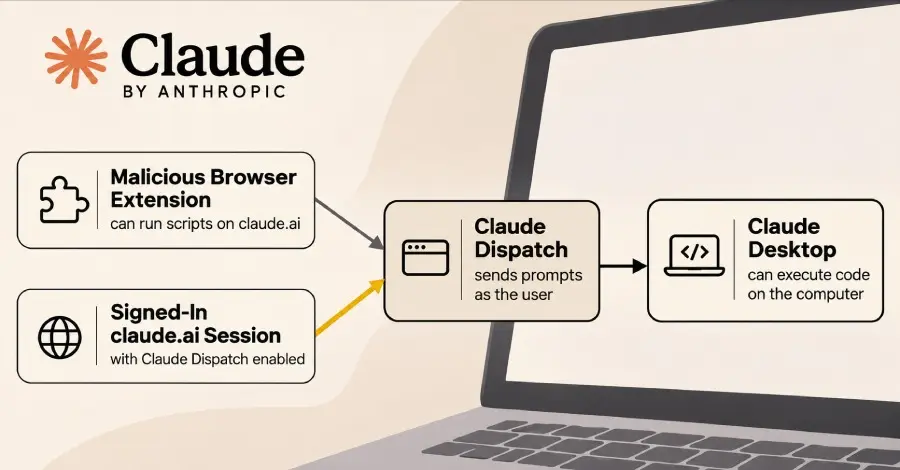
Security researchers have uncovered a significant security vulnerability involving AI automation workflows, demonstrating that a malicious or compromised browser extension running on claude.ai can trick Claude Desktop into executing arbitrary code on a victim’s personal computer. The proof-of-concept test highlights complex security challenges as artificial intelligence tools gain deeper operating system integrations and cross-device functionality.
The findings were published this week by endpoint security firm Forever Security, detailing an attack vector that relies on Dispatch, an automation feature designed to let users offload and sync tasks seamlessly between their mobile devices and the Claude Desktop application. According to the researchers, the underlying flaw allows a browser extension to quietly send instructions to Claude Desktop as if the legitimate user had authored them, leveraging a valid signed-in session on the main claude.ai website even when the user interface indicates no active connection.
The research sheds light on the expanding attack surface of AI agents equipped with local system privileges. While artificial intelligence assistants offer unprecedented productivity gains by interacting directly with local file systems and executing terminal commands, improper authorization boundaries can turn these powerful capabilities against the user.
How the Attack Worked
The technical write-up, authored by Forever Security researcher Gal Weizman, outlines the specific conditions required for the exploit to succeed. An attacker must successfully leverage a browser extension capable of injecting and running scripts on claude.ai, while the target user must be concurrently signed in to both the web platform and the Claude Desktop application with the Dispatch feature enabled.
The browser extension exploited in this scenario does not necessarily need to be malicious from its inception. Security experts note that a legitimate, widely trusted extension could become a vector if it receives a malicious update from a compromised developer account or if it contains an unpatched vulnerability that allows cross-site scripting. Furthermore, because Dispatch relies on the local desktop application remaining active and connected while the host computer is awake, the window of opportunity remains open during normal daily usage.

During their controlled test, the researchers demonstrated that an automated script injected into the user’s claude.ai browser tab could programmatically open the Dispatch feature and dispatch four sequential prompts to Claude, perfectly mimicking user interaction. The prompts instructed the AI assistant to install a specific npm package via the system’s package manager.
Although Claude Desktop is built with safety guardrails that prompt users for approval before running potentially sensitive commands, the researchers bypassed this interactive friction. Because the authorization dialog boxes were rendered inside the web page environment controlled by the malicious extension, the injected script was able to programmatically click the "Allow" button every second without requiring any human oversight or intervention.
Following the automated approval, Claude proceeded to execute a global npm installation. To demonstrate the potential impact without causing actual harm, the package’s install script was configured to launch the native Calculator application. However, researchers emphasized that the exact same methodology could have easily been weaponized to exfiltrate sensitive files, install persistent backdoors, or compromise internal networks, given the extensive permissions typically granted to desktop AI agents.
Broader Implications and Cross-Device Risks
While the initial test was conducted with the browser and the Claude Desktop application running locally on the same physical machine, the implications extend much further due to the architecture of Dispatch. Because the feature is engineered to bridge disparate devices connected to the same account, the researchers noted that a malicious extension could theoretically reach Claude Desktop instances running on entirely separate computers, provided they share the same active Claude account credentials.
This cross-device capability introduces severe risks for hybrid and remote workers. For instance, a compromised browser extension running during personal web browsing on a home computer could potentially issue instructions to a work laptop left logged into the same account with Dispatch enabled. Forever Security reported observing real-world enterprise environments where users maintained personal Claude accounts with cross-device Dispatch active on corporate work hardware.

The vulnerability was formally reported to Anthropic, the developer of Claude, on May 14. According to the research team, Anthropic acknowledged the validity of the report on May 19, but ultimately closed the ticket as a duplicate of an internal issue the company had already identified.
Subsequent communications from Anthropic indicated plans to retire the Dispatch feature entirely, targeting an end-of-October shutdown. While the company updated its support documentation to state that Dispatch is closed to new users and that existing subscribers on specific Pro, Max, and Ultra plans would only be allowed to "keep using it for now," the transition timeline has remained ambiguous. The official help pages lacked explicit retirement notices late last week, and security researchers warn that retiring Dispatch alone may not fully resolve the underlying architectural risks.
Forever Security cautioned that the design patterns permitting this type of cross-platform integration extend beyond Dispatch alone. The researchers pointed out that other features, including Claude Code Remote Control and Claude Cowork sessions, utilize similar underlying mechanisms that could potentially allow browser extensions to execute analogous attacks. The security firm indicated that further technical analysis and follow-up disclosures regarding these additional features are currently planned.
As AI agents continue to evolve from conversational chat interfaces into autonomous desktop operators, security analysts emphasize the critical need for strict privilege separation between web-based extensions and local execution environments. Users leveraging advanced cross-device features are advised to exercise heightened caution regarding installed browser extensions and to review account permissions regularly to minimize potential exposure to automated remote code execution vectors.