
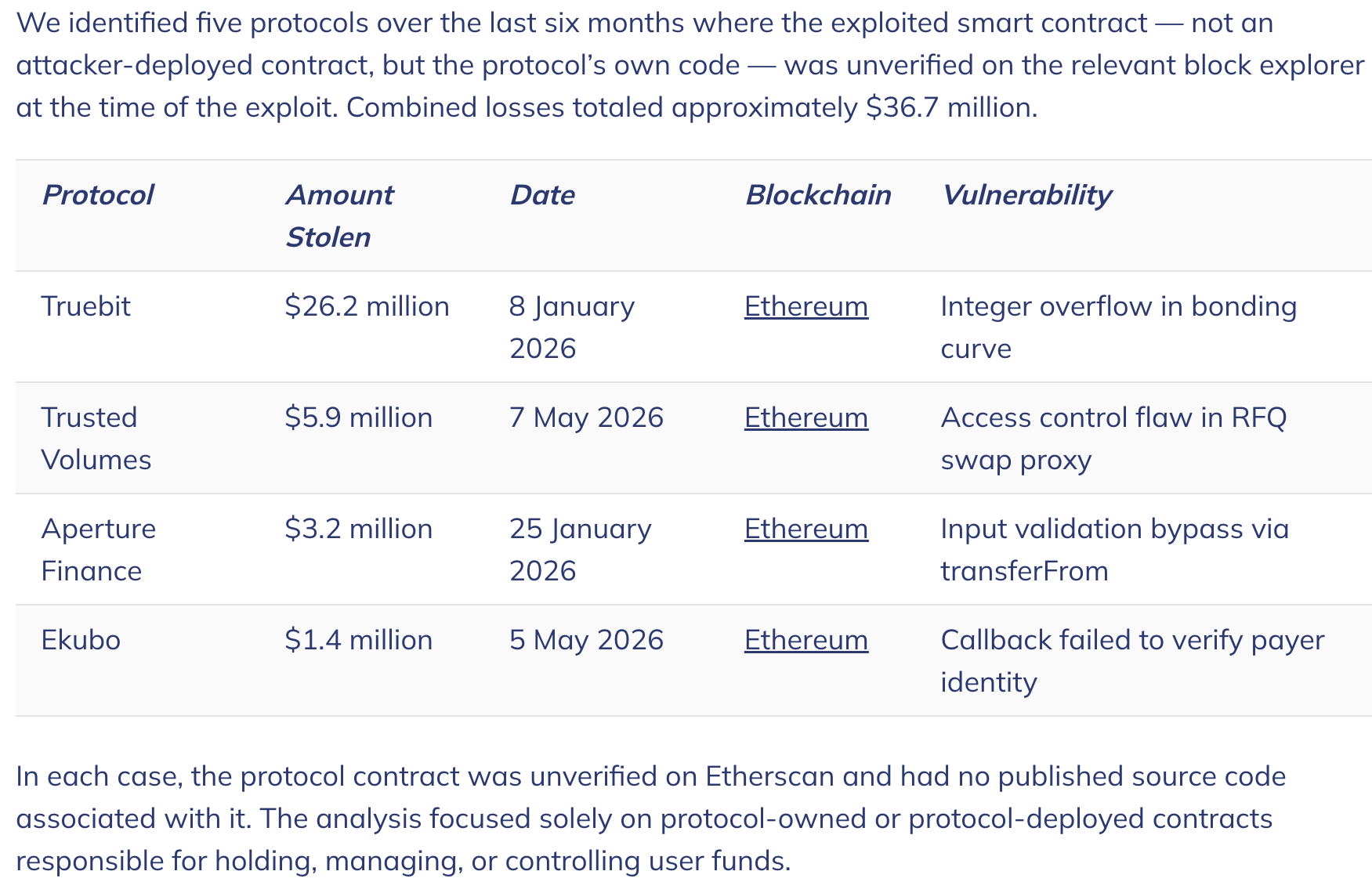
Unverified smart contracts have been directly linked to at least $36.7 million in losses across four distinct decentralized finance exploits over the past six months, according to a comprehensive new report from blockchain intelligence firm Chainalysis. The findings highlight a shifting paradigm in the threat landscape, as malicious actors increasingly target Web3 protocols whose source code is not publicly available on blockchain explorers. For years, keeping underlying code hidden was viewed by some developers as an additional protective layer. However, the latest security data indicates that this strategy is failing rapidly under the pressure of advanced cyberattack techniques.
The largest of the four incidents detailed in the report involved Truebit, which suffered a staggering $26.2 million loss after an attacker successfully exploited an integer overflow vulnerability. The vulnerable contract had reportedly remained unverified on the Ethereum blockchain since 2021. According to Chainalysis, the remaining three incidents targeted Trusted Volumes, Aperture Finance, and Ekubo. In every single one of these cases, the exploited smart contracts had not undergone the standard practice of verification on a blockchain explorer, meaning the underlying source code was withheld from public view and independent security review.
This lack of transparency carried severe consequences for the protocols involved. By keeping their code unverified, these projects severely limited the scope of external scrutiny from independent security researchers and white-hat hackers. Furthermore, these hidden contracts were routinely excluded from many established bug bounty programs, depriving the projects of crowdsourced vulnerability assessments despite the fact that the contracts were actively controlling substantial amounts of user funds.

According to Chainalysis, this concerning trend is being heavily fueled by rapid advancements in automated decompilation tools and artificial intelligence. These sophisticated technological aids now allow attackers to efficiently reverse-engineer smart contract bytecode and pinpoint critical vulnerabilities even when the original human-readable source code is completely hidden from public sight. The report notes that tasks which historically required a highly skilled reverse engineer to spend painstaking days analyzing a single contract can now be partially automated across massive volumes of unverified contracts simultaneously.
This technological shift directly challenges a longstanding, albeit flawed, assumption within the decentralized finance sector: the belief that keeping smart contract code private provides a meaningful barrier against exploits. Chainalysis points out that protocols relying on hidden code are essentially depending on "obscurity as a security measure"—an approach that security experts agree is rapidly losing its effectiveness in an era where automated analysis tools are readily available to malicious actors. To counter these evolving threats, Chainalysis has strongly recommended that all protocols prioritize universal source code verification, expand their bug bounty coverage to encompass deeper layers of their infrastructure, and implement robust real-time monitoring tools to detect anomalous contract interactions before catastrophic damage can occur.
DeFi Security Concerns Persist After Record April Losses
The warning regarding unverified contracts arrives against the backdrop of a broader, deeply concerning surge in cryptocurrency exploits across the entire Web3 ecosystem. According to aggregated data from DeFiLlama, hackers and malicious actors successfully stole an astonishing $629.7 million in digital assets during the month of April alone. This represented the highest monthly total for crypto-related thefts recorded since February 2025, sending shockwaves through the decentralized finance community and prompting renewed calls for sweeping infrastructure overhauls.
A significant majority of April’s devastation was concentrated within just two massive security breaches. KelpDAO suffered a catastrophic exploit resulting in the loss of $293 million, while Drift Protocol was simultaneously drained of $280 million. Together, these two high-profile incidents accounted for more than 80 percent of all stolen funds for the month, underscoring the systemic risks still present within large-scale liquidity and lending protocols.
Although the macro level of stolen funds fell sharply in May—with blockchain security firm CertiK reporting a comparatively lower $68.3 million lost to cryptocurrency exploits—the long shadow cast by April’s record-breaking attacks continued to dominate industry discussions. The aftermath spilled heavily into June, when blockchain intelligence platform Arkham released findings revealing that the attacker behind the massive KelpDAO exploit had successfully laundered nearly all of the roughly $220 million in unfrozen stolen funds that remained under their control.
The fallout from the KelpDAO security breach extended far beyond the immediate financial losses, prompting numerous other decentralized finance protocols to urgently reevaluate and restructure their underlying security architectures. Among them, projects such as Solv Protocol publicly announced strategic plans to migrate their operations to Chainlink’s advanced crosschain infrastructure following exhaustive internal security reviews aimed at closing potential vectors for cross-chain manipulation.
The growing intersection of advanced technology and malicious cyber activity was further emphasized this month when AI developer Anthropic released figures regarding its platform safety enforcement. The company disclosed that 560 out of the 832 accounts it had banned for policy violations over a one-year period had actively utilized artificial intelligence capabilities to assist in preparing sophisticated cyberattacks. These malicious use cases included writing custom malware and utilizing AI models to identify and exploit software vulnerabilities, painting a clear picture of an environment where both defenders and attackers are increasingly reliant on automated systems.