
Solana’s first major consensus upgrade, Alpenglow, officially went live on the mainnet at approximately 1:54 pm UTC on Wednesday, marking a historic turning point for the high-performance blockchain network. According to data provided by the Solana Foundation’s Alpenglow activation dashboard, the deployment represents the most substantial core protocol evolution since the network’s genesis block.
The primary objective of Alpenglow is to dramatically reduce transaction finality by up to 99%. While legacy network finality hovered around 12.8 seconds prior to the broader rollout of the upgrade, Alpenglow is engineered to compress that confirmation window down to roughly 150 milliseconds. This near-instantaneous settlement capability is designed to bridge the performance gap between decentralized blockchain architecture and traditional Web2 centralized infrastructure.
A Two-Phase Overhaul of Core Mechanics
The Alpenglow upgrade is structured around a multi-phase technical roadmap aimed at completely modernizing how transactions are validated, finalized, and distributed across the network. Its first operational phase introduces a mechanism known as Votor, which replaces Solana’s legacy voting and finalization framework—historically governed by TowerBFT.
Votor transitions the network toward a direct validator voting model coupled with an advanced certificate-based system. This architectural shift is the primary driver behind the anticipated reduction in transaction finality to the 150-millisecond threshold. Following the successful activation of Votor, a subsequent phase of the Alpenglow upgrade will introduce Rotor, an entirely new block data-distribution protocol intended to eventually replace the network’s existing Turbine system.

By achieving a 150-millisecond finality target, the Solana Foundation hopes to deliver a seamless, near-immediate transactional experience for end users. Such responsiveness opens the door to a wide array of high-frequency use cases, ranging from lightning-fast retail payments and complex trade settlements to highly responsive decentralized applications that previously struggled with blockchain latency constraints.
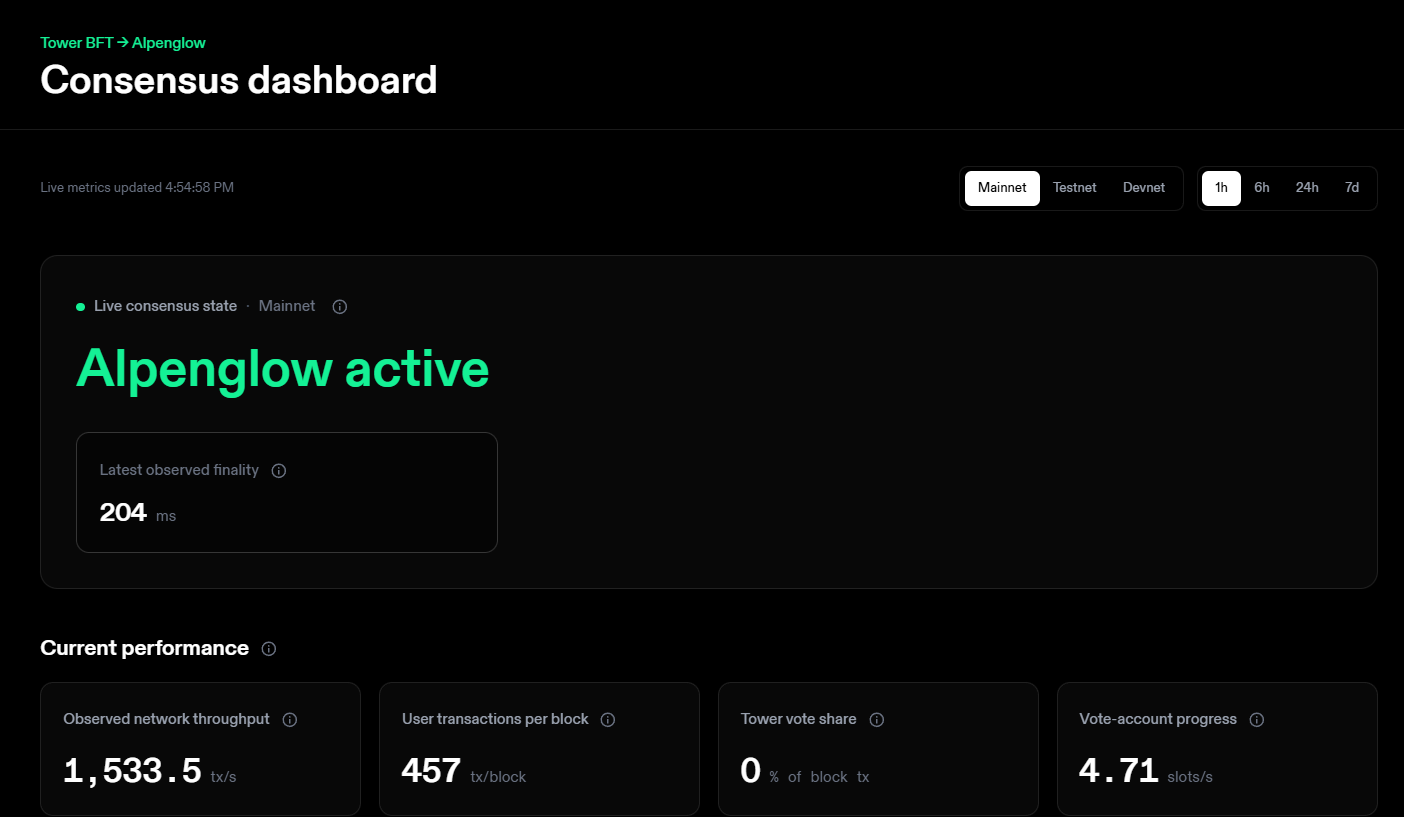
At the time of the mainnet activation, live metrics displayed on the Solana Foundation dashboard indicated a current transaction finality of roughly 6.6 seconds alongside a network throughput of 4,721 transactions per second, illustrating that the network is actively transitioning and scaling as the phased rollout progresses. Cointelegraph has approached the Solana Foundation for further comment regarding detailed finality measurements recorded during testnet environments and expected performance benchmarks in live, real-world deployment scenarios.
Alpenglow Marks the Biggest Change to Solana’s Core Protocol
The magnitude of the Alpenglow upgrade has been heavily emphasized by core developers and research teams across the Solana ecosystem. In a comprehensive blog post published in May, researchers from Solana Labs offshoot Anza characterized Alpenglow as introducing the "biggest change to Solana’s core protocol" since the blockchain first launched.
Authored by Anza researchers Quentin Kniep, Kobi Sliwinski, and Roger Wattenhofer, the May publication highlighted that achieving a 150-millisecond latency profile allows Solana to directly compete with traditional Web2 infrastructure in terms of system responsiveness. The researchers argued that this level of performance could ultimately render blockchain technology viable for entirely new categories of consumer and enterprise applications that demand immediate feedback loops.
The launch of Alpenglow follows closely on the heels of other foundational network adjustments implemented throughout the year. In August, Solana successfully reduced its blockchain slot time for the first time since genesis. That adjustment formed a key component of the Solana Foundation’s broader strategy to halve traditional slot times down to 200 milliseconds, a move specifically intended to improve overall network latency and accelerate confirmation times. The fourth and final stage of that targeted slot reduction plan was successfully completed in October.
Looking ahead, Solana validators and core contributors are already laying the groundwork for subsequent protocol enhancements. Among the most anticipated is Agave 4.5, a forthcoming upgrade that proposes increasing the number of accounts supported within a single versioned transaction from 64 to 96. According to the Solana Foundation, this enhancement could significantly optimize swap routes and improve execution prices for decentralized finance participants. The upgrade is currently undergoing active development, with a mainnet rollout planned for December.
Against the backdrop of these significant technical milestones, native token market activity has shown positive momentum. The price of Solana (SOL) rose by nearly 3% in the 24-hour window leading up to the mainnet activation of Alpenglow, helping to offset a portion of the broader market corrections experienced over the preceding year, according to data from CoinMarketCap.