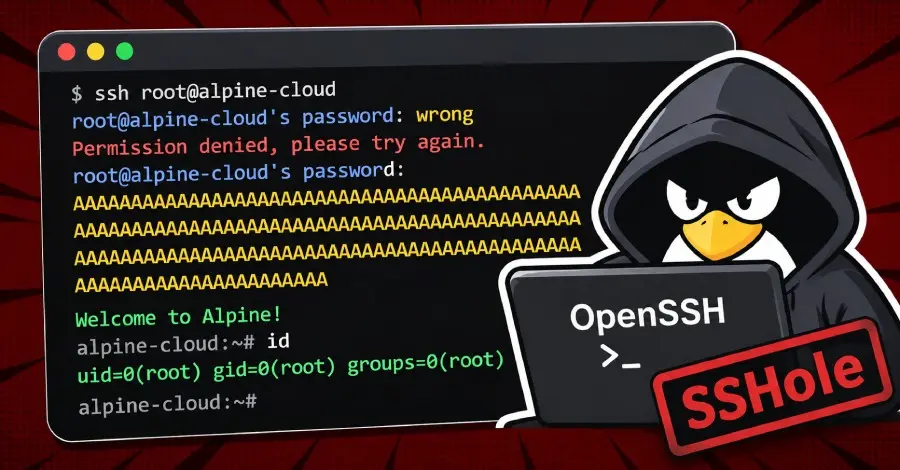
Cybersecurity researchers have detected active exploitation attempts targeting a critical security flaw in OpenSSH just hours after its public disclosure. The vulnerability, which has been assigned the tracking identifier CVE-2026-123158 and the codename "SSHole" or "*sshole," carries a high CVSS severity score of 8.1. It presents a significant risk by potentially allowing unauthenticated threat actors to sign into specific system accounts that have not been configured with a usable password.
Discovered by security researcher Ozgun Kultekin, the vulnerability impacts Linux systems running OpenSSH on the musl C library with Pluggable Authentication Modules (PAM) disabled. Notably, this specific configuration matches the default OpenSSH server setup utilized by Alpine Linux, leaving certain deployments exposed unless immediate remedial actions are taken.
According to telemetry and threat intelligence gathered by Previdian, threat actors began scanning for and attempting to exploit the flaw less than nine hours after the vulnerability details and corresponding CVE were officially published. Researchers confirmed that an initial attack vector successfully secured root access on a honeypot system running Alpine Linux and OpenSSH, highlighting the rapid weaponization capabilities typically observed in modern threat landscapes.

The root cause of the vulnerability traces back to a software patch introduced nearly a decade ago, in 2016. At the time, developers implemented a modification to mitigate a username enumeration vulnerability tracked as CVE-2016-6210. Under specific conditions within this legacy mechanism, the password-handling logic inside OpenSSH mistakenly interprets a failed password-hashing operation as a successful authentication event.
Specifically, when the underlying system encounters certain conditions, it produces an asterisk character ("*"). This exact value is normally used internally by the system to indicate that a specific user account has its password disabled at the system level.
An unauthenticated attacker can exploit this behavioral quirk by supplying an oversized password—typically ranging between 257 and 1,024 bytes in length—during the connection handshake. This artificially large input causes the cryptographic password hash attempt to fail, which in turn returns the asterisk value. The sshd daemon then compares this generated asterisk against the asterisk stored in the targeted account’s password field. Because the values match, the daemon incorrectly concludes that valid credentials have been provided, leading to a successful authentication bypass without requiring any stolen passwords, pre-existing credentials, or cryptographic SSH keys.
Security experts emphasize that successful exploitation requires at least one account on the target system to have an asterisk as its active password hash configuration. The vulnerability does not grant attackers the ability to bypass password controls on accounts that maintain legitimate, functional password hashes.

Nevertheless, organizations utilizing vulnerable software configurations face severe potential consequences. Cybersecurity firm Safe Security noted that a successful SSHole attack grants access with the existing permission level of the compromised account. For enterprise networks, the downstream impact depends heavily on the privilege level associated with the compromised user.
While unauthorized remote SSH access serves as the immediate entry point, malicious actors frequently leverage such initial footholds to acquire deployment credentials, application secrets, and access to interconnected internal infrastructure. This unauthorized access can subsequently enable malicious lateral movement across the corporate network or result in critical service disruptions.
Industry analysis indicates that the vulnerability’s scope is relatively targeted rather than universal. Systems utilizing glibc-based Linux distributions, non-Linux operating systems, alternative SSH implementations such as Dropbear, and systems configured to validate passwords through Pluggable Authentication Modules (PAM) are not affected by CVE-2026-123158.
Despite these limitations, threat intelligence telemetry has documented active malicious probing. Ryan Dewhurst, founder and CEO of Previdian, reported that monitoring systems observed eight separate exploitation attempts originating from a single IP address geolocated to Japan. The source IP address, identified as 89.116.89[.]18, deployed oversized passwords to bypass standard authentication hurdles and subsequently executed automated reconnaissance commands, including standard utilities such as id, uname, and hostname, through non-interactive SSH sessions.

In response to the emerging threat, the OpenSSH development team has released OpenSSH version 10.6p2 to remediate the flaw. System administrators and enterprise IT teams overseeing affected environments are strongly urged to upgrade their OpenSSH packages immediately and restart the corresponding sshd daemon service to neutralize the risk.
Alpine Linux project maintainers have also issued specific operational guidance, recommending that administrators proactively inspect system log files—specifically examining /var/log/messages for sshd log entries reading "Accepted password for"—particularly when those entries involve system accounts that should inherently reject password-based logins, such as root, alpine, or designated key-only administrative users.
Furthermore, security teams are advised to audit recent usage of privilege escalation utilities, verify the creation of any unauthorized user accounts, and thoroughly inspect filesystem modifications and authorized keys files across all potentially exposed machines. Experts caution that if unauthorized access or log anomalies cannot be definitively ruled out following a thorough review, the affected machine must be treated as fully compromised and isolated for forensic investigation.