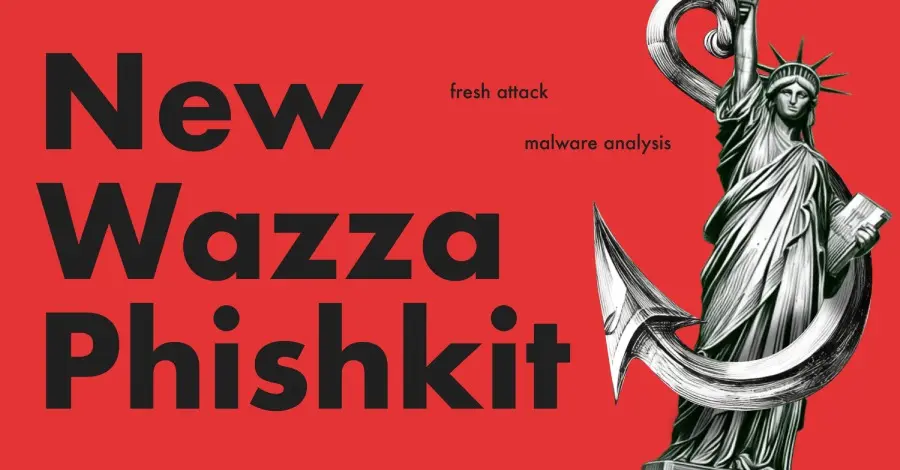
Modern phishing campaigns have evolved far beyond simple web page duplication. While older threats relied on copying a familiar login portal and waiting for unsuspecting victims to surrender their credentials, contemporary threat actors are weaving intricate layers of traffic filtering, automated validation, and session management directly into their delivery infrastructure. Security researchers at ANY.RUN have uncovered a notable new threat adhering to this sophisticated model, identifying a campaign dubbed Wazza that focuses heavily on high-value targets across the United States, Europe, and Australia.
The Wazza phishkit specifically targets organizations operating within the banking, manufacturing, and government sectors. Rather than routing every incoming visitor straight to a malicious landing page, the campaign deploys a complex multi-stage routing chain designed to carefully screen human visitors and eliminate automated security crawlers, sandboxes, and security researchers before the final lure is ever displayed.

For enterprise security teams and Managed Security Service Providers (MSSPs), the emergence of Wazza represents a distinct challenge. The campaign highlights how threat actors can deliberately obscure the path to their final social-engineering payloads, rendering initial links appear entirely innocuous while complicating automated detection mechanisms and stretching incident response workflows.
Unmasking Wazza’s Multi-Stage Routing Infrastructure
At the core of Wazza’s effectiveness is its refusal to expose its payload indiscriminately. When a user or automated system encounters an initial link associated with the campaign, the traffic does not immediately land on a credential-harvesting form. Instead, the phishkit initiates a tightly controlled routing sequence to evaluate the incoming connection.

The technical workflow begins at a wildcard landing domain—specifically observed using formats like boegl-krysl[.]eu—where visitors are immediately redirected to an internal API endpoint designed to check whether the incoming hostname belongs to an active, authorized campaign. Once this initial handshake succeeds, the infrastructure engages a cloud worker endpoint, such as beacon-surge-sync[...]workers[.]dev, to issue a unique client marker capable of tracking and correlating the specific visit.
Following this marker generation, another API endpoint mints a short-lived, signed session token for the current browser session. This token is subsequently handed off to a secondary validation gate that rigorously inspects browser telemetry and filters out unwanted or suspicious traffic patterns. Only after the connection successfully passes through these stringent validation gates is the visitor routed through deeper path directories, eventually culminating in the delivery of an Adobe-themed Device Code phishing page.

By employing a recognizable enterprise brand for its visual theme, the final stage creates a false sense of routine familiarity. Furthermore, leveraging a Device Code authentication flow allows attackers to target broader account access rather than relying strictly on conventional password-harvesting techniques, shifting the focus to session persistence and authorization abuse.
Amplified Pressures on Managed Security Service Providers
The intricate evasion techniques embedded within Wazza create disproportionate complications for Managed Security Service Providers. MSSPs operate in high-pressure environments where analysts must constantly balance massive alert volumes across multiple disparate customer infrastructures while adhering to strict Service Level Agreements regarding response and remediation times.

Evasive phishing kits like Wazza introduce a heavy layer of operational uncertainty. A suspicious URL flagged by baseline security alerts may initially appear completely benign because automated defenses fail to navigate the multi-stage routing sequence or because the infrastructure actively hides its payload from automated scanners. Consequently, Tier 1 analysts who lack the tooling to reliably reproduce the complete attack chain are often forced to escalate investigations simply to determine the true nature of the URL.
This uncertainty directly fuels common operational bottlenecks, driving up investigation durations, forcing unnecessary case escalations to senior engineering tiers, and drawing precious resources away from genuinely complex, high-impact security incidents. To mitigate these pressures, security teams require specialized environments capable of safely detonating and interacting with suspicious URLs to map out dynamic routing behaviors in real time.

Expanding Threat Intelligence and Continuous Monitoring
Security analysts examining campaigns like Wazza quickly realize that blocking a single domain offers limited long-term protection. Because threat actors can easily rotate infrastructure, substitute domains, and modify routing logic the moment a detection rule goes live, static indicators of compromise have a heavily restricted shelf life.
Instead of treating a Wazza indicator as an isolated event, effective SOC workflows treat a single investigation as a starting point for broader intelligence gathering. The multi-stage routing architecture inherently creates multiple pivots for threat hunters, allowing them to connect initial URLs with underlying API endpoints, redirect paths, and behavioral signatures associated with the broader campaign.

By integrating interactive analysis tools with threat intelligence lookups and real-time intelligence feeds, organizations can transform reactive alert triage into proactive security monitoring. Validated indicators and behavioral telemetry can be automatically streamed directly into existing security information and event management platforms and security orchestration, automation, and response tools via standard APIs and protocols like STIX/TAXII.
This capability is particularly vital for MSSPs managing diverse customer bases. When an analyst uncovers a novel Wazza indicator while investigating an alert for one client, that intelligence can be instantly operationalized to hunt for and block identical campaign structures across other monitored environments. Rather than requiring analysts to repeatedly perform manual research for every individual client exposed to the same evolving threat, the initial investigation yields reusable, high-confidence detection intelligence that scales across the entire enterprise.

Ultimately, Wazza underscores a fundamental shift in modern cybercrime operations. The phishing page itself is no longer the entirety of the attack, but merely the final, carefully guarded window of a much larger, highly adaptive delivery system. Defending against these sophisticated campaigns demands deep visibility into the mechanisms operating behind the link, turning tactical investigations into comprehensive, scalable protection.