Wallets supposedly linked to the United States government moved more than $100 million in digital assets on Tuesday, according to fresh on-chain data provided by blockchain intelligence and analytics firm Arkham. The substantial movement of cryptocurrency has once again drawn the attention of market analysts, crypto traders, and industry observers who closely monitor the digital asset holdings accumulated by federal law enforcement agencies through various asset forfeiture and criminal enforcement actions.
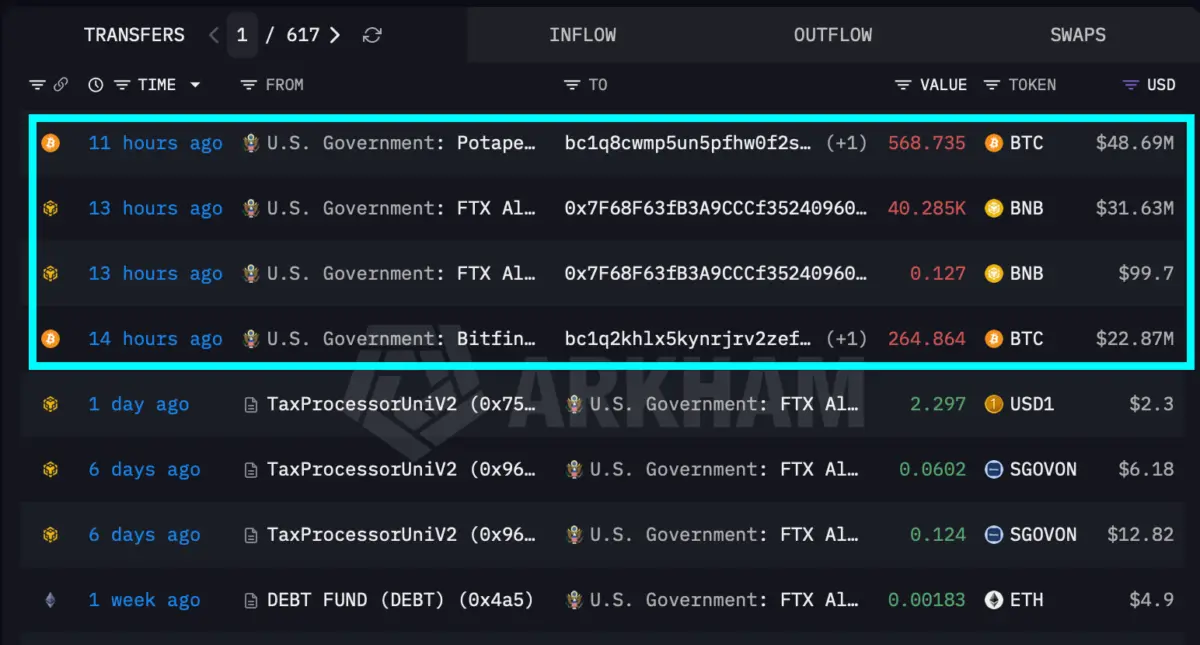
According to the data detailed by Arkham, the government-linked infrastructure executed transactions involving both Bitcoin and Binance Coin. Specifically, the government sent 833.599 Bitcoin, which was worth approximately $71.6 million at the time of the transaction, to two separate addresses that are currently unlabeled within Arkham’s database. Within a matter of hours, both of those intermediate addresses passed the coins onward to addresses that Arkham specifically identifies as Coinbase Prime deposit addresses, a custody and prime brokerage platform widely utilized by institutional investors and large-scale entities.
In a separate series of transactions tracked by the blockchain intelligence firm, a distinct government-labeled wallet initiated a transfer of about 40,285 BNB—valued at roughly $31.63 million—to an unlabeled address designated on the blockchain as 0x7F68F63fB3A9CCCf352409603421E0A574FbAD90. Following that initial transfer, that particular address swiftly routed the entire sum of Binance Coin onward to a second unlabeled destination address, identified as 0x6fB3Fe7b7E78AbB84CE007cBC7412C850B15A579.
A deeper look into the origin of the transferred funds reveals the historical criminal and civil forfeiture cases tied to the digital assets. The Bitcoin that moved through the pipeline originated from two distinct sources. A portion of the funds—amounting to 568.7 Bitcoin—came from a wallet that Arkham specifically labels as containing Potapenko and Turogin forfeited funds, referencing high-profile law enforcement actions against cryptocurrency mining and fraud operations. The remaining portion of the Bitcoin movement, consisting of 264.9 Bitcoin, originated from coins that had been successfully seized in connection with the notorious Bitfinex hack case, which has yielded massive asset recoveries for federal authorities over recent years. Meanwhile, the Binance Coin that changed hands originated from digital assets previously seized from Alameda Research, the prominent quantitative trading firm closely affiliated with the collapsed cryptocurrency exchange FTX.
Despite the movement of such a substantial nine-figure sum, federal holdings in the digital asset sector remain vast. The United States government still maintains custody of approximately $27.5 billion in various cryptocurrencies. It is worth noting for context that all of these digital assets held by federal agencies have been acquired strictly through enforcement actions, criminal asset seizures, and civil forfeiture proceedings rather than through discretionary government purchases. To date, the federal government has not utilized taxpayer money to make new acquisitions of cryptocurrencies in the open market, relying entirely on law enforcement seizures to build its digital treasury.
Large-scale movements of government-controlled cryptocurrency wallets have historically tended to spark widespread speculation, rumors, and fears across digital asset markets regarding an impending sell-off that could potentially exert downward pressure on token prices. However, industry experts and market analysts have emphasized that such transfers do not inherently signal a liquidation event or an immediate intention to dump assets on open exchanges.
Addressing the nuance behind these routine custody adjustments, market commentator Jose Rosell shared his perspective on the social media platform X. "A transfer is not the same as a sale. Under a March 2025 executive order, bitcoin forfeited to the government is meant to be held in a Strategic Bitcoin Reserve," Rosell noted, highlighting the evolving regulatory and administrative framework governing how federal authorities manage and retain seized digital assets rather than hastily liquidating them through standard market channels.