U.S. government agencies have issued a sweeping and urgent joint warning to critical infrastructure operators worldwide, highlighting an alarming trend of cyberattacks actively targeting industrial refrigeration and cold-chain monitoring systems. The coordinated advisory comes in the wake of a persistent wave of malicious digital intrusions designed to cause widespread service disruptions, severe fire hazards, and catastrophic losses of temperature-sensitive inventory across multiple continents.
According to the joint advisory released by the Cybersecurity and Infrastructure Security Agency (CISA), the Federal Bureau of Investigation (FBI), the Department of Health and Human Services (HHS), the Department of Agriculture (USDA), and the Department of Transportation (DOT), malicious actors are aggressively seeking out unpatched or internet-accessible controllers. By exploiting these vulnerabilities, attackers can remotely alter device settings, forcing units into continuous heating and defrost cycles that can destroy sensitive goods and severely strain physical equipment.
The advisory emphasizes that threat actors are systematically leveraging authentication bypasses, arbitrary code injection vulnerabilities, and weak out-of-the-box configurations to gain unauthorized access to operational technology environments. Once inside, these intruders manipulate vital control parameters, transforming automated cooling infrastructure into potential vectors for physical destruction and economic sabotage.
In response to the escalating threat, owners and operators of industrial facilities are being urged to implement robust security measures. Government authorities strongly recommend the deployment of strong multi-factor authentication, maintaining rigorous software and firmware update schedules, and systematically identifying any control systems that remain directly accessible from the public internet. Furthermore, operators must ensure the complete logical or physical isolation of operational technology devices, eliminate default passwords, retire legacy equipment that can no longer be effectively secured, and strictly audit or remove unnecessary remote access pathways while securing those that are genuinely required for operational continuity.

Brett Leatherman, FBI Cyber Branch Operations Director, underscored the gravity of the situation, noting the indispensable nature of the targeted infrastructure. Industrial refrigeration and cold-chain monitoring systems protect food, medicine, and other vital temperature-sensitive products, making them highly attractive and devastating targets for malicious cyber actors. Law enforcement and intelligence agencies are observing these systems being targeted across critical infrastructure sectors globally, placing both critical inventory and expensive operational equipment at immediate risk.
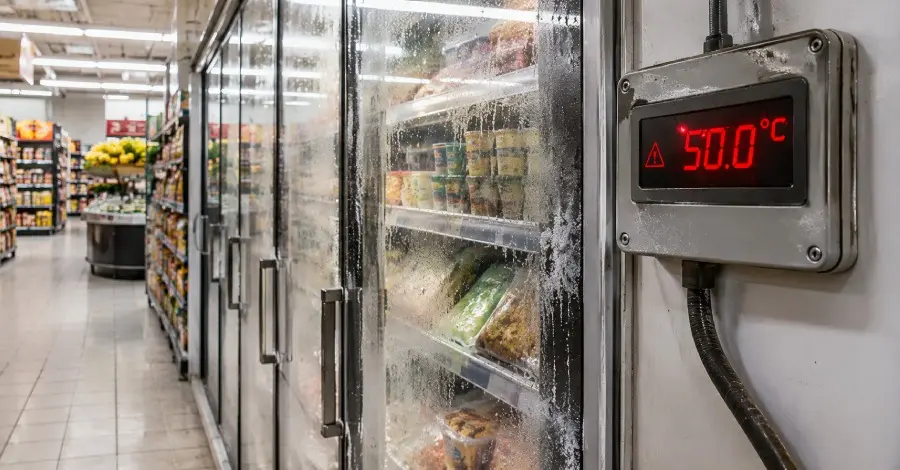
The government warning arrives on the heels of a troubling campaign that unfolded in recent weeks across Europe. Threat actors successfully targeted hundreds of supermarkets and grocery stores by exploiting security weaknesses in internet-accessible refrigeration controllers. In these incidents, attackers maliciously escalated internal temperatures—in some instances driving them as high as 50 degrees Celsius, or 122 degrees Fahrenheit—or forced cooling units directly into continuous defrost modes. The resulting spoilage of fresh food and perishable goods has inflicted substantial financial and operational losses on businesses ranging from multinational retail conglomerates to independent local merchants.
The geographic scope of these disruptions has been extensive, affecting commercial enterprises across Belgium, Estonia, Finland, France, Germany, Ireland, Italy, Luxembourg, the Netherlands, Portugal, Sweden, and the United Kingdom. The diversity of the victims underscores the indiscriminate nature of the campaigns, which have compromised major supermarket chains alongside small grocers and local butchers who rely heavily on uninterrupted cold-chain integrity.
Among the most alarming targets identified in the European campaign was the French Blood Establishment. The organization formally confirmed that a cybersecurity incident impacting one of its external refrigeration equipment providers forced temperature and defrost settings to extreme levels at three specialized facilities utilized for the safe storage of vital blood plasma. While investigations remain ongoing, authorities have yet to publicly attribute the sweeping hacking spree to a specific threat actor or state-sponsored group, leaving the exact motivations behind the attacks open to analysis by international cybersecurity researchers.

Recent telemetry data compiled by attack surface management platform Censys sheds light on the sheer scale of the digital exposure underlying these physical incidents. The data indicates that hundreds of Danfoss StoreView instances remain exposed globally, with the highest concentrations located within France. Although targeted remediation efforts and defensive advisories have driven down exposure numbers—with total Danfoss instances dropping from 3,004 to 708 between early October and early November 2026, and Copeland/Dixell XWEB exposures declining from 3,708 to 2,420—the remaining attack surface represents a persistent and dangerous window of opportunity for motivated attackers.
Censys researchers have categorized these widespread refrigeration attacks as the latest manifestation of a broader, deeply concerning trend targeting vulnerable industrial internet-of-things devices embedded within critical infrastructure. Similar campaigns in recent years have set their sights on gas station tank gauges, municipal air raid warning systems, and automated water towers, demonstrating a calculated shift by threat actors toward exploiting peripheral industrial control components that often lack the rigorous cybersecurity oversight applied to primary enterprise networks.
Global exposure metrics compiled by Censys further illustrate the distribution of industrial control system risks. North America currently accounts for approximately 38 percent of global industrial control systems exposure, while Asia’s share has experienced a steady upward trajectory, growing from 22 percent in 2024 to 25 percent by 2026. Conversely, Europe’s share of global exposure decreased from 36.5 percent to 32 percent over the same comparative period. However, industry analysts point out that these regional shifts have not translated into an overall reduction in global risk.
Security experts emphasize that while the sheer volume of exposed industrial systems remains high, the phenomenon is hardly unexpected. The precarious state of industrial control system security has been the subject of extensive reporting and repeated governmental warnings for years. Because these connected devices often serve as foundational gatekeepers to the world’s most vital critical infrastructure sectors, their exposure continues to pose an immediate, systemic risk to public safety, economic stability, and the continuous delivery of essential societal services.