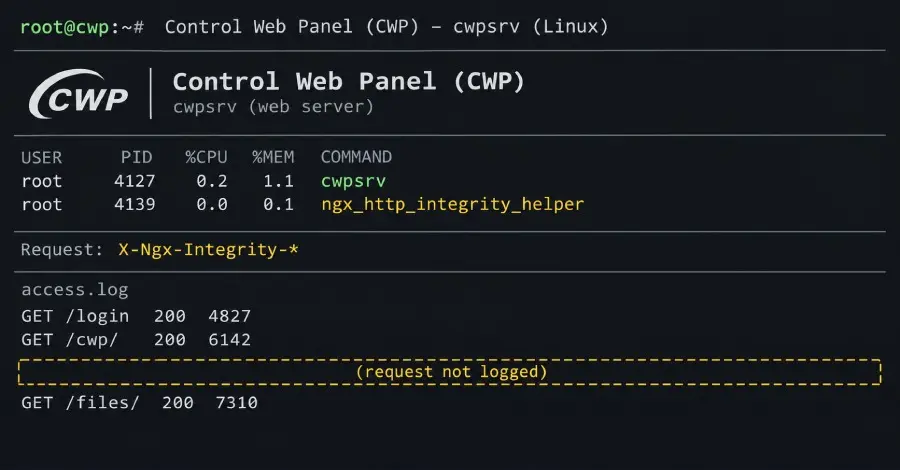
Security researchers have uncovered a highly sophisticated and stealthy backdoor embedded deep within the web server architecture of Control Web Panel (CWP), a widely utilized and free administration tool for managing Linux hosting environments. Identified by threat intelligence analysts at QiAnXin’s XLab, the malicious mechanism—dubbed "cwpdoor"—allows unauthorized actors to silently execute remote commands by intercepting incoming web traffic while leaving zero trace in standard server access logs.
The discovery highlights an evolving threat landscape where malicious actors are increasingly targeting core infrastructure components to maintain persistent, undetected access over compromised web hosting environments. Because the deployment of this backdoor requires root-level privileges, investigators have concluded that threat actors must already possess administrative control over the underlying server before the installation script can be successfully executed.
Anatomy of the Threat and Stealth Capabilities
According to the technical analysis published by QiAnXin XLab, the cwpdoor installer was first captured by researchers on June 29, appearing as a seemingly innocuous shell script disguised as a routine version update. The installer is specifically engineered to interact with two distinct legacy versions of the Control Web Panel web server environment, namely cwpsrv 1.15.10 and 1.24.0. At the time of the discovery, investigators noted that the exact vector utilized by attackers to attain the requisite root privileges prior to launching the script remained undetermined.

Further investigation into the operational mechanics of cwpdoor revealed that the backdoor is not a separate application, but rather the core cwpsrv binary itself, painstakingly rebuilt with malicious source code modifications. During normal operating conditions, the compromised server behaves identically to a legitimate, uninfected application. However, when an incoming web request features a valid timestamp and a cryptographic signature embedded within custom HTTP headers beginning with the prefix X-Ngx-Integrity, the modified web server intercepts the instruction and executes the payload carried within the request.
To evade detection by system administrators and automated security audits, the installation script meticulously restores the original modification timestamps of the cwpsrv binary. Consequently, standard file integrity inspections utilizing fundamental administrative commands like ls and stat report the file as entirely unmodified. Furthermore, when the researchers initially analyzed the compiled backdoor binary, it registered a detection rate of zero out of sixty-three security engines on the VirusTotal platform, underscoring its profound evasive capability.
Evidence of In-The-Wild Exploitation
The existence of active campaigns leveraging cwpdoor was further substantiated on September 30, when an archive containing a functional copy of the backdoor was uploaded to VirusTotal from a source in Brazil. Security analysts interpreted this upload as a clear indication that real-world victims have already been compromised in the wild, though comprehensive statistical data regarding the total volume of infected servers remains unavailable.

Intriguingly, the malicious archive uploaded from Brazil also contained traces of the long-standing Ebury malware, an infamous OpenSSH backdoor and credential-stealing toolkit that has remained actively exploited in global threat landscapes since at least 2009. While security analysts have not yet established a definitive operational link between the deployment of cwpdoor and the Ebury framework, they noted that multiple distinct adversarial groups frequently target the same vulnerable enterprise infrastructure, occasionally depositing overlapping toolsets on a single compromised machine.
Methods for Detecting and Remediating Compromised Servers
Given the extreme stealth characteristics of cwpdoor—such as the deliberate masking of file timestamps and the total absence of transactional records in traditional web server access logs—standard monitoring procedures are frequently insufficient to identify an active infection. To assist system administrators in auditing their hosting environments, QiAnXin XLab has outlined specific diagnostic indicators and detection methodologies designed to unmask the presence of the hidden backdoor.
In their technical advisories, the researchers highlighted that specialized socket and process evaluations can successfully reveal anomalous behavior on infected machines, even when open network ports and standard process lists appear entirely normal to the casual observer. Administrators who discover unauthorized modifications or detect the established indicators of compromise are urged to execute rigorous incident response protocols.

Recommended remediation efforts emphasize the complete eradication of the compromised binary, a comprehensive security audit of all root-level access credentials, and the restoration of affected systems from verified, uncompromised backups to ensure complete eradication of the persistent threat.