In a significant move that highlights the growing tension between the democratization of offensive security tools and the reality of cyber-criminal activity, Singapore and Hong Kong-based security firm ThreatBook has officially discontinued the open-source version of its AI-powered penetration testing platform, CyberStrikeAI. The decision, announced on November 26, marks a decisive shift in how the company intends to manage its suite of agentic offensive frameworks (AOFs), prioritizing controlled, enterprise-grade deployment over public accessibility.
The move comes as a direct response to the weaponization of the tool by threat actors who have leveraged the framework to orchestrate high-velocity cyberattacks. While the open-source iteration of CyberStrikeAI has been permanently purged from public repositories—including its prominent home on GitHub, where it had previously garnered more than 7,000 stars—the company confirmed that a closed-source, "Pro" version remains available for vetted corporate clients through its RedAgents platform.
The Rise and Fall of an Agentic Framework
Acquired by ThreatBook in September, CyberStrikeAI represents a new breed of cybersecurity technology: the agentic offensive framework. Unlike traditional penetration testing scripts that require significant manual input, AOFs are designed to function autonomously. By leveraging large language models and complex reasoning chains, these tools can identify vulnerabilities, navigate internal networks, and simulate adversarial movements with a level of speed and scale that was, until very recently, considered the sole domain of highly sophisticated state-sponsored hackers.
When it first appeared on the open-source scene in late 2025, CyberStrikeAI was lauded by the white-hat community as a breakthrough for security professionals. It promised to automate the often-tedious process of reconnaissance and vulnerability assessment, allowing under-resourced security teams to "red team" their own infrastructure with unprecedented efficiency. However, the open-source nature of the project proved to be a double-edged sword. Once the code was published, it became accessible to anyone with an internet connection, including the very threat actors that security firms strive to neutralize.
For months following the acquisition, ThreatBook attempted to maintain a dual-track strategy: supporting the open-source community while simultaneously developing a hardened, enterprise-focused version for its RedAgents portfolio. Ultimately, however, the mounting evidence of widespread misuse forced the company’s hand. By pulling the project offline, ThreatBook has effectively acknowledged that the risks associated with public distribution now far outweigh the benefits of community-driven innovation.
A Global Pattern of Misuse
The decision to shutter the open-source project was not made in a vacuum. It follows a wave of reports from international cybersecurity watchdogs detailing how AOFs are being integrated into the arsenals of organized crime syndicates and advanced persistent threat (APT) groups. The speed at which these tools can be deployed has fundamentally altered the threat landscape, allowing attackers to conduct wide-scale scans and exploit vulnerabilities in a fraction of the time required by human-operated campaigns.
Just one month prior to ThreatBook’s announcement, the Indian Computer Emergency Response Team (CERT-In) issued a stark warning to the financial and cryptocurrency sectors. The agency highlighted the activities of a threat group identified as "Crafty Falcon," which had been launching successive, highly automated attacks against high-value targets. According to CERT-In, Crafty Falcon had successfully integrated several AI-powered tools into their workflow, with CyberStrikeAI identified as a core component of their operational kit. This revelation underscored the reality that legitimate security tools, when left in the public domain, are frequently repurposed by adversaries to bypass traditional defenses.
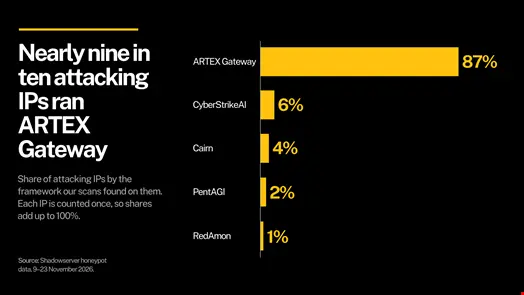
The extent of this trend was further illuminated by a November 25 report from the Shadowserver Foundation, a UK government-funded non-profit organization that monitors global internet traffic. The data paints a concerning picture: as of November 23, researchers identified more than 4,200 servers globally running various agentic offensive frameworks. This represents a rapid escalation in activity, with the number of active nodes climbing significantly in a single day.

While the report noted that not all of these servers are necessarily controlled by malicious actors—as they may include legitimate security teams conducting authorized testing—the sheer volume of deployment is telling. Of the frameworks identified by Shadowserver, 6% were confirmed to be utilizing CyberStrikeAI. The vast majority, however, were identified as ARTEX, another powerful agentic framework that has been previously linked to cyber-campaigns associated with Chinese and North Korean actors. The rapid growth of this ecosystem suggests that the "agentic" revolution in cyber-warfare is accelerating, placing immense pressure on both developers and defenders to secure these tools.
The Future of Defensive AI
Despite the controversy, ThreatBook remains adamant that the technology itself is not the problem. In a statement accompanying the takedown, the company emphasized its belief that AI-driven offensive technology is inherently neutral. They argue that if security teams are to defend against the next generation of automated attacks, they must have access to the same tools that their adversaries use.
"We firmly believe that technology is neutral, and that the most advanced attack technologies should be prioritized and solely used by security teams," the company stated. By restricting access to its "Pro" suite, ThreatBook hopes to maintain the utility of these tools for legitimate defensive self-assessment—allowing enterprises to test their own systems and patch vulnerabilities before a malicious actor can discover them.
Under the new RedAgents model, access to platforms like CyberStrikeAI Pro and ARTEX Pro is gated. Potential users must be verified enterprises that hold clear, legal authorization for the network assets they intend to test. Furthermore, the company has implemented strict monitoring protocols, explicitly stating that it reserves the right to immediately revoke access if it detects any misuse. This "gated access" model represents a broader industry trend toward the controlled distribution of high-risk security technologies.
For those who had previously relied on the open-source version of CyberStrikeAI, the company has issued a stern warning: do not attempt to source the tool from unofficial repositories. ThreatBook advised users to remain "vigilant of forks that appear elsewhere," noting that any unauthorized or third-party iterations of the code could be backdoored or otherwise compromised. In the context of cyber-security, using an unverified, community-forked version of an offensive tool could inadvertently turn a security professional into a victim, providing attackers with a backdoor into the very infrastructure they intended to protect.
As the industry grapples with the fallout of the CyberStrikeAI takedown, the conversation is shifting toward the responsibility of developers. The transition of powerful AI tools from open-source experiments to restricted enterprise software is a significant milestone, reflecting a maturation of the market. While the move will undoubtedly frustrate those who advocate for unrestricted open-source development, it serves as a pragmatic, if difficult, solution to the challenge of managing the dual-use nature of AI in an increasingly volatile digital world.
For now, the era of open-source "agentic" offensive frameworks appears to be closing, replaced by a more cautious, regulated environment where the power of artificial intelligence is tethered to the accountability of the enterprise. Whether this shift will be sufficient to slow the tide of automated, AI-driven cyberattacks remains an open question, but for ThreatBook, the priority is clear: ensuring that the tools of the trade are kept in responsible hands.