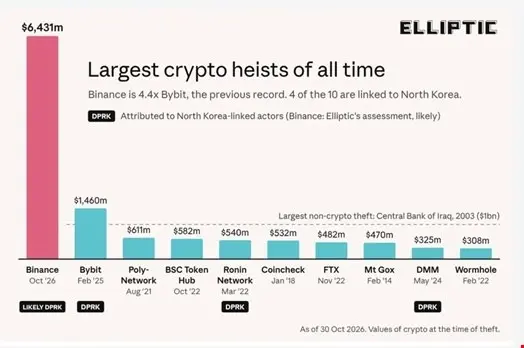
In an unprecedented development that has sent shockwaves through the global financial and cryptocurrency sectors, Binance—the world’s largest cryptocurrency exchange—has officially confirmed it was the victim of a massive cyber-attack. The breach, which resulted in the theft of approximately $6.3 billion in digital assets, marks the largest single hack in the history of the cryptocurrency industry, eclipsing all previous security incidents in terms of scale and financial impact.
The company, which maintains a complex corporate structure with origins in China, current headquarters in Dubai, and registration in Delaware, issued a formal statement on October 30 detailing the gravity of the situation. In a move aimed at stabilizing market confidence and protecting its user base, Binance announced that it has successfully frozen $3 billion of the stolen funds. Furthermore, the exchange has committed to covering all remaining losses through its Secure Asset Fund for Users (SAFU) and its own corporate reserves, ensuring that no individual user will bear the financial burden of this catastrophic breach.
Unraveling the Mechanics of the Breach
The investigation into how such a monumental theft occurred is currently in its nascent stages, yet the initial findings suggest a highly sophisticated and multi-layered attack vector. According to the company’s preliminary assessment, the primary point of entry may have been a compromised laptop belonging to a DevOps engineer working within the Binance infrastructure.
This initial breach allegedly granted the unauthorized actors the permissions necessary to access a service container, which in turn allowed them to bypass internal controls and submit a series of fraudulent withdrawal transactions. However, as the digital forensics team at Binance continues to pore over server logs and transaction data, the company has revised its initial assessment. They now state that the attack was far more complex than a single point of failure, revealing that the intruders likely exploited multiple, distinct vulnerabilities within the exchange’s security architecture.
"This was a complex attack," the company stated in a brief press release, acknowledging the sophisticated nature of the threat. Binance is currently coordinating an exhaustive post-mortem analysis in collaboration with law enforcement agencies, prominent blockchain intelligence firms, and various industry partners. The primary objective of this joint effort is to establish the full timeline of events, identify the specific technical lapses that allowed the breach to persist, and track the flow of stolen assets to facilitate recovery.

Despite the severity of the intrusion, Binance has provided some reassurance regarding its internal security protocols. The exchange explicitly stated that there is no evidence to suggest that any wallet private keys—the essential cryptographic credentials required to authorize transfers—were leaked or compromised. This distinction is critical, as it suggests the attack targeted the operational layer of the exchange rather than the core cryptographic security of the user funds themselves.
Attribution and Industry-Wide Implications
The sheer scale of the theft has drawn the attention of the world’s leading blockchain analysis firms, including TRM Labs, Elliptic, and Chainalysis. These organizations, which specialize in tracing illicit activity across public ledgers, have arrived at a startlingly consistent conclusion. With what they describe as "high confidence," these firms have attributed the operation to the threat actor known as TraderTraitor, a hacking group widely believed to be affiliated with the North Korean government.
North Korean state-sponsored hackers have become increasingly notorious in the cryptocurrency space, frequently utilizing advanced persistent threat (APT) methodologies to fund state operations by targeting high-value financial institutions. The attribution to a nation-state actor underscores the geopolitical dimension of this hack, transforming what might have been viewed as a standard security failure into a matter of international concern.
Operational Disruptions and Security Measures
In the immediate aftermath of the detection of the unauthorized outflows, Binance moved to implement a series of aggressive precautionary measures. The most significant of these was the temporary suspension of all deposits and withdrawals across its platform. Additionally, the exchange halted specific trading activities linked to its Binance Alpha service, including CEX Buy Token, Alpha Instant, and various purchase prediction marketing campaigns that utilized funds from users’ spot wallets.
As of the latest updates provided by the exchange, the situation is beginning to stabilize. Binance has confirmed that its deposit functionality has been fully restored and is operating as intended. However, the suspension of withdrawals remains in effect at the time of writing. The company is currently executing a comprehensive security revamp of its withdrawal architecture and associated wallet addresses. This process is deemed necessary to ensure that the vulnerability exploited by the attackers is completely remediated before normal services can resume. Binance has informed its users that they expect to fully restore withdrawal capabilities within 45 hours of their latest update.

The exchange also confirmed that its intervention successfully halted the unauthorized outflow of funds once the withdrawal systems were taken offline. By revoking the authorization for the affected addresses, Binance has effectively ring-fenced the remaining capital. The company continues to work around the clock with its external partners to trace the movement of the stolen assets, hoping that the transparency of the blockchain will assist in the eventual freezing and recovery of these funds across other exchanges and service providers.
Protecting the User Base
In light of the incident, Binance has urged its global user base to exercise extreme caution. History has shown that in the wake of major security breaches, threat actors often attempt to exploit the panic and confusion of users through phishing campaigns and social engineering tactics. Binance has issued a stern warning, advising customers to ignore any unsolicited links, messages, or requests for account information that claim to be from the exchange.
The company emphasized that its official communication channels remain the only reliable source of information regarding the status of the investigation and the restoration of services. Customers seeking assistance or clarity regarding their account status have been directed to contact Binance’s official Customer Support team exclusively.
Throughout its social media updates, Binance has maintained a consistent message of resilience, repeatedly asserting that user funds remain secure due to the company’s commitment to covering losses from its own reserves. Furthermore, the exchange has pledged to provide full transparency once the incident is fully resolved, promising to publish an updated proof-of-reserves report. This document is expected to provide users with an audited, clear view of the assets currently held by the exchange against individual user balances, a step intended to restore trust in the platform’s solvency and operational integrity.
As the industry waits for the final technical post-mortem, the event serves as a stark reminder of the persistent and evolving threats facing centralized cryptocurrency exchanges. The ability of a single entity to withstand a multi-billion dollar breach, both financially and operationally, will likely become a benchmark for the resilience of the digital asset ecosystem moving forward. For now, the global focus remains on the ongoing investigation, the efforts to recover the stolen capital, and the security upgrades that Binance hopes will prevent such an event from ever recurring.