The emergence of artificial intelligence has long been touted as a double-edged sword for the cybersecurity industry. While defenders leverage machine learning to detect anomalies and automate incident response, malicious actors are increasingly turning to the same underlying technologies to accelerate and scale their operations. A primary example of this shift is the rapid, global spread of ARTEX, an open-source, AI-powered autonomous penetration testing framework that has transitioned from a niche developer project to a staple in the arsenals of sophisticated cyber threat groups.
Originally released on GitHub in July 2026 by a user known as "Autumn-27," ARTEX was designed as an autonomous penetration testing tool. It was built using the Go programming language and features an embedded Next.js web console, providing a user-friendly interface for managing complex cyber-attacks. By integrating with various large language models (LLMs) and independent AI agents, the framework allows operators to orchestrate offensive maneuvers with unprecedented efficiency. However, the tool’s utility for legitimate security research has been overshadowed by its adoption in a series of high-profile, malicious campaigns that began surfacing as early as October 2026.
Despite the original author’s attempt to mitigate abuse by removing the repository from GitHub in October—citing the widespread misuse of the tool and clarifying that it was intended strictly for authorized penetration testing—the framework has proven difficult to contain. The genie, it seems, is out of the bottle. ARTEX continues to circulate through community-maintained forks and localized variations, such as "ScopeWeaver," and has even spawned a commercial iteration known as "ARTEX PRO." This persistent availability highlights the challenges of controlling dual-use technology in an era where software code can be replicated and modified instantaneously across global networks.
High-Profile Campaigns and Attributions
The transition of ARTEX from a proof-of-concept tool to a weaponized framework was signaled by a series of targeted attacks identified by top-tier threat intelligence firms. In early October 2026, security researchers at CrowdStrike linked the framework to a calculated campaign against South Korean financial institutions. During this period, which spanned from late September through early October, attackers utilized ARTEX in conjunction with Anthropic’s Claude AI model. CrowdStrike’s analysis pointed to a financially motivated, Chinese-speaking threat actor, marking one of the first instances where the autonomous capabilities of ARTEX were observed in the wild.
The severity of these threats was underscored later that same month when Microsoft identified the framework’s involvement in a large-scale compromise of ConnectWise customer tenants. This incident forced the IT management software provider to take a number of its cloud services offline to contain the breach. Microsoft attributed the operation to Storm-0940, a China-state-aligned group also known by the aliases CovertNetwork-1658 and ORB07. The use of ARTEX by a state-aligned actor demonstrated that the tool was not just a passing trend for petty cybercriminals, but a viable platform for high-stakes, persistent operations.
The threat landscape shifted further in early November 2026, when the Indian Computer Emergency Response Team (CERT-In) issued a public warning regarding a threat group dubbed "Crafty Falcon." This group had been targeting financial and cryptocurrency organizations in a series of successive, automated attacks. According to the advisory, Crafty Falcon was not relying on ARTEX alone; instead, they employed a multi-layered approach, utilizing several AI-powered tools to conduct reconnaissance and exploit vulnerabilities. The involvement of such a group served as a sobering reminder that AI-powered offensive frameworks are becoming increasingly integrated into the modern attacker’s workflow.
The Global Footprint: Censys Uncovers Widespread Infrastructure
While the individual attacks provided the initial alarm, the true scale of the ARTEX proliferation was only fully realized through a comprehensive analysis by the Censys Advanced Research Collective (ARC). In a report published on November 5, 2026, principal security researcher Silas Cutler provided a granular look at the infrastructure supporting these AI-driven campaigns.

The findings were alarming: 1,465 hosts worldwide were found to be exposing an ARTEX console directly to the public internet. While approximately 650 of these hosts were concentrated within two specific hosting blocks—suggesting a degree of centralized deployment—the remaining 815 deployments appeared to be distinct, independent instances. This massive, decentralized footprint confirms that ARTEX is not being utilized by a single, monolithic group, but rather by a diverse array of actors globally.
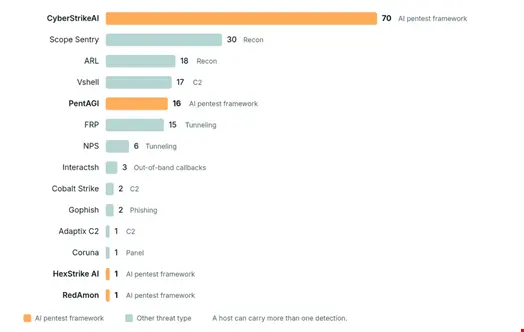
Beyond the sheer volume of deployments, the nature of the infrastructure associated with these hosts is telling. Censys telemetry revealed that 10.6% of the exposed ARTEX hosts—roughly 155 in total—were also running other known threat artifacts. These include established malicious tools such as Cobalt Strike, Vshell, and Adaptix C2, alongside various tunneling tools and reconnaissance platforms. Furthermore, the researcher noted that the creator of ARTEX is also responsible for "ScopeSentry," an asset-discovery and vulnerability-scanning tool, which also appears in the list of identified threat artifacts.
Perhaps most concerning is the degree of synergy between these frameworks. The researchers found that ARTEX frequently shares infrastructure with other AI-powered penetration testing tools, such as CyberStrikeAI, PentAGI, HexStrike AI, and RedAmon. In one notable finding, CyberStrikeAI was observed alongside ARTEX on 70 different hosts. As Silas Cutler noted, operators appear to be using multiple agent frameworks side by side, likely leveraging the strengths of each to conduct more comprehensive, automated campaigns.
The Maturation of Offensive AI Infrastructure
The evolution of these attacks suggests that the "offensive infrastructure stack" is becoming more sophisticated. It is no longer just about the penetration testing framework itself; it is about the surrounding ecosystem. The recent "Crafty Falcon" campaign, for instance, saw the combined use of ARTEX, PentAGI, and CyberStrikeAI, illustrating that attackers are moving toward a modular, "best-of-breed" approach for their AI-driven campaigns.
Furthermore, the research identified 32 ARTEX hosts that maintained publicly accessible directories containing a variety of post-exploitation kits, stagers, and implants. This indicates that these servers are not just acting as control panels, but as centralized hubs for the entire lifecycle of an attack. Perhaps most indicative of this trend is the discovery that 43 of the ARTEX hosts were running self-hosted LLM gateway or reseller software. By hosting their own gateways, attackers can circumvent restrictions placed on commercial LLMs, ensuring they have the computational power and intelligence necessary to drive their autonomous agents without interference from the model providers.
While researchers like those at Check Point have noted that these AI agents can still be prone to "hallucinations" and occasional failures in judgment, the speed and cost-effectiveness of these attacks cannot be ignored. A sophisticated, multi-stage operation can now be conducted for a few hundred dollars with minimal human intervention. As these frameworks continue to evolve, with developers adding new features and refining the underlying models, the barrier to entry for conducting high-impact cyber-attacks will continue to drop.
The ongoing proliferation of ARTEX and its peers represents a critical inflection point in the cybersecurity industry. As these tools continue to spread across global infrastructure, they shift the burden of defense. Organizations must move beyond static security models and prepare for an environment where attackers can deploy autonomous agents capable of adapting to defenses in real-time. With thousands of hosts potentially compromised or prepared for action, the challenge for global security teams is not merely identifying these tools, but neutralizing the increasingly complex, interconnected, and automated threat infrastructure that they represent.