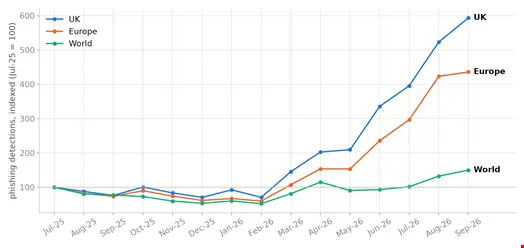
A stark new analysis of the cybersecurity landscape reveals that Europe has become the primary battleground for sophisticated phishing operations, with threat activity intensifying at a rate significantly higher than the global average. According to the latest research from Proofpoint, released on November 12, phishing threats across the European continent surged 4.5 times between 2025 and 2026. This escalation stands in sharp contrast to the global increase of 1.5 times during the same period, signaling a targeted shift in the focus of global cyber-criminal syndicates toward European targets.
The data, which tracks telemetry gathered from July 2025 through September 2026, highlights that the United Kingdom is currently facing the most acute pressure. During this 15-month reporting window, the UK experienced a staggering six-fold jump in phishing attempts, marking it as a focal point for malicious actors seeking to exploit regional digital infrastructure.
The implications of this surge extend beyond mere volume. Proofpoint’s researchers observed that European users are significantly more susceptible to these campaigns than their global counterparts. European users are now clicking on 8.3 out of every 100 delivered threat messages, a rate that dwarfs the global average of 2.0. This heightened engagement suggests that modern phishing campaigns have become increasingly effective, utilizing advanced social engineering and psychological manipulation to bypass standard user awareness and security filters.
The Rise of Precision Cloud Attacks
While high-volume, "spray and pray" phishing campaigns remain a persistent nuisance, the most alarming development identified by Proofpoint is the rise of highly effective, precision cloud attacks. These are not indiscriminate bulk emails; they are surgical, targeted operations designed to compromise specific high-value cloud accounts.
The impact of these precision attacks is severe. Proofpoint’s telemetry indicates that 64% of European organizations targeted by such methods show clear evidence of a successful compromise. These breaches are rarely simple credential thefts. They often involve complex, multi-stage processes that include session hijacking, account takeovers, and the establishment of long-term persistence within an organization’s cloud environment.
Speaking to the media during the Proofpoint Protect London event on November 12, Daniel Blackford, VP of threat research at Proofpoint, provided deeper insight into how these findings were derived. The research team utilized specialized account-takeover telemetry, which meticulously tracks login anomalies, unauthorized follow-on actions, and the modification of security configurations.
"These targeted attacks use techniques such as phishing and session hijacking to gain access to specific users and accounts," Blackford explained. "This highlights their effectiveness compared with broader brute-force attacks." Once an attacker gains entry to a cloud account, they often move quickly to consolidate their position. Common follow-on actions identified by the researchers include the creation of malicious email forwarding rules to intercept communications and the linking of unauthorized applications to the victim’s environment, which allows for continued, stealthy access long after the initial entry.
Espionage and the Changing Threat Landscape
The sophistication of the threat landscape in Europe is being driven by a confluence of factors, including the evolution of state-aligned espionage and the rapid integration of artificial intelligence into the attacker’s toolkit.
Different industry sectors are experiencing these threats in unique, often devastating ways. The hospitality and leisure sector, for example, has seen malware account for 21% of all detected threats, a figure nearly double the global industry average. This suggests that attackers view the hospitality industry as a gateway to both sensitive consumer financial data and, potentially, the corporate networks of high-profile travelers.
The healthcare sector, which has long been a target for ransomware, is facing a new wave of advanced threats. Proofpoint reported that callback phishing—a sophisticated technique where an initial email prompts a user to call a fake support number—has increased by 257% year-over-year in healthcare. Furthermore, malware detections within healthcare organizations rose by 84% over the same period, suggesting that attackers are aggressively testing the defenses of these critical service providers.
Beyond sector-specific trends, the geopolitical nature of the threats is shifting. Espionage remains a significant driver of cyber-activity in the region. Proofpoint researchers have observed that threat actors based in South Asia are successfully extending their operational reach into Western Europe. Simultaneously, state-aligned groups from Russia and China are continuing to refine their tactics, demonstrating a high degree of adaptability in response to improved defensive measures.
The AI Transformation
Perhaps the most significant long-term challenge identified by the report is the rapid adoption of AI by both legitimate businesses and malicious actors. The widespread integration of cloud services and AI-enabled technologies has created an expanded attack surface that organizations are struggling to secure.
Proofpoint’s telemetry identified more than 188,000 AI-enabled applications currently connected through standard authentication and OAuth frameworks. This level of interconnectedness, while beneficial for productivity, creates significant security gaps. The proportion of European sensors affected by attacks specifically targeting open-source AI technologies increased 4.6 times between consecutive 90-day periods, indicating that attackers are actively searching for vulnerabilities in the AI supply chain.
For years, the cybersecurity industry debated whether AI would genuinely change the nature of cyber-attacks or if it was simply a marketing trend. According to Blackford, that debate has been settled by the reality of the last eight months. "Up to last year, I could have said AI for attackers was still a bit too hyped up, but within the last six to eight months, we’ve really started seeing widespread adoption of coding assistants and AI usage across the vast majority of the landscape," Blackford noted.
This transition means that even entry-level hackers can now utilize AI-powered tools to draft more convincing, localized, and contextually aware phishing lures. When combined with the speed at which AI can identify vulnerabilities in OAuth configurations or cloud-based AI tools, the barrier to entry for conducting high-impact, precision attacks has been lowered significantly.
As European organizations navigate this volatile period, the findings from Proofpoint serve as a stark reminder that legacy security postures are no longer sufficient. The shift from broad, detectable spam to highly targeted, AI-augmented, and cloud-focused exploitation requires a fundamental reassessment of how European businesses protect their identities, their data, and their access to the cloud. With phishing engagement rates in Europe currently running four times higher than the global average, the urgency for a more resilient and intelligence-driven defense strategy has never been more apparent.