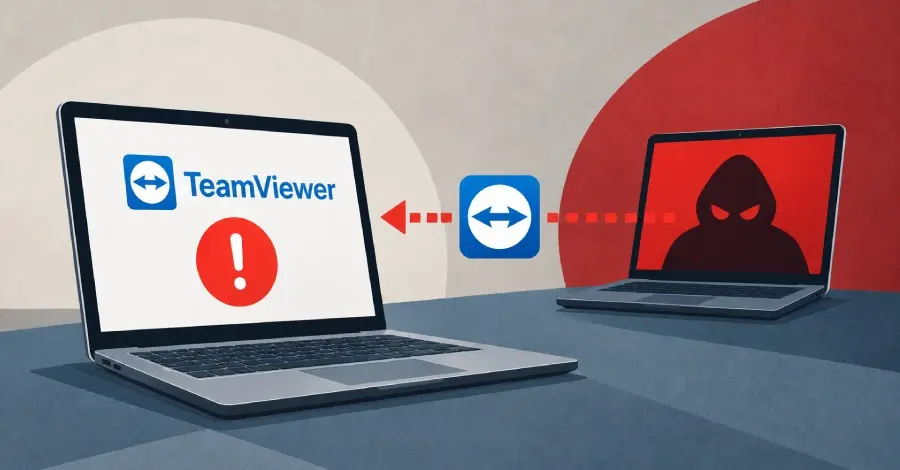
TeamViewer has rolled out a critical security update to address a high-severity vulnerability that effectively flips the script on remote desktop sessions, allowing a compromised or malicious host machine to launch attacks against the computer connecting to control it.
Discovered and detailed by security researchers, the vulnerability highlights a dangerous twist in traditional remote-access trust dynamics. In a standard TeamViewer session, the machine that initiates the connection and takes control is designated as the viewer, while the remote machine being accessed and managed is known as the host. Under normal operational circumstances, security assumptions dictate that the viewer exercises authority and control over the host. However, the newly patched vulnerability demonstrates that this trust relationship can be dangerously subverted, putting the controlling device directly in the crosshairs of a compromised remote endpoint.
The security flaw has been officially cataloged as CVE-2026-111585 and carries a high severity score of 8.8 out of 10 on the Common Vulnerability Scoring System. It impacts a wide array of TeamViewer editions across multiple major operating systems. Specifically, the vulnerability affects the TeamViewer Full Client on Windows, Linux, and macOS, the Windows Portable edition, and the Android Remote Control app. All software versions released prior to the newly issued patch are vulnerable to exploitation.
According to technical advisories and documentation provided by TeamViewer, the vulnerability is addressed in version 15.83. Interestingly, TeamViewer’s security bulletin for this specific update lists the Full Client, Portable edition, and Android application, but notably omits the dedicated TeamViewer Host package from the primary advisory. However, because the version 15.83 update bundle simultaneously patches two other vulnerabilities that do directly affect the Host package, software maintainers and system administrators operating Host editions are strongly advised to apply the update immediately as part of standard security hygiene.
The technical mechanics behind the vulnerability were brought to light on October 29 through a comprehensive analysis published by Omri Dar, a security researcher at the cybersecurity firm Remedio. In his technical breakdown of the bug, Dar succinctly summarized the inverted threat vector by noting that within the context of the exploit, "the attacker is the host and the victim is the viewer."
The root cause of the vulnerability lies in how TeamViewer handles screen resolution and image data transmission during an active remote support session. When a connection is established, the remote host machine communicates the physical dimensions and size of its screen image to the connecting viewer. The viewer’s software relies on this reported dimension to dynamically allocate memory space to render the incoming visual data.
However, a critical flaw in this calculation process leaves the system prone to an integer or memory overflow. Because the calculation can be manipulated, the viewer application inadvertently reserves significantly less memory than required to handle the incoming data stream. Consequently, subsequent screen data packets transmitted by the host arrive and are written past the designated boundaries of the allocated memory space, resulting in a classic buffer overflow condition.
At its most basic level of impact, this memory corruption instantly crashes the viewer’s TeamViewer session. More alarmingly, a malicious host can repeatedly trigger this crash mechanism at will, disrupting ongoing administrative tasks or support operations.

On Windows platforms, Remedio’s research demonstrated that the vulnerability could be pushed far beyond a simple denial-of-service crash. By crafting specialized payloads, the researchers successfully bypassed the operating system’s built-in exploit mitigations and executed arbitrary code of their choosing directly on the viewer’s machine. While this advanced phase of the demonstration relied on a specialized stand-in on the host side to supply a portion of the malicious attack data—meaning it has not yet been packaged as a fully automated attack carried out entirely over a standard network connection—it underscores the severe risk profile of the flaw.
The demonstration of arbitrary code execution was explicitly documented on Windows, while the security write-up left the feasibility of similar OS-specific exploits on macOS, Linux, and Android unconfirmed. Nevertheless, TeamViewer’s official advisories acknowledge that remote code execution remains a distinct possibility depending on the underlying platform and environment.
A particularly concerning aspect of the vulnerability is the minimal level of interaction required for an attack vector to open. According to Dar’s analysis, the attack requires neither a password nor any additional user interaction beyond the initial acceptance of the remote session itself. Furthermore, the vulnerability is present in TeamViewer’s default out-of-the-box configuration settings.
The discovery also highlights the limitations of past patching cycles. The flaw affects all versions preceding 15.83, which includes version 15.82—the security update that TeamViewer had previously released in September. Organizations and individual users who diligently applied last month’s updates would still remain exposed to CVE-2026-111585 unless they take further action to adopt the newly released version.
What to Do
TeamViewer has confirmed that updating to software version 15.83 or later is the definitive and sole remediation for CVE-2026-111585, as no alternative workarounds have been provided. Users operating older supported branches are directed to upgrade their installations to the latest builds.
The release of version 15.83 addresses more than just the viewer-side memory corruption issue. The same update package includes patches for two additional high-severity vulnerabilities detailed in the same security bulletin, including a separate remote code execution flaw that specifically impacts Linux and macOS environments. Simultaneously, TeamViewer published a companion security bulletin, designated TV-2026-1012, to resolve six separate vulnerabilities discovered within the platform’s Remote Management add-on modules, which are typically deployed via automatic update mechanisms.
At the time of the update’s release and the subsequent public disclosures, TeamViewer indicated that it had received no credible reports or telemetry suggesting that CVE-2026-111585 was actively being exploited in the wild. Furthermore, the vulnerability had not been incorporated into the Cybersecurity and Infrastructure Security Agency Known Exploited Vulnerabilities catalog as of the late October disclosures, and the researchers at Remedio chose not to release functional exploit code to the public domain.