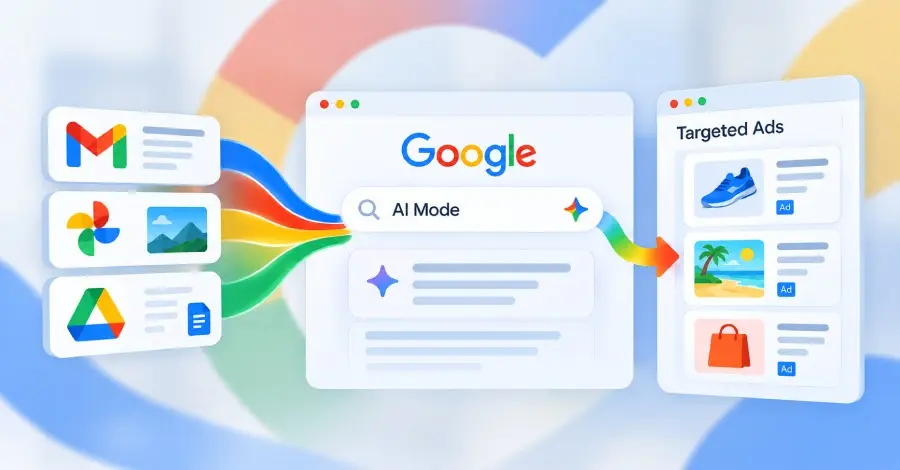
Google has updated its privacy policy to explicitly state that utilizing personalized artificial intelligence features across Google Search or Gemini Apps may enable the tech giant to deliver targeted advertisements to users. This ad serving can be influenced by user activity and data derived from other connected Google services, tying deeper AI integrations directly to the company’s core advertising ecosystem.
The policy update, which became effective on October 16, 2026, details how enabling cross-service data access transforms the information available for content and ad personalization. According to the revised terms, users may choose to allow certain Google services—including Search and Gemini—to access data from other integrated Google tools they use, such as Google Photos and Workspace applications like Gmail and Google Drive. This integration is designed to provide a more personalized, cohesive user experience, though it remains subject to the specific policies and settings of the accessing service.
As the updated policy notes, Search may process some of the data that users permit it to access in order to personalize content, which explicitly includes advertisements. While Google notes in its revised documentation that it does not show personalized ads based on user content from Drive, Gmail, or Google Photos by default, that boundary shifts the moment individuals choose to make data from those services available to other Google features that support personalized ads.

News of the policy modification was first brought to light by Android Authority, shedding further illumination on the evolving privacy trade-offs inherent in modern generative AI features. The update closely intersects with Google’s rollout of "Personal Intelligence," a capability unveiled for Gemini in January 2026. This feature allows users to connect complementary services like Gmail, Google Photos, and YouTube directly to Gemini, generating tailored, context-aware answers that combine personal data with ongoing chat history and user preferences.
Currently, the Personal Intelligence feature is rolling out as a beta to eligible users over the age of 18 globally. However, regional regulatory frameworks have carved out exceptions; the feature is not available in the European Economic Area, Switzerland, the United Kingdom, and Nigeria, where stricter privacy regulations govern cross-service data sharing and automated profiling.
The core privacy nuance lies in the shift from passive data storage to active AI utilization. By default, Google maintains that content stored within Gmail, Drive, or Photos is walled off from ad personalization pipelines. However, that status changes if users opt to share specific photos, emails, or documents with AI Mode and other Search tools via the Personal Intelligence framework. When individuals interact with AI Mode or Gemini while Personal Intelligence is enabled, the underlying data that informs those customized AI responses—such as personal emails or photo metadata—can subsequently act as a behavioral signal used to serve targeted ads.
This policy clarification highlights how feeding personal data into sophisticated AI tools can directly contribute to advertising profiles. For everyday users, navigating these changes requires mindfulness regarding the privacy trade-offs involved in connecting isolated apps to powerful AI ecosystems. Individuals who prefer to preserve a strict separation between their private communications, stored files, and targeted advertising profiles retain options to opt out. Users can selectively disconnect specific applications from Personal Intelligence or disable personalized recommendations entirely by adjusting their preferences through the Search Services Personalization settings available online.

The intersection of artificial intelligence and digital advertising is rapidly transforming the technology landscape beyond Google as well, creating a broader industry trend toward AI monetization. In January 2026, OpenAI initiated a parallel shift by beginning to display advertisements to logged-in adult users in the United States across both the free tier and the ChatGPT Go subscription tier. At the time of that rollout, OpenAI emphasized that user data and private conversations remained protected and were never sold to advertisers, asserting that the presence of ads did not influence the substantive responses generated by the chatbot and that users retained control over their overall experience.
Earlier this week, OpenAI announced a significant expansion of its advertising framework, bringing ads in ChatGPT to 26 additional countries and raising the total footprint to 89 markets worldwide. This expansion incorporates 14 additional nations across Latin America alongside several new markets distributed throughout Europe, Africa, and Asia. In reiterating its stance on user privacy during the expansion, OpenAI maintained that individual conversations remain strictly confidential from advertisers, customer data is never sold, ads are clearly labeled and kept separate from generated answers, and advertising does not sway the outputs provided by ChatGPT.
As both Google and OpenAI integrate advertising models directly into advanced conversational AI and personalized intelligence platforms, users face increasing choices regarding how their personal data flows between productivity tools, AI assistants, and commercial advertising networks.