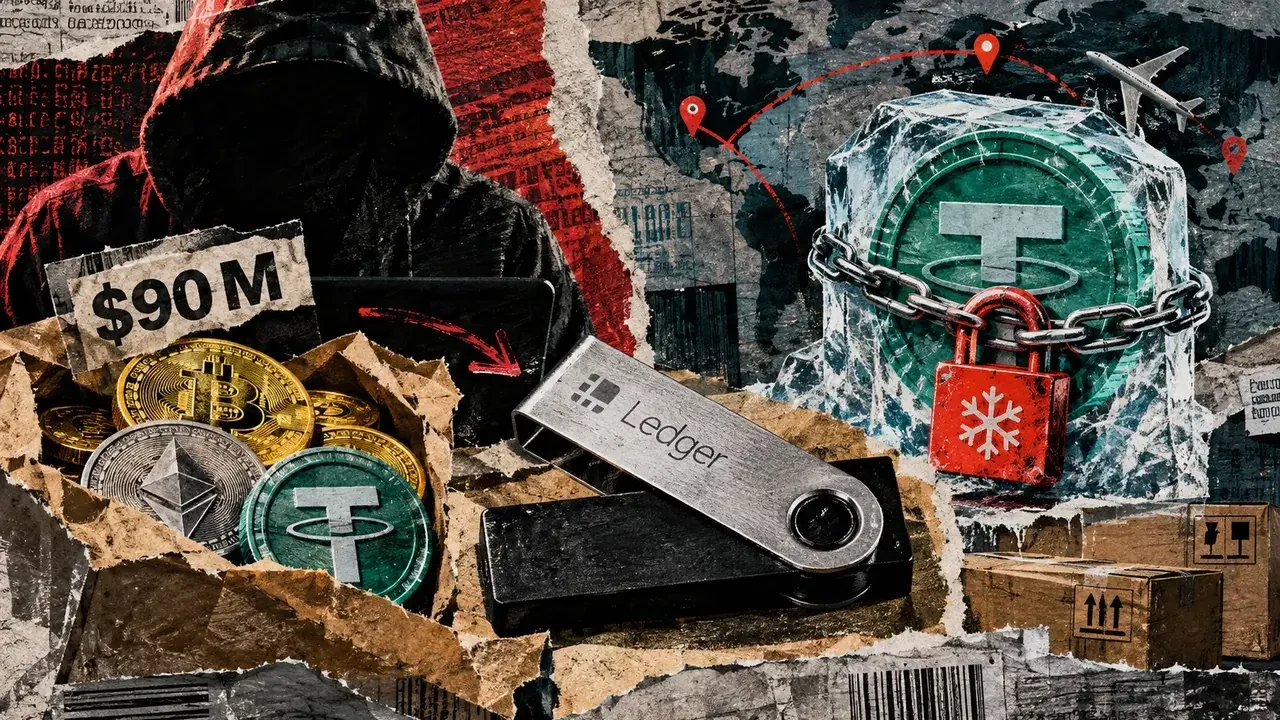
Suspected thefts involving Ledger hardware wallets are rapidly approaching the $90 million threshold, catching the attention of blockchain investigators, industry executives, and security experts worldwide. The escalating security crisis centers around devices distributed through an authorized reseller operating in Southeast Asia, prompting swift containment efforts, industry-wide tracing operations, and emergency administrative actions by stablecoin issuer Tether.
In an official statement released on Oct. 9, hardware wallet manufacturer Ledger announced that it had launched a comprehensive internal investigation into reports that multiple customers had suffered catastrophic losses of funds. These affected users had reportedly purchased their hardware wallet devices directly from CryptoBilis, a recognized and authorized reseller operating within Malaysia, Indonesia, and the Philippines.
As a severe precautionary measure to protect prospective buyers, Ledger immediately requested that the regional distributor pause all sales and shipments of its hardware wallets while the ongoing investigation attempts to determine the exact origin and scope of the compromise. Furthermore, the company issued urgent guidance to anyone who had purchased a Ledger device from CryptoBilis within the preceding 90 days, explicitly advising them not to initialize the hardware if they had not yet completed the initial setup process.
For customers who had already configured their vulnerable wallets, Ledger urged them to consider transferring their remaining cryptocurrency assets immediately to a brand-new Ledger device that had been initialized securely using a completely fresh recovery phrase.
CryptoBilis is a Recognized Ledger Reseller
The involvement of CryptoBilis has introduced significant concern across the digital asset community, given that the vendor occupies a legitimate and verified position within Ledger’s official reseller directory for Southeast Asia. Typically, retail customers purchase cryptocurrency hardware through authorized distribution channels precisely to mitigate and minimize the inherent risks associated with acquiring counterfeit, second-hand, or physically compromised hardware components from unverified secondary markets.
The unprecedented scale and unusual nature of the security incident quickly drew public commentary from high-profile industry figures, including Binance founder Changpeng Zhao. Taking to social media platform X, Zhao urged cryptocurrency users to exercise extreme caution, especially if they had recently acquired a Ledger hardware wallet through regional channels.
Based on the preliminary information available during the early stages of the disclosure, Zhao remarked that the issue appeared to be closely localized to a supply chain attack originating with a single vendor. He suggested that a relatively limited number of retail customers may have inadvertently received counterfeit or physically tampered devices, while concurrently emphasizing Ledger’s long-standing, stellar security reputation within the broader blockchain ecosystem.
Zhao also issued a strong appeal for widespread cooperation across the global cryptocurrency industry to help identify the suspected malicious actors behind the operation and ultimately recover the stolen assets. He stated that he fully expected and knew that all participants within the BNB ecosystem—alongside the wider cryptocurrency industry—would step up to help trace and recover the drained funds.
Meanwhile, former Mt. Gox CEO Mark Karpelès has independently initiated investigations to determine whether malicious hardware components or microchips were physically inserted into the internal circuitry of the devices distributed to unsuspecting customers. Karpelès publicly requested that CryptoBilis voluntarily open a selection of its unsold Ledger inventory so that their internal circuit boards could be physically inspected for unauthorized modifications, spying implants, or hidden hardware bugs.
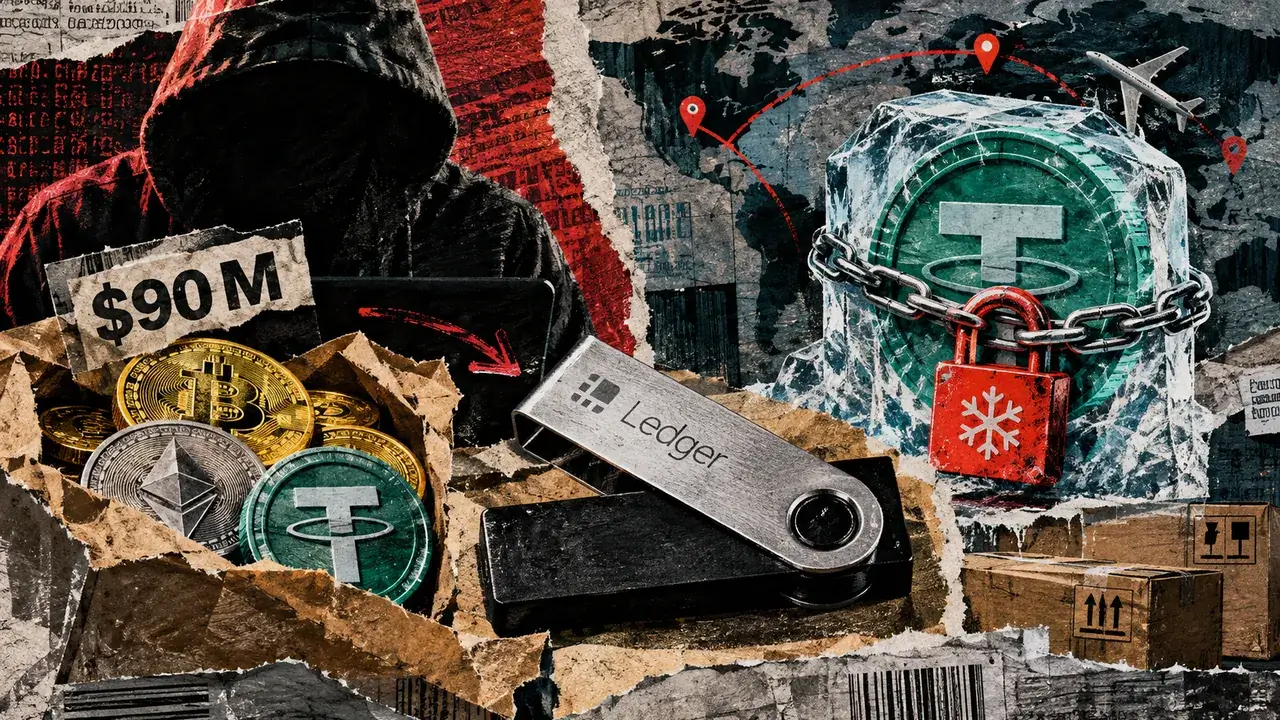
This intensive focus on physical supply chain integrity highlights a known limitation inherent in Ledger’s hardware authentication architecture. According to the company’s published security documentation regarding its device genuineness threat model, the proprietary Genuine Check system is designed to verify the authenticity of a device’s Secure Element chip. However, the system cannot necessarily identify unauthorized physical modifications elsewhere on the circuit board if the original security chip remains intact and operational. Consequently, a physically altered hardware wallet could theoretically pass automated factory authentication checks even if it harbors unauthorized components designed to compromise user keys.
Despite intense speculation and ongoing forensic examinations, no confirmed evidence has yet emerged to prove conclusively that malicious hardware implants were the primary vector responsible for the reported thefts. Ledger has consistently maintained that it has not yet disclosed the exact number of potentially compromised devices, nor has it formally established whether the incident stemmed from counterfeit hardware, physical tampering during transit, or an entirely different attack vector altogether.
Tether Freezes Funds as Investigators Race to Contain Losses
While Ledger and independent security researchers continue to examine the suspected source of the security breaches, on-chain blockchain investigators are locked in a high-stakes race to trace, isolate, and restrict the movement of the stolen cryptocurrency before it can be completely laundered.
Prominent on-chain investigator Specter reported that detailed transaction analysis successfully identified suspicious inflows originating from hundreds of suspected victim wallets. These stolen funds were funneled into a network of consolidated addresses spanning multiple major blockchain networks, including Bitcoin, Ethereum, and Tron. While Specter initially estimated that the total volume of suspected thefts exceeded $86 million, subsequent analyses conducted by prominent blockchain security firm MistTrack placed the total reported losses even higher, drawing closer to the $90 million mark.
Industry analysts emphasize that these preliminary estimates have not yet been independently verified by law enforcement agencies, and investigators have not yet definitively established whether every single wallet included in the aggregate calculations was compromised through the exact same underlying operational attack.
Nevertheless, the investigation took a significant turn when MistTrack reported observing Tether actively freezing USDT tokens linked directly to the unfolding incident, noting that several affected users had proactively reached out to its security team for assistance. This rapid intervention offers a vital potential recovery avenue because the USDT stablecoin incorporates centralized administrative control features. These mechanisms allow Tether to restrict administrative transfers from designated addresses flagged for illicit activity, effectively locking the funds in place.
Once an affected blockchain address is successfully frozen by the issuer, users and malicious actors alike are entirely blocked from moving the targeted USDT through ordinary, peer-to-peer blockchain transactions unless the administrative restriction is explicitly lifted. This capability serves as a crucial defensive barrier, preventing stolen capital from immediately shifting across additional intermediary wallets or rapidly converting into privacy coins and decentralized assets while investigators work tirelessly to establish definitive ownership.
However, security experts caution that this administrative intervention possesses inherent limitations. The suspected multi-million-dollar thefts span multiple distinct blockchain networks and encompass a wide variety of native digital assets that extend far beyond USDT. Because Tether possesses no technical authority or administrative control over native Bitcoin or Ethereum, investigators remain heavily dependent on voluntary cooperation from centralized cryptocurrency exchanges, custodial platforms, and international law enforcement agencies if those native assets manage to move into identifiable, KYC-compliant services.
Furthermore, freezing USDT does not automatically translate to an immediate return of the tokens to their rightful owners. Any formal restitution process would inevitably require extensive further verification, legal documentation, and tight coordination with relevant regulatory authorities and institutional counterparties. Because MistTrack has not publicly disclosed the exact dollar value of the restricted stablecoins, it remains entirely impossible to calculate what precise proportion of the nearly $90 million in total reported losses can ultimately be recovered. This persisting uncertainty places immense pressure on the global blockchain security community to track down the remaining dispersed funds before they can be completely obscured through complex, cross-chain laundering schemes.