During Strategy’s (MSTR) Q3 earnings call, executive leadership—featuring founder and executive chairman Michael Saylor alongside CEO Phong Le—engaged in a comprehensive and forward-looking question-and-answer session with Wall Street analysts and industry experts. The discussion spanned critical topics shaping the corporate treasury and digital asset landscape, including the evolution of digital credit, the mechanics behind Stretch (STRC) returning to par, the outlook for other preferred instruments, and the broader implications of Bitcoin’s ongoing financialization and tokenization.
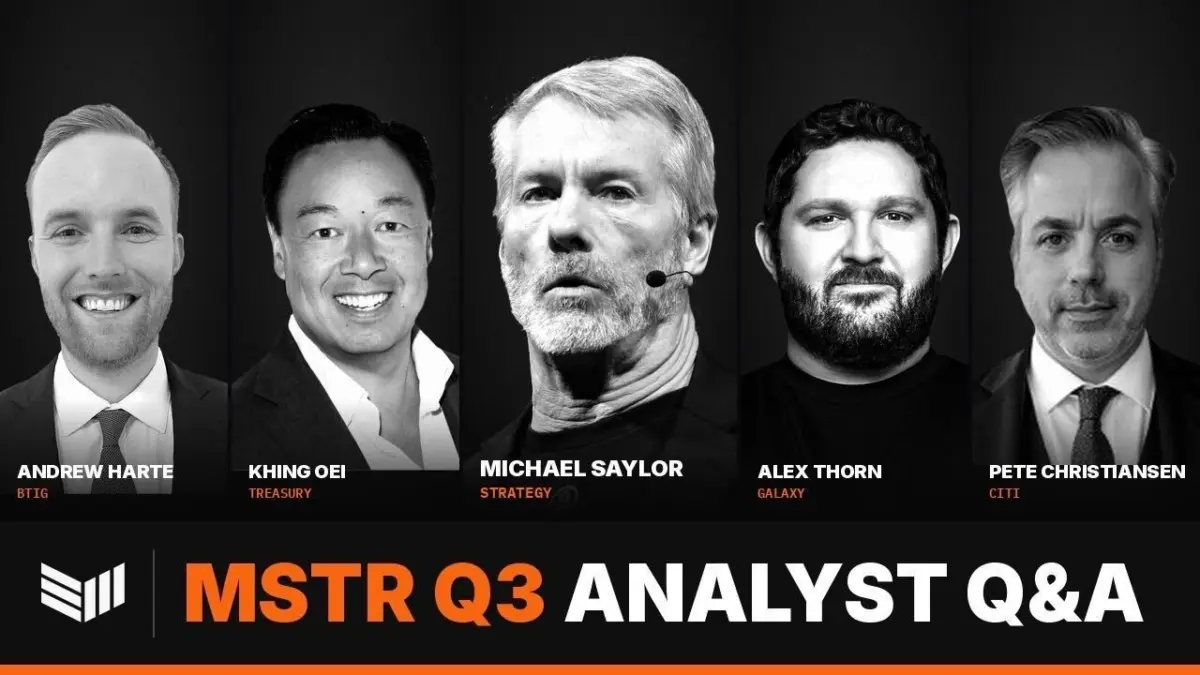
The interactive session featured inquiries from prominent financial institutions and market participants, including Andrew Harte of BTIG, Khing Oei of Treasury, Alex Thorn of Galaxy, Pete Christiansen of Citi, and independent analyst Scott Melker. Their questions drew out detailed commentary from Strategy’s leadership regarding how the firm plans to navigate the capital markets, manage its balance sheet through shifting macroeconomic cycles, and pioneer new frontiers in Bitcoin-backed financial products.
Strategy’s Balance Sheet vs. the Last Bull Market
The conversation opened with a structural examination of how Strategy’s balance sheet has evolved when compared to previous bull market cycles. Leadership highlighted the vast difference in scale, liquidity, and operational maturity between the company’s early accumulation phases and its current standing. In past cycles, the firm operated with a much leaner capital structure and relied more heavily on direct debt or spot purchases. Today, Strategy has built a sophisticated treasury apparatus capable of supporting multi-layered financial instruments, allowing the firm to weather volatility while continuously expanding its underlying digital asset holdings.
Expanding on this structural maturity, Saylor and Le addressed the capital-intensive nature of modern corporate finance within the digital asset sector. Emphasizing that scaling digital credit requires substantial foundational backing, leadership noted that a firm must deploy a massive amount of capital to create a corresponding volume of credit in the market. This foundational strength enables Strategy to innovate without compromising its core treasury strategy, setting a precedent for how corporate balance sheets can interact with premier decentralized assets.
Managing Equity and Capital Instruments
As the discussion progressed toward market mechanisms, analysts pressed leadership on capital allocation strategies, specifically questioning when Strategy might turn its equity ATM (at-the-market) facility back on. The management team provided insights into the delicate balance between share issuance, accretion, and market demand, explaining that capital-raising decisions are continuously evaluated against prevailing market conditions, equity premiums, and the ultimate objective of maximizing shareholder value per Bitcoin.
A significant portion of the Q&A focused on specialized financial instruments, most notably Stretch (STRC) and the reasons behind its four-month journey to return to par. Analysts sought to understand the unique liquidity and market dynamics that influenced STRC during this stabilization period. Leadership broke down the mechanics of the instrument, explaining the supply-and-demand factors, structural maturities, and market friction points that temporarily diverged the asset from its par value before structural adjustments successfully brought it back into alignment.
The conversation naturally broadened to encompass the suite of related preferred instruments, including STRD, STRK, and STRE. Analysts queried management on the strategic roadmap for these assets and how they fit into the broader corporate credit ecosystem. Particular attention was paid to the euro-listed STRE, with leadership candidly discussing the unique regulatory, cross-border, and liquidity challenges associated with maintaining financial products across disparate international jurisdictions. Despite these hurdles, management underscored the value of offering diversified credit options to global institutional investors seeking exposure to Bitcoin-backed financial vehicles.
Bitcoin’s Financialization and Institutional Evolution
Moving beyond specific corporate instruments, the dialogue shifted toward macro themes, specifically addressing whether Strategy is actively financializing Bitcoin. Management explored the philosophical and practical dimensions of this trend, arguing that as Bitcoin integrates deeper into traditional capital markets, it naturally undergoes a process of financialization. This evolution allows institutional market participants to interact with the asset through familiar financial wrappers, thereby bridging the gap between legacy capital systems and pristine digital scarcity.
This integration is already having a measurable impact on market behavior. Analysts and executives discussed how institutional participation is actively damping Bitcoin’s historical volatility. By introducing sophisticated hedging strategies, structured credit, and long-term capital allocations, institutional inflows help smooth out the sharp boom-and-bust cycles that once characterized the asset class. Leadership compared this maturation process to historical industrial revolutions, invoking the pioneering eras of inventors and industrialists like Thomas Edison and John D. Rockefeller to contextualize how foundational technologies eventually undergo financial abstraction and widespread economic integration.
The Frontier of Tokenization
The final segment of the Q&A tackled the burgeoning landscape of tokenization and its potential to reshape capital markets. When asked whether Strategy would issue tokenized MSTR shares tailored specifically for U.S. investors, leadership evaluated the regulatory environment and the immense technological promise of distributed ledger technology. Management emphasized that the true promise of tokenization lies in the creation of a freer, more transparent, and highly efficient market where securities can settle instantly and interoperate seamlessly across global networks.
However, the conversation also confronted the regulatory hurdles facing the industry, highlighting the lack of a unified U.S. token standard as the primary "elephant in the room." Without clear regulatory frameworks and standardized protocols from domestic authorities, the widespread adoption of tokenized corporate securities in the United States remains constrained. Despite these regulatory bottlenecks, Strategy’s leadership remains optimistic about the long-term trajectory of tokenization and its potential to unlock unprecedented liquidity and utility for investors worldwide.
Disclaimer: The views and opinions expressed in this show are those of the participants and do not necessarily reflect the official policy or position of BTC Inc., Bitcoin Magazine, or any affiliated entities. This content is provided for informational and educational purposes only and should not be construed as investment, legal, tax, or accounting advice. Nothing contained in this show constitutes a solicitation, recommendation, endorsement, or offer to buy or sell any securities or financial instruments. Viewers should consult their own advisors before making financial or business decisions.