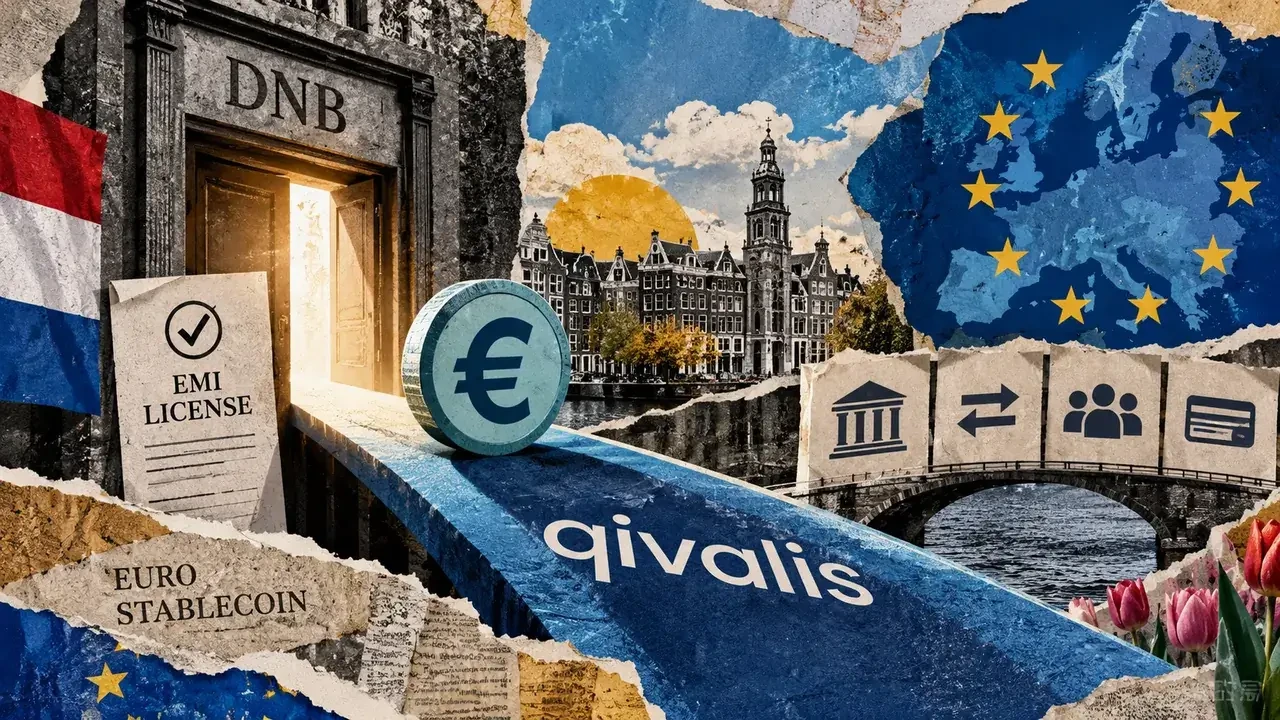
The landscape of European digital finance has taken another significant step forward as bank-backed stablecoin initiative Qivalis officially secured an electronic money institution (EMI) license from De Nederlandsche Bank (DNB), the central bank of the Netherlands. The regulatory milestone marks a crucial progression for the enterprise, though the formal introduction of its euro-denominated electronic money tokens (EMTs) to the broader public remains on hold pending full compliance with the European Union’s sweeping Markets in Crypto-Assets Regulation framework.
According to announcements made by the company, the authorization successfully fulfills a core licensing prerequisite required for its envisioned digital asset rollout. The initiative itself boasts substantial backing from traditional finance, drawing support from a consortium of 37 European banks spanning 15 distinct countries. Despite obtaining the vital regulatory nod from Dutch authorities, Qivalis has emphasized that it has not yet commenced the actual issuance of electronic money or the delivery of payment services to the public. Current website disclosures reflect this status, indicating that public-facing operations are currently deferred while the organization works toward meeting remaining regulatory benchmarks.
While the enterprise has outlined an overarching timeline pointing toward an issuance window within the coming months, it has deliberately avoided locking itself into a fixed calendar date. Instead, the upcoming launch remains explicitly subject to applicable regulatory standards under the European Union’s MiCA legislation, alongside the mandatory preparation and publication of an official white paper. This measured approach underscores the complex regulatory environment governing digital assets within the European bloc, where institutional backing and central bank authorization represent only the initial phases of a multi-step compliance journey.
Distribution Strategy and Institutional Ecosystem
The distribution model envisioned by Qivalis relies heavily on an indirect, collaborative framework rather than direct-to-consumer onboarding. Plans detailed by the company indicate that its euro-denominated tokens will be distributed through a carefully vetted network of eligible counterparties, including traditional commercial banks, digital asset exchanges, payment service providers, and various market-infrastructure participants. Under this structural design—often referred to in the industry as a business-to-business-to-consumer, or B2B2X, model—Qivalis will act as the primary issuer of the digital currency, while its commercial partners will handle the operational pathways required to deliver the product to end users.
Although the consortium’s broad coalition encompasses dozens of financial institutions across multiple European jurisdictions, the sheer size of the network does not automatically dictate the timeline or availability for individual customers. Each participating bank or payment provider will ultimately determine its own schedule and terms for offering the token to its client base. This decentralized distribution strategy is designed to integrate the stablecoin smoothly into existing European financial infrastructure, leveraging the established trust and compliance frameworks of traditional banking partners rather than building a standalone retail network from scratch.
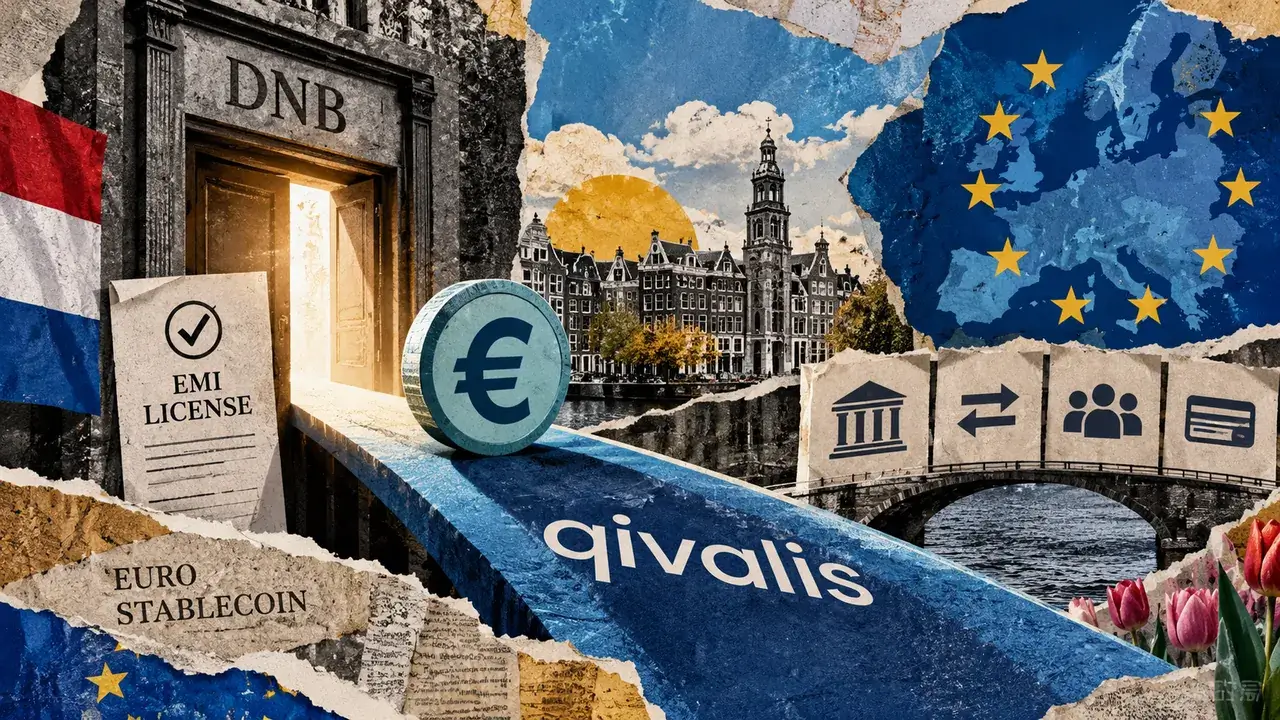
The involvement of numerous legacy financial institutions highlights a broader industry trend toward bank-backed digital assets. As commercial banks seek to remain competitive in an increasingly tokenized economy, initiatives like Qivalis offer a bridge between traditional fiat currency deposits and distributed ledger technology. By anchoring electronic money tokens directly within the regulatory perimeters of central bank oversight and institutional collaboration, these networks aim to mitigate the counterparty and liquidity risks that have historically surrounded privately issued stablecoins.
Regulatory Hurdles and the Path Under MiCA
Navigating the legal requirements established by the European Union requires strict adherence to precise regulatory procedures before any public offering or admission to trading can take place. Under Article 48 of the Markets in Crypto-Assets Regulation, an entity seeking to issue electronic money tokens must generally hold authorization either as a traditional credit institution or as an electronic money institution. Furthermore, the issuer is obligated to complete formal notification procedures and publish a comprehensive white paper before its digital assets can be legally marketed or offered to the public within the European single market, subject to specific narrow exemptions provided within the regulatory text.
Guidance issued by De Nederlandsche Bank regarding EMT issuance reinforces these statutory mandates, requiring prospective issuers to formally notify the regulator of their intention to bring a token to market while simultaneously submitting the corresponding white paper for review. Because Qivalis remains subject to these stringent compliance mandates, obtaining the Dutch EMI license represents a major foundational achievement rather than a final green light for immediate commercial operations. The license establishes the legal identity and institutional standing required to operate within the regulated financial space, but it must be complemented by the successful completion of the disclosure and notification stages.
The forthcoming white paper is expected to serve as a critical transparency tool for prospective holders and market participants alike. Under the regulatory framework, the document must provide detailed insights into the issuing institution, the structural characteristics of the token, the specific rights and obligations conferred upon token holders, the underlying technological architecture, and an exhaustive assessment of potential financial and operational risks. These disclosures are intended to ensure that market participants are fully informed about the nature of the asset before interacting with it through any of the consortium’s designated distribution partners.
Importantly, the process of white-crystal notification under the European regulatory regime is distinct from formal regulatory pre-approval. Under Article 51 of MiCA, competent national authorities are explicitly restricted from demanding prior authorization or approval of an EMT white paper before its publication. For Qivalis, the final steps toward making its euro-denominated tokens accessible through its partner network will rely on completing the required publication of this documentation and fulfilling all remaining statutory obligations, guiding the initiative closer to its anticipated operational debut in the European digital asset market.