IT management and remote monitoring software provider N-able has announced that it is taking swift precautionary measures following the public disclosure of a severe new set of vulnerabilities tracked under the names 4EverAble2Shell and Agent2Shell. The newly revealed security flaws impact N-central, a widely used enterprise management platform, prompting the company to restrict specific product features and integrations while emergency remediation efforts are underway.
In a security update published on Thursday, the company explained that these operational adjustments may temporarily affect certain system functionalities, but emphasized that adopting an aggressive defensive posture is a necessary step to protect managed service partners and their end customers. The proactive response comes on the heels of independent security research revealing that the vulnerabilities are not merely theoretical, but are already being actively weaponized by malicious actors in the wild to deploy unauthorized cryptocurrency miners across global networks.
The emerging threat landscape centers on a sophisticated exploit chain combining a critical component vulnerability with platform-specific weaknesses. Independent security researcher Sean Bales publicly disclosed the two new sets of flaws, 4EverAble2Shell and Agent2Shell, which successfully target recent iterations of N-central. Under specific conditions, these vulnerabilities grant remote attackers the ability to execute arbitrary code with root privileges and attain complete SYSTEM-level access to vulnerable Windows operating systems.

According to threat intelligence data and multiple cybersecurity firms tracking the campaign, 4EverAble2Shell has rapidly transitioned from preliminary reconnaissance to active exploitation. Threat actors have been observed chaining a critical Apache Axis vulnerability—tracked as CVE-2026-90436 and carrying a maximum CVSS severity score of 9.8—with a separate privilege escalation weakness residing natively within N-central. This potent combination allows unauthorized external parties to bypass authentication checks and execute operating-system commands directly on the underlying host.
Technical analysis provided by threat intelligence provider Previdian describes the mechanism behind the attack as an unauthenticated exploit chain leveraging unsafe class instantiation during SOAP fault processing within the bundled Apache Axis component. Specifically, a meticulously crafted request forces an attacker-selected Java library class to process malicious input, resulting in command execution under the privileges of the nable service account.
Further forensic investigations conducted by cybersecurity firm Huntback uncovered that threat operators are actively leveraging a specific Internet Protocol address, 157.20.241[.]16, to execute malicious shell scripts on compromised infrastructure. In documented attacks, servers have been targeted with automated routines designed to remount temporary directories with execution permissions, download a payload script designated as "jup.sh" from the attacker-controlled server, and relay diagnostic telemetry back to the malicious infrastructure.
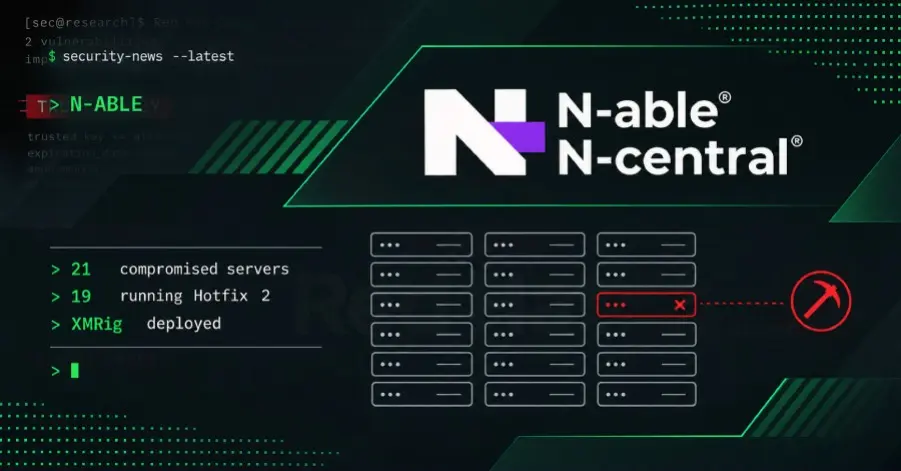
The primary payload identified by security researchers thus far is an XMRig Monero cryptocurrency miner. To avoid immediate detection by system administrators, the malicious mining software has been configured to intentionally utilize only half of the available CPU processing cores, allowing the unauthorized tasks to fly under the radar of standard performance monitoring tools. Telemetry gathered by Huntback indicates that the targeted N-central servers span a broad geographical footprint, with confirmed compromises identified across the United States, South Africa, Canada, the United Kingdom, Germany, France, and Sweden.

Security analysts have issued strong warnings regarding the deceptive security posture offered by partial patches. Huntback researchers noted that applying available hotfixes alone may not be sufficient to neutralize an established compromise, revealing that a significant portion of the victims identified in their telemetry analysis were already running Hotfix 2 at the time of the attack. Because the exploit sequence grants complete administrative root access to a platform designed to manage extensive customer endpoint architectures, security professionals advise treating any confirmed indicator of compromise as a total system takeover rather than a routine cleanup operation.
In response to the active threat campaign, N-able has deployed immediate configuration restrictions across hosted cloud environments while urging administrators of on-premises deployments to take urgent action. Hosted customers have been advised to adhere strictly to previous guidance regarding the upgrading of Agents and Probes to N-central version 2026.4 HF1 or higher. This specific software update introduces fundamental changes to the underlying communication protocol utilized between agents and probes, making the upgrade mandatory to ensure that all managed devices remain properly patched and capable of secure communication.
For organizations operating local, on-premises N-central environments, N-able is strongly advising administrators to upgrade all deployment components immediately and ensure that legacy API access is completely disabled if it was previously enabled for integration purposes. Company representatives reiterated that internal engineering and security teams are actively evaluating the disclosures, developing comprehensive remediation patches, and working diligently to safely restore any restricted product functionalities as soon as risk levels subside.