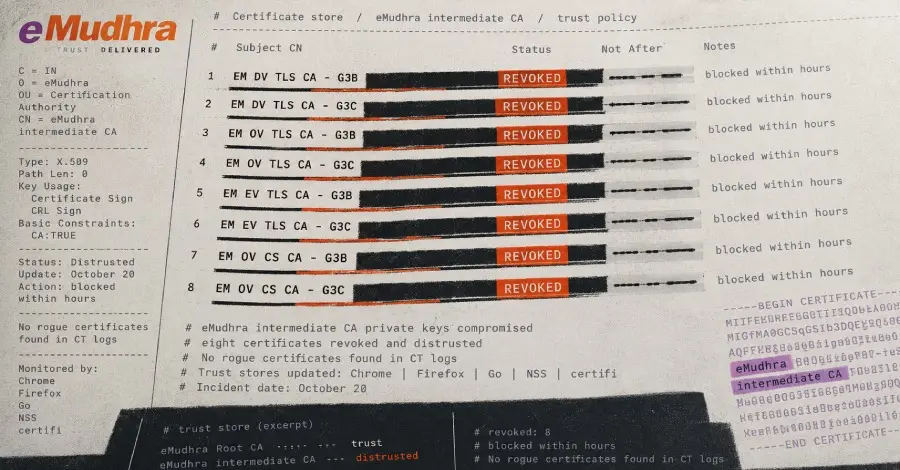
Major web browsers, software vendors, and cryptographic maintenance teams moved swiftly to protect global internet users after the private keys belonging to eight intermediate certificate authority (CA) certificates issued by eMudhra were severely compromised. The security breach, which was independently confirmed by Mozilla and Google’s Chrome Root Program, creates significant risks for web security because an intermediate CA holds the cryptographic capability to sign digital certificates for any website. Possession of these private keys means that unauthorized entities could potentially issue trusted TLS certificates capable of bypassing browser security warnings, raising the specter of sophisticated man-in-the-middle attacks and fraudulent website impersonation across the global digital ecosystem.
The alarming security failure came to light on the evening of October 17, when an independent security researcher reported the compromise directly to the root programs. Moving with exceptional speed to avert potential exploitation, both Google and Mozilla verified the findings and enacted emergency blocks against the eight affected certificates within a matter of hours. Subsequent investigations by the Chrome Root Program revealed that no TLS certificates chaining back to the six vulnerable intermediates used for websites had been logged to Certificate Transparency public logs prior to Chrome’s emergency block. This crucial safeguard ensured that the compromised intermediates could not have been trusted by default in Chrome or any other modern web browser that strictly enforces Certificate Transparency logging policies.
Despite the rapid containment efforts, critical questions remain unanswered regarding how the private keys managed to leave eMudhra’s secure infrastructure, exactly when the breach occurred, and whether any malicious actors aside from the reporting researcher currently possess copies of the keys. The compromised digital assets correspond precisely to a series of cryptographic hash values identified in an emergency security release issued by the Go programming language team. Go handled the remediation through its urgent security track, a rigorous protocol reserved exclusively for severe threats to ecosystem integrity or active in-class exploits.
What Was Compromised
The root of the incident traces back to eMudhra, a prominent Indian certificate authority that commercializes digital certificates under the emSign brand through a network of subsidiary companies operating in India, the United States, and the Netherlands. eMudhra maintains trusted root certificates embedded directly within the cryptographic root stores of major ecosystem vendors, including Mozilla, Google, and Apple. The eight compromised certificates include six TLS-focused intermediates and two code-signing intermediates. The six TLS certificates were originally issued by the emSign Root TLS CA – G3 and trace their cryptographic lineage back to the emSign ECC Root CA – G3, a primary root embedded in the Chrome and Apple trust stores, and previously in Mozilla’s store until the October 20 revocation.
Further complicating the cryptographic landscape, each of the eight compromised certificates also exists as a dual entity with an identical public key, cross-signed by Sectigo under its widely recognized AAA Certificate Services root. This interconnected trust hierarchy was mapped out in detail by Dennis Jackson, a cryptographic engineer at Mozilla, who published an exhaustive list of the affected certificates. Notably, Chrome’s engineering team did not need to explicitly block the two code-signing certificates within the browser environment. The browser’s TLS verifier is architecturally designed to reject certificate paths that attempt to build through an intermediate restricted strictly to code-signing operations, providing an inherent layer of defense against misuse in web contexts.
Who Is Protected, and How

The timeline of the remediation effort highlights a coordinated, multi-stakeholder response across the cybersecurity community. The Chrome Root Program received the initial researcher report at 18:05 UTC on October 17 and deployed an automated CRLSet update to block the six TLS intermediates globally by 19:45 UTC. Mozilla received the notification shortly after at 20:06 UTC, successfully pushing a OneCRL revocation block to standard Firefox installations by 22:59 UTC. Because both CRLSets and OneCRL operate as dynamic revocation lists that web browsers fetch automatically in the background, end-users did not need to perform manual browser updates or restart their applications to receive protection.
Chrome’s blocking mechanism was engineered to match the cryptographic public key rather than the specific certificate metadata. This design choice ensured that the block also neutralized the Sectigo cross-signed copies of the certificates. This approach mirrors the defensive tactic Chrome deployed earlier in the month to thwart rogue certificates targeting Google domains. The researcher who uncovered the flaw, credited by Mozilla simply as Wayne, authenticated the discovery by signing a specific message with each of the eight compromised private keys and transmitting them to the root programs. Jackson subsequently published these cryptographic signatures and affected certificate details on a dedicated verification portal.
In the wake of the disclosures, eMudhra officially revoked all eight compromised certificates. Apple moved to block them on October 19, Microsoft followed suit on October 20, and other global trust stores were formally notified on the same timeline. The presence of the Sectigo cross-signed copies did not expand the attack surface for Chrome or Firefox users, as both browsers had already ceased trusting Sectigo’s AAA Certificate Services root for web traffic in April 2025. Furthermore, Chrome’s core root store file completely omits the legacy root, while Apple’s root list for its latest operating system releases incorporates necessary updates.
Mozilla and Google have conducted extensive internal audits following the incident. Mozilla currently believes the compromise is isolated and does not affect other certificate authorities. Similarly, Chrome officials reported analyzing every other CA certificate residing within their trust store and uncovered no parallel instances of this specific failure mode.
The Broader Software Impact and Mitigation
While major web browsers benefit from automated revocation mechanisms, the broader software ecosystem faces a more complex mitigation challenge. Many third-party applications, programming language standard libraries, and client tools that validate TLS certificates—ranging from compiled Go binaries to software relying on Python’s certifi bundle—do not actively check real-time revocation data. Instead, these systems continue trusting a certificate chain blindly until their underlying source code, dependencies, or root trust bundles are explicitly updated.
Mozilla advised software operators managing independent trust stores that environments with reliable, enforced revocation checks may not require immediate action, provided clients strictly refuse connections when revocation servers are unreachable. However, where software cannot evaluate individual intermediate blocks, operators were strongly advised to consider removing absolute trust in the parent roots that originally signed the compromised intermediates.
Software maintainers across the technology sector raced to publish updates addressing the crisis. The Go team released versions 1.27.3 and 1.26.10, introducing a hardcoded security filter within the standard library that explicitly rejects any certificate chain incorporating one of the cryptographic keys tied to the incident. Because this mitigation is embedded directly into Go’s verifier for both native execution and platform system-verifier paths, developers must rebuild their applications with the updated Go toolchain to secure their software. Older, unsupported versions of Go receive no such patches.

Other key software ecosystems chose to prune vulnerable roots rather than filter individual keys. Python’s certifi bundle, the Rust webpki-roots package, and Homebrew’s ca-certificates formula all released updates dropping the emSign ECC Root CA – G3 from their trusted bundles. Homebrew went a step further by excluding Sectigo’s AAA Certificate Services root and the emSign Root TLS CA – G3 by public key. While these sweeping removals effectively neutralize the immediate threat, they also sever trust for any legitimate servers still utilizing valid certificates tied to those roots, potentially causing temporary availability disruptions for clients relying on those specific trust bundles until server operators transition to alternative certificate chains.
Firefox installations equipped with default settings received the necessary block lists automatically via Remote Settings, requiring manual updates only for enterprise environments where remote telemetry or network policies restrict dynamic updates. Other major environments, including Node.js and PHP’s Composer ecosystem, drafted pending pull requests and code modifications to block the vulnerable keys or remove the affected roots from their default bundles.
What Happens to eMudhra
The long-term operational future of eMudhra within the global trust ecosystem remains uncertain as root program operators weigh the severity of the security lapse. Mozilla formally removed the emSign ECC Root CA – G3 from its Network Security Services (NSS) cryptographic library, and Google indicated that Chrome will excise the same root in version 43 of its root store. Furthermore, the Chrome Root Program announced an active review of eMudhra’s remaining root, emSign Root CA – G1, citing the gravity of the private key compromise.
Questions surrounding the exact timeline and vector of the key exfiltration remain open. Mozilla confirmed it is actively collaborating with eMudhra, fellow root program administrators, and downstream trust stores to conduct a thorough root-cause analysis, promising further disclosures as investigations progress. As of October 20, eMudhra’s official trust-services repository contained no public notices addressing the incident.
Discussing the necessity of embedding cryptographic hashes directly into source code releases rather than relying solely on traditional revocation channels, Filippo Valsorda, who maintains the standard library cryptography packages for Go, emphasized the practical limitations of modern infrastructure. He noted that Linux root stores are often maintained too poorly for dynamic revocation mechanisms to reliably reach backend applications, making hardcoded binary filters the only viable protective measure for certain software environments under emergency conditions.