
A potential initial public offering (IPO) next year by cryptocurrency exchange Kraken could serve as a powerful catalyst for attracting fresh capital from traditional finance (TradFi) investors, even as the broader digital asset market navigates a complex period of volatility and shifting macroeconomic currents.
The prospect of Kraken entering public markets arrives during a turbulent phase for the world’s leading digital assets. Bitcoin recently achieved a monumental milestone, recording an all-time high price above $126,000 on Oct. 6. However, the premier cryptocurrency has struggled to fully recover from a severe $19 billion liquidation event that rippled across the industry just days after its historic peak. At the time of writing, Bitcoin was changing hands at $87,015 per coin, marking a 6% decline over a two-week period, according to data from CoinGecko.
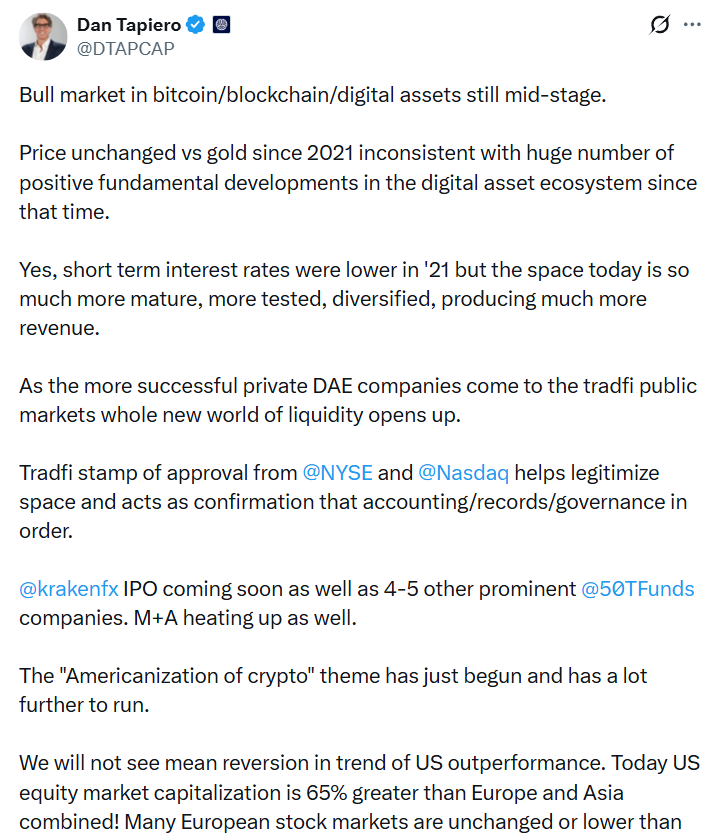
Despite the recent market correction and lingering aftershocks from the massive leverage flush, industry veterans remain optimistic about the broader market structure. Dan Tapiero, the founder and chief executive officer of 50T Funds, asserted that the overarching Bitcoin bull market is "still mid-stage." Tapiero emphasized that corporate milestones such as Kraken’s anticipated IPO, alongside an increasing wave of mergers and acquisitions (M&As) within the sector, could provide the essential market tailwinds required to bridge the gap between digital assets and institutional TradFi capital.

Kraken’s market positioning has strengthened significantly in recent months. The prominent cryptocurrency exchange successfully raised $800 million in a funding round that propelled its valuation to $20 billion, an achievement the company officially announced on Nov. 18. Building on this financial momentum, Kraken reportedly filed confidentially for a United States initial public offering earlier in November, setting the stage for what could be one of the most closely watched financial market debuts of the coming year.
Crypto industry watchers are divided over the bull cycle’s continuation in 2026
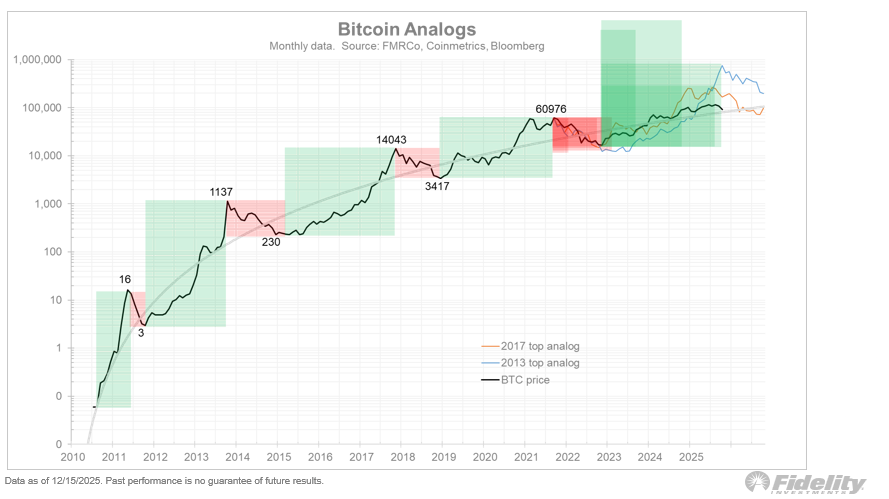
While executives like Tapiero view upcoming corporate milestones as signs of an expanding market cycle, not all analysts are convinced that the current bull run will maintain its upward trajectory through the coming years. Jurrien Timmer, Fidelity’s director of global macroeconomic research, has taken a more cautious stance, projecting a challenging year of downside for Bitcoin throughout 2026.
Tapiero’s bullish projections contrast sharply with the views shared by Timmer, who anticipates that a prolonged corrective phase could ultimately lead Bitcoin to a local bottom around $65,000.
"Bitcoin winters have lasted about a year, so my sense is that 2026 could be a ‘year off’ (or ‘off year’) for Bitcoin. Support is at $65-75k," Timmer wrote in a post on the social media platform X.
Market observers note that while Bitcoin’s historical four-year halving cycle has traditionally provided the initial rhythm for market behavior, modern price movements are increasingly dictated by more complex fundamental drivers. Jimmy Xue, co-founder and chief operating officer of Axis—an onchain quantitative yield platform managing $100 million in live capital—points to global liquidity trends and continued sovereign adoption as the new primary catalysts shaping the landscape.
"It’s not surprising to see institutional caution as we close out 2025," Xue told Cointelegraph, noting that Fidelity’s call for a potential pullback serves as a "valid reminder that volatility is still on the table."
At the same time, Xue cautioned against a purely pessimistic outlook, adding that "framing 2026 purely as a year of downside might be missing the forest for the trees."
If global liquidity conditions continue to loosen across major economies, Xue suggested that the predicted $75,000 support level might actually end up forming a higher low within the framework of a much longer, secular super-cycle. This perspective suggests that the traditional four-year cycle is actively evolving into a broader macroeconomic trend influenced heavily by global monetary policy.
In the near term, however, market positioning suggests lingering caution among sophisticated market participants. The industry’s most successful traders by historical returns—frequently tracked as "smart money" traders via blockchain intelligence platforms like Nansen—have increasingly been betting on short-term market declines. According to Nansen’s latest blockchain analytics, smart money addresses have maintained net short positions across the vast majority of top-tier cryptocurrencies, with notable exceptions found primarily in the Avalanche token and the memecoin launchpad Pump.fun’s native coin.
As the cryptocurrency industry looks toward the horizon of 2026, the intersection of institutional adoption, macroeconomic liquidity, and landmark corporate events like Kraken’s public offering will likely dictate whether the market enters a cooling period or continues its maturation into the broader global financial ecosystem.