
Blockchain analytics powerhouse Nansen is officially stepping beyond its traditional boundaries of data analysis, launching autonomous cryptocurrency trading tools that enable users to execute trades directly through artificial intelligence agents and natural language prompts. The newly introduced feature represents a significant shift for the platform, bridging the gap between deep onchain research and direct market action by allowing retail investors to interact with decentralized finance markets through conversational commands rather than traditional, complex trading interfaces.
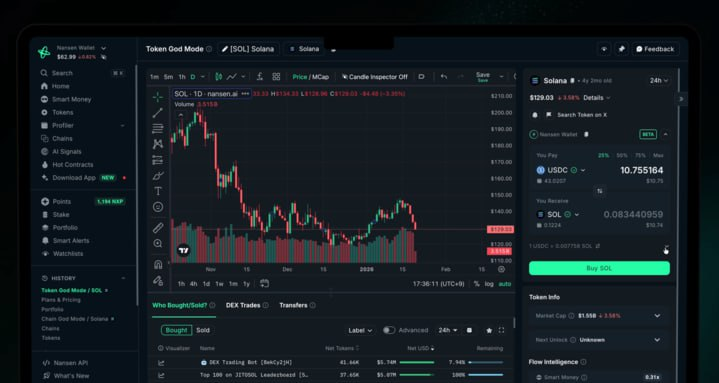
According to an announcement shared on Wednesday, the platform’s mobile application now features an AI-driven interface where users can place trades simply by typing or speaking natural language instructions. This capability is designed to streamline the trading process, particularly for retail market participants who may find conventional order books, candlestick charts, and multi-step decentralized exchange navigation overwhelming. By combining advanced onchain analytics with automated execution—an approach the company informally refers to as "vibe trading"—Nansen aims to provide a seamless user experience that keeps ultimate control firmly in the hands of the trader.
The initial rollout of the autonomous trading feature supports activity across the high-performance Base and Solana blockchain networks, with a clear roadmap to incorporate additional layer-1 and layer-2 networks in the near future. To facilitate smooth cross-chain trading execution across these supported ecosystems, Nansen has forged strategic partnerships with prominent crypto industry players. Decentralized exchange aggregator Jupiter, cryptocurrency exchange OKX, and cross-chain protocol LI.FI have all integrated to support the new product, laying the groundwork for broader network expansion as the tool matures.
Behind the scenes, the trading functionality is powered by the embedded Nansen Wallet, which utilizes Privy’s secure, self-custodied wallet experience. This ensures that while the user interface abstracts away the technical complexities of signing transactions and managing gas fees across different chains, the underlying security model remains non-custodial. Users maintain ownership of their private keys and assets while leveraging the AI agent to navigate the market on their behalf.

The autonomous trading tools became available to users starting Wednesday, though regulatory restrictions have forced Nansen to exclude residents of certain jurisdictions. Due to compliance requirements, the feature is unavailable in Singapore, Cuba, Iran, North Korea, Syria, Russia, and specific parts of Ukraine.
Nansen Adds AI-Driven Trade Execution
The core differentiator of Nansen’s new toolset, according to the company, is its reliance on proprietary onchain data rather than generalized training sets. While consumer-facing chatbots like OpenAI’s ChatGPT or Google’s Gemini rely on broad internet data, Nansen’s AI interface draws directly from its extensive proprietary onchain database. This database encompasses hundreds of millions of labeled blockchain addresses, allowing the AI to contextualize transactions, identify smart money movements, and evaluate wallet behaviors with a level of precision that general-purpose language models cannot match.
Nansen co-founder and CEO Alex Svanevik emphasized that the launch represents the culmination of years of foundational work in data intelligence. For a long time, the company’s primary mission was to surface high-quality onchain signals for investors, helping them make sense of a noisy and fragmented market. With the introduction of these new capabilities, the platform is effectively closing the loop by allowing users to act on those proprietary insights immediately within the same product environment, accessible via an AI-native conversational mobile user experience as well as a dedicated web-based trading terminal.
Svanevik made bold claims regarding the performance of Nansen’s proprietary models compared to major general-purpose AI systems. He asserted that Nansen AI agents consistently outperform leading market chatbots when tasked with onchain analysis specific to wallet identification, token discovery, deep due diligence, and comprehensive portfolio analysis. According to Svanevik, Nansen AI achieves quality scores exceeding 85% when operating in Expert Mode, whereas standard large language models struggle significantly with tasks requiring an understanding of wallet labeling or complex crypto trading patterns.
Despite these high performance metrics within specialized financial domains, Svanevik acknowledged that the underlying technology still requires careful calibration. While Nansen incorporates foundational AI models as core components of its platform, these systems must undergo rigorous fine-tuning and be equipped with specialized onchain capabilities to achieve the reliability necessary for handling financial assets safely and effectively.
Launch Highlights Rise of AI
Nansen’s strategic expansion into automated execution arrives amid a broader wave of industry-wide experimentation with artificial intelligence. Across the cryptocurrency sector, companies are increasingly deploying automated strategies and conversational interfaces in an effort to lower the barriers to entry for retail market participants and redefine how users interact with decentralized protocols.
This competitive landscape has sparked intense discussion regarding the capabilities and limitations of various AI models when applied to financial markets. Recent testing has revealed fascinating nuances in how different systems perform under real-world trading conditions. In some instances, lower-cost regional models have demonstrated an ability to outperform larger, more heavily resourced Western systems in specific crypto trading tasks. For example, an autonomous trading competition previously highlighted the competitive edge of models like QWEN3 MAX and DeepSeek over higher-profile chatbots, illustrating that specialized architecture and efficient processing can sometimes yield superior market outcomes.
At the same time, these benchmarks underscore the persistent challenges that even the most advanced general-purpose AI systems face when attempting real-time market execution. By anchoring its AI agents directly to a specialized, labeled onchain database rather than relying solely on general web knowledge, Nansen hopes to bypass the analytical pitfalls that have historically hampered conversational crypto bots. As the platform rolls out its automated trading suite to global retail users, the industry will be watching closely to see how effectively natural language prompts and autonomous agents can safely manage capital in the fast-moving decentralized finance arena.