
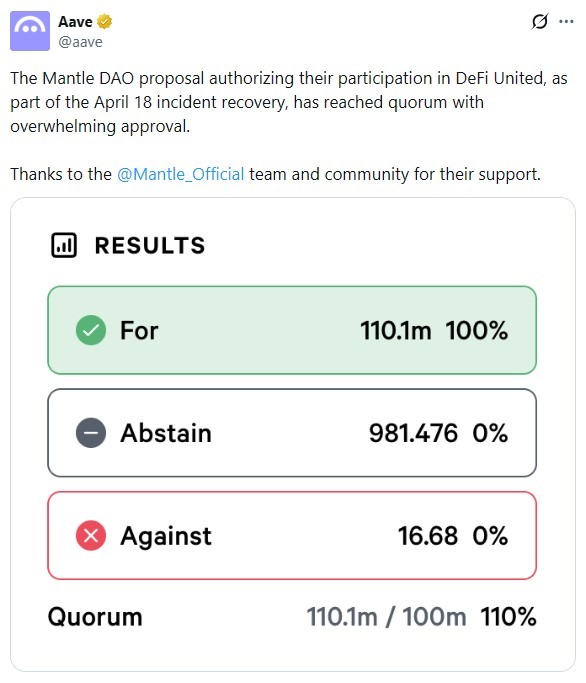
Mantle tokenholders have officially backed a pivotal governance proposal authorizing a credit facility of up to 30,000 Ether, valued at approximately $68 million, designated for Aave DAO. This decisive move marks a significant step forward in the ongoing remediation efforts tied to the substantial bad debt generated by the high-profile rsETH exploit that shook the decentralized finance ecosystem in April.
The proposal, formally designated as MIP-34, successfully passed following a rigorous seven-day Snapshot vote that officially concluded on Friday, according to data from the decentralized autonomous organization governance platform Snapshot. The newly passed measure authorizes the Mantle Foundation to actively negotiate and subsequently execute definitive agreements with Aave DAO concerning the provision of a loan originating directly from the Mantle Treasury. However, governance participants noted that the implementation of the credit facility still remains strictly subject to Aave successfully executing its planned recovery strategy, alongside both participating entities finalizing the specific legal and operational terms of the agreement.
The primary objective of this substantial credit facility is to help address the profound negative impact that the rsETH security incident inflicted on Aave V3 markets. According to details outlined within the governance proposal, the malicious actor responsible for the exploit managed to deposit 89,567 unbacked rsETH tokens onto the Aave lending protocol. Following this maneuver, the attacker borrowed approximately $190 million worth of Wrapped Ether, wrapped staked Ether, and various stablecoins. This unauthorized borrowing activity created massive potential bad debt across the protocol, with current industry estimates placing the shortfall anywhere between $123.7 million and $230.1 million.

This major governance vote arrives at a critical juncture as the broader fallout from the rsETH exploit transitions away from the initial immediate liquidity shock and into a much more complex, multi-layered remediation phase. By stepping in with this financial backstop, Mantle is positioning its treasury as a strategic pillar of support for the wider decentralized finance community, while Aave concurrently works through its operational channels to systematically address the outstanding bad debt and restore long-term user confidence in its foundational lending markets.
Aave WETH Market Cools After Post-Exploit Squeeze
The creation of the Mantle credit facility is designed to directly target and alleviate the severe shortfall that also triggered profound liquidity stress across a multitude of Aave’s core lending markets. The cascading effects of the exploit extended far beyond simple token devaluation, profoundly disrupting the normal supply and demand dynamics of the protocol’s most heavily utilized assets.
A comprehensive analysis published on Thursday by Galaxy Research shed light on the mechanical strain placed on the protocol, noting that the rsETH exploit effectively pushed Aave’s Wrapped Ether market into a prolonged and punishing liquidity squeeze. According to the research findings, WETH utilization rates on the platform remained stubbornly and dangerously high, staying above the 99% threshold for an astonishing 12.7 consecutive days immediately following the security incident.
Across the full analysis horizon examined by the researchers, WETH utilization remained structurally elevated and hovered dangerously close to the absolute 100% operational ceiling. The market recorded an average utilization rate of approximately 99.6% during this critical window, only beginning to ease downward to about 98.47% by the very end of the designated snapshot period.
In the complex mechanics of decentralized lending protocols, exceptionally high utilization means that the vast majority of any supplied asset has already been borrowed out by active market participants. This leaves very little idle liquidity available in the reserves for everyday users seeking to make immediate withdrawals. In the specific case of Aave, Galaxy Research explained that the WETH market remained exceptionally strained because the overall supply of the asset contracted at a much faster pace than active borrows could be paid down or liquidated, thereby keeping utilization locked near full capacity even long after the initial security shock had passed.
Fortunately, the market conditions surrounding the protocol have steadily cooled down from the near-100% saturation levels thoroughly documented in Galaxy’s post-mortem analysis. Recent operational data retrieved from Aavescan on Friday indicated that Aave’s Ethereum V3 WETH market had experienced a notable recovery in available liquidity, with utilization settling down to approximately 91.6%. At the time of the data retrieval, the protocol registered roughly 2.02 million WETH supplied to the pools, paired against approximately 1.85 million WETH actively borrowed by market participants, signaling a gradual return to more sustainable operational health as ongoing remediation measures take effect across the ecosystem.